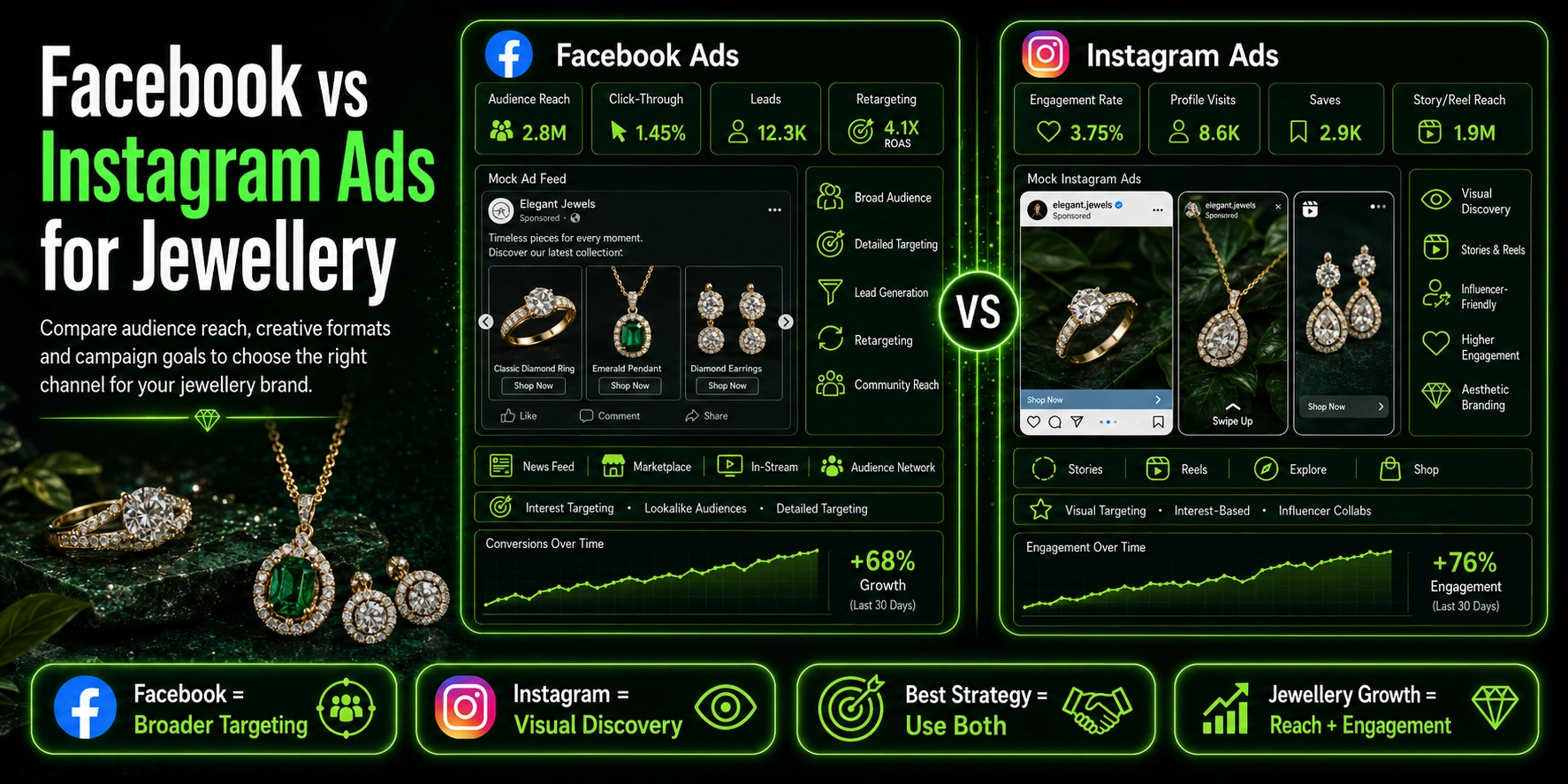
Every jewellery founder running Meta ads eventually opens Ads Manager, looks at the platform breakdown, and asks the same question: should we just move everything to Instagram? The ads look better there. The audience feels younger. The engagement is louder. Facebook, meanwhile, feels like the platform your uncle uses to forward good morning messages.
Here is the short answer before we go deep. For jewellery brands, Instagram wins discovery and everyday jewellery sales among urban buyers under 35, while Facebook wins reach, bridal and gifting enquiries, and Tier 2 and Tier 3 conversions among 30-plus family decision makers. Most brands get their best blended results running both inside one Meta campaign with Advantage+ placements, then steering outcomes through creative, audiences, and destinations rather than platform toggles.
If that answer feels less dramatic than “Instagram killed Facebook,” good. The dramatic version is what most articles on this topic sell, and it quietly costs Indian jewellery brands real money. This post explains what actually happens inside the Meta auction, who is really on each platform in India in 2026, and how to decide your split based on what you sell, whom you sell it to, and at what price point.
We have already covered how Meta compares with Google in Google Shopping vs Meta Ads for jewellery brands. This post goes one level deeper, inside Meta itself.
One Account, One Auction: Why This is Not the Platform War You Think
The first thing to understand is structural. You do not buy Facebook ads and Instagram ads as two separate products. You buy impressions from a single Meta auction that spans Facebook, Instagram, Messenger, and the Audience Network, all through one Ads Manager, one pixel, one Conversions API, and one budget.
Since Advantage+ placements became the default, Meta’s delivery system decides on a per-impression basis whether your next rupee is better spent showing a Reel to a 27-year-old in Bengaluru or a feed carousel to a 42-year-old in Rajkot. Meta’s own guidance and independent tests consistently show automated placements delivering roughly 10 to 30 percent better cost per result than manual platform selection, because the algorithm fills gaps that a human turning placements on and off cannot see. Advantage+ Shopping campaigns now carry the majority of ecommerce conversion spend on Meta globally, and the direction of travel is more automation, not less.
So the practical question is not “Facebook or Instagram?” It is: which levers do I still control, and how do I pull them for jewellery? You control four things. The audience signals that you feed the system. The creative formats you supply, which determine where your ads are even eligible to show. The objective and destination, whether that is a product page, a WhatsApp chat, a lead form, or a store visit. And the campaign structure that decides how the budget flows between prospecting and remarketing.
The platform split is an output of those four decisions. Brands that obsess over the platform toggle usually neglect the four levers that decide the toggle’s result. One more thing before the audience data: turning off the “expensive” platform because its standalone cost per result looks worse is a documented mistake. Meta’s delivery logic optimises the blend, and removing a placement removes conversions that the cheaper placement cannot reach. Judge the blended cost per acquisition, not the platform-level line items.
Who is Actually on Facebook in India in 2026
Facebook in India is bigger than most jewellery founders assume, and older than their creative assumes. Tracking data from NapoleonCat for mid-2026 counts roughly 707 million Facebook users in India, close to 48 percent of the population, with the 25 to 34 bracket as the single largest cohort and a strong male skew of around 70 percent among registered profiles. Analysis of India’s social landscape published in 2026 also notes that Facebook still commands around 64 percent of social platform web traffic in India, far ahead of Instagram’s roughly 26 percent, even though Instagram is the “favourite” app of younger users.
Three Facebook realities matter specifically for jewellery.
Facebook is the default social layer of Tier 2 and Tier 3 India: For a large share of first-time internet users, Facebook was the entry point, and it remains where community groups, local buy-and-sell activity, and family networks live. If your growth plan includes Surat, Rajkot, Indore, Coimbatore, Lucknow, or the hundreds of cities where organised jewellery retail is expanding fastest, Facebook inventory is where a big slice of those impressions physically exists.
Facebook holds the family decision makers: Bridal jewellery in India is rarely a solo purchase. Mothers, fathers, aunts, and the couple all weigh in, and gold purchases above a few lakh rupees are effectively household financial decisions. The 35 to 55 audience that anchors those decisions spends significant daily time on Facebook, and industry tracking in 2026 shows users 65-plus are now the group most loyal to Facebook relative to their overall internet use. Your bridal campaign that runs only on Instagram is talking to the bride and ignoring the people co-signing the budget.
Facebook’s formats favour explanation: Longer captions, link posts, and lead forms suit messages that need words: exchange policies, gold rate protection schemes, EMI options, making charge offers, hallmarking explainers. Jewellery objections are wordy objections, and Facebook gives them room.
The weakness is equally real. Facebook’s under-30 urban attention has migrated, and purely aesthetic, trend-led content performs worse there. If you sell minimalist silver stackables to 24-year-olds in Mumbai, Facebook is your secondary market, not your primary one.
Who is Actually on Instagram in India in 2026
India is Instagram’s largest market on the planet. Depending on the tracker, India has between roughly 473 million and 553 million Instagram users in 2026, comfortably ahead of the United States. The 18 to 34 band dominates, urban density is high, and one nuance surprises almost every founder: Instagram India skews around 65 to 70 percent male by registered profiles, a sharp contrast with Western markets where it leans female. We will come back to why that matters more than it seems.
For jewellery, Instagram’s power sits in three places.
Instagram is where jewellery desire is manufactured: Try-on Reels, stacking tutorials, unboxings, craftsmanship close-ups, and creator content are native behaviours, not interruptions. This is the engine that built India’s new-generation jewellery brands. GIVA grew from roughly 600 thousand to 1 million Instagram followers in the twelve months to March 2025, one of the fastest climbs by any Indian jewellery brand, and used that community as the top of a funnel that now feeds 240-plus stores. CaratLane, Mia, BlueStone, Palmonas, and Salty all run Instagram-first creative engines for the same reason: the everyday and demi-fine jewellery buyer discovers them there.
Instagram compresses the impulse window: A ₹2,500 silver pendant or a ₹15,000 lightweight gold chain can go from first view to checkout inside a week. Saves, shares, and DMs behave like soft purchase intent, and Meta’s delivery system reads those signals. For low and mid AOV jewellery, Instagram is not just awareness; it is a direct response channel.
Reels remain the cheapest quality attention in India: Reels CPMs typically run 25 to 40 percent below feed CPMs, and in India that often means ₹20 to ₹60 per thousand impressions for well-targeted jewellery creative, against ₹30 to ₹100 on Facebook feed. Multiple 2026 media analyses still describe Reels as underpriced relative to the attention they capture in India, because advertiser competition has not caught up with user time spent. For a visual category, that is an arbitrage worth taking while it lasts.
Instagram’s weakness is the mirror of Facebook’s strength. It thins out above age 40 and outside metros and large Tier 2 cities, exactly where a large share of India’s high-value gold purchasing sits. And its scroll speed punishes wordy messages, which is a problem when your product needs a hallmark conversation before anyone pays ₹80,000.
Facebook vs Instagram Ads: The Numbers That Matter for Jewellery
Benchmarks vary by account, creative quality, and season, so treat these as directional planning ranges compiled from 2026 India benchmark reports and our own jewellery account data, not guarantees.
| Factor | Facebook ads (India) | Instagram ads (India) |
|---|---|---|
| Users in India, 2026 | Roughly 707 million | Roughly 473 to 553 million |
| Core strength by age | Strongest 30 to 55-plus | Strongest 18 to 34 |
| Geographic depth | Deep Tier 2 and Tier 3 penetration | Metro and large Tier 2 led |
| Typical CPM | ₹30 to ₹100 feed; wider ₹50 to ₹400 range in competitive windows | ₹45 to ₹350 feed and Stories; Reels often ₹20 to ₹60 |
| Typical CPC | ₹2 to ₹25 | ₹6 to ₹55 |
| Click behaviour | Higher CTR on link-out and lead formats | Higher engagement, more saves and DMs, fewer link clicks |
| Best jewellery use | Bridal and gifting reach, lead forms, store visits, and remarketing with detail | Discovery, everyday and demi-fine sales, creator amplification, Reels prospecting |
| Funnel character | Explains and converts considered purchases | Creates desire and converts impulse to mid-ticket |
Two honest caveats. First, Meta costs are rising everywhere: global benchmark data show Meta CPMs up roughly 20 percent year over year into 2026, so whatever you pay today is the cheapest you will pay. Second, India remains one of the lowest-cost Meta markets in the world, with ecommerce CPMs a fraction of US rates. Cheap impressions are not the constraint for Indian jewellery brands. Converting them profitably is, which is why the rest of this post matters more than the table.
Match the Platform to the Purchase, Not the Platform to the Hype
Here is the reframe that generic comparison articles miss. “Jewellery” is not one purchase. It is at least four different purchases with different buyers, price points, and decision cycles, and each maps differently onto Facebook and Instagram behaviour.
| Purchase type | Typical AOV | Who decides | Decision cycle | Platform lean |
|---|---|---|---|---|
| Bridal and wedding sets | ₹1,00,000 plus | Family committee, 30 to 55 heavy | 3 to 12 months | Facebook-led reach, Instagram for inspiration |
| Festive and occasion gifting | ₹10,000 to ₹75,000 | Spouses, parents, and often male buyers | 2 to 6 weeks, calendar-driven | Balanced, Facebook is stronger in Tier 2 and 3 |
| Everyday and demi-fine | ₹1,500 to ₹25,000 | Self-purchase, 20 to 35 | Days to 2 weeks | Instagram-led, Reels-heavy |
| Investment-adjacent gold | ₹50,000 plus | Household financial decision | Rate-sensitive, event-driven | Facebook-led, detail formats |
Read your own catalogue against this table, and your split starts writing itself. A lab-grown diamond and silver brand doing ₹4,000 average orders should expect 65 to 80 percent of efficient delivery on Instagram, and forcing Facebook spend will mostly buy cheap, low-intent clicks. A bridal-led retailer in Gujarat with ₹2 lakh average tickets should expect Facebook to carry reach and lead generation while Instagram carries lookbook inspiration for the bride herself, and judging that account on Instagram-style engagement metrics would be a category error.
The India-specific male skew deserves a paragraph because most founders instinctively target women only. Around two-thirds of profiles on both platforms in India are male. Men are the buyers in a huge share of gifting and festive transactions; they heavily influence bridal budgets, and shared-device browsing in smaller cities blurs profile demographics further. Blanket-excluding men from jewellery campaigns, especially gifting campaigns in the run-up to Karva Chauth, anniversaries, and Valentine’s Day, deletes reachable revenue on both platforms. Run gifting creative for male audiences with messaging built around the recipient, and let the results argue with your assumptions.
For a wider view of how paid social sits inside the full growth stack, see our guide on how to market a jewellery brand in India.
Placements Beat Platforms: Where Jewellery Money Actually Works
Once you accept the one-auction reality, the sharper question becomes which placements deserve your best creative. Five matter most for jewellery in India.
Reels, on both apps: The prospecting engine. The best jewellery Reels do not look like ads: a 15-second try-on with real Indian skin tones, a karigar setting a stone, a founder explaining why 92.5 silver tarnishes and what you do about it. Benchmark analyses in 2026 consistently show Reels delivering the lowest CPMs in the Meta ecosystem with strong prospecting efficiency, and Indian festive-season trackers report short video commanding a premium in creator fees precisely because it converts attention. Feed the Reels engine 8 to 12 fresh creatives a month or watch it stall.
Facebook and Instagram feed: The conversion workhorse. Across most accounts, feed placements still carry the largest share of actual purchases, commonly 60 to 70 percent of efficient conversion spend in benchmark studies, because feed is where carousels, catalogue ads, and detailed captions live. Dynamic Product Ads showing the exact ring she viewed, now with a review and a delivery promise, remain the highest-ROI remarketing format in jewellery.
Stories: The urgency layer. Full-screen, tappable, and cheap for retargeting. Countdown stickers for festive offers, back-in-stock alerts, and last-day gold rate protection messages belong here, aimed at warm audiences rather than cold ones.
Click-to-WhatsApp ads, on both apps: India’s trust bridge. With over 500 million WhatsApp users in the country, the natural next step after seeing a ₹40,000 piece is not checkout; it is a conversation about hallmarking, customisation, and delivery. As we said in the Google Shopping comparison, for AOVs above ₹15,000, CTWA is not optional. It routes Facebook’s older, high-trust-need audience and Instagram’s DM-native audience into the same closing room, and the 72-hour messaging window after each conversation is effectively free nurture. Pair it with a trained responder or the leads rot in the inbox.
Lead forms and Marketplace-adjacent inventory on Facebook: For bridal appointment booking, store visit campaigns, and exchange-scheme enquiries, Facebook’s native lead forms with pre-filled details routinely beat website forms on completion rate in India, because they remove load time and trust friction in one tap. If you run showrooms, this is Facebook doing something Instagram structurally cannot match.
Whatever the placement, the click lands somewhere, and jewellery pages leak trust faster than any other category. Shopify forum threads from jewellery sellers are full of the same autopsy: healthy CTRs, zero sales, and a product page missing hallmarking proof, real photography, policies, and reviews. Before scaling either platform, read our guide on how to increase jewellery website conversion rate, because the auction cannot fix a page that does not answer objections.
How to Split Your Budget: Three Realistic Scenarios
Assume the working minimum we recommend across posts is ₹1.5 to ₹3 lakh per month on paid, scaling with proof. Within the Meta share, structure beats toggling. Run Advantage+ placements as the default, then shape delivery with creative supply and separate campaigns by objective, not by platform.
Scenario one: new D2C brand, everyday silver or demi-fine, AOV under ₹10,000. Expect and welcome an Instagram-heavy outcome, typically 70 to 80 percent of delivery. Structure: one Advantage+ Shopping campaign for purchases, one Reels-led prospecting campaign feeding it, one small remarketing layer. Supply mostly 9:16 video. Do not force Facebook budget; let the small Facebook share it earns handle 30-plus gifting buyers who find you anyway.
Scenario two: growing omnichannel brand, mixed catalogue, AOV ₹15,000 to ₹60,000, a few stores. Aim for a genuine blend, roughly 55 to 65 percent Instagram-delivered, 35 to 45 percent Facebook-delivered, arrived at by running purchase campaigns alongside CTWA campaigns and a Facebook-led store visits or lead form campaign for locations. This is where the two platforms stop competing and start specialising: Instagram manufactures the desire, Facebook and WhatsApp close the considered ticket.
Scenario three: bridal and high-value retailer, AOV ₹1 lakh plus, offline-led. Invert the influencer’s advice. Facebook-led lead generation and reach among 30 to 55 family audiences in your catchment districts, CTWA as the primary destination, Instagram running lookbook and craftsmanship content targeted at brides for influence rather than last-click sales. Measure appointments, qualified WhatsApp conversations, and walk-ins, not website ROAS, or the account will look like it is failing while the showroom fills up.
If the operational lift of running this properly is the bottleneck, our comparison of in-house digital marketing vs agency for jewellery brands lays out the real costs of each route.
The Festive Auction: What Changes From August to December
Indian jewellery demand is violently seasonal, and the Meta auction reprices around it. Founders interviewed across the 2025 festive season reported the festive and wedding quarter contributing 40 to 45 percent of annual jewellery sales, with brands like Palmonas and Jewelbox raising ad spends 30 to 40 percent for the window. TAM data showed jewellery ad volumes in August and September 2025 up 130 percent over 2023 levels. And the wedding window itself has grown into what media buyers now call a second festive season, backed by roughly 4.6 million weddings and a wedding economy estimated at around ₹6.5 lakh crore in the November to mid-December stretch.
All of that competition lands on the same auction you bid in. Indian benchmark trackers warn that CPMs can double or more around Diwali in jewellery, apparel, and gifts, and 2026 planning guides note costs tripling in peak sale windows. The platform-level effect is asymmetric: Instagram’s premium urban inventory inflates hardest because every D2C brand in the country is fighting for the same Reels attention, while Facebook’s Tier 2 and Tier 3 inventory inflates less, temporarily improving Facebook’s relative value exactly when gifting buyers are most active there.
The playbook follows from the maths. Build cheap in August and September: run Reels-heavy prospecting on Instagram while CPMs are low, grow retargeting pools, engagement audiences, and WhatsApp lists. Harvest in October to December: shift weight toward remarketing, CTWA, catalogue ads, and Facebook lead and store formats, and let festive creative do emotional work rather than discount work. One structural tailwind worth knowing: Meta and YouGov research on Indian festive shoppers found 66 percent saying creator content influences their Diwali purchases and 69 percent saying personalised suggestions on Facebook and Instagram made festive shopping easier. The intent is on both platforms. The question is whether you pre-built the audiences to buy it cheaply.
Gold prices add a 2026-specific wrinkle. With rates crossing ₹1.39 lakh per 10 grams early this year and quarterly gold jewellery volumes dipping as buyers shifted to lightweight pieces, the winning festive messages are lightweight collections, lab-grown alternatives, rate protection, and exchange schemes. Those are explanation-heavy messages, and explanation-heavy messages disproportionately reward Facebook formats and WhatsApp conversations.
Creative Rules: One Idea, Two Languages
The same campaign should speak two dialects. On Instagram, the ad must not feel like an ad: vertical video, movement in the first second, real skin, real light, creator-style voiceovers, text kept minimal, and the product worn rather than displayed. On Facebook, the ad is allowed to inform: carousels that walk through a collection, captions that state the making charge offer and the BIS hallmark plainly, testimonial formats featuring 35-plus faces, and thumbnails that read clearly on the slower feed scroll.
Two production notes from jewellery accounts specifically. First, creative fatigue hits jewellery brutally fast; refresh every one to two weeks, because the algorithm now taxes stale creative with rising CPMs. Second, the biggest unlock for small catalogues is rendering. High-quality 3D renders and animations generate endless angle, metal, and stone variations without reshoots, which is exactly the creative volume Advantage+ systems reward. We compared the economics of 3D jewellery renders vs photography, and for most D2C brands, the answer is both, with renders carrying ad-volume duty.
Measurement: The Last-Click Trap That Makes Facebook Look Worse Than It Is
Judge both platforms on last-click website ROAS, and you will systematically defund the wrong things. Three distortions matter.
RedSeer research cited across the 2025 festive coverage estimates that 50 to 60 percent of Indian jewellery purchases are online-influenced, while roughly 90 percent of jewellery revenue still closes offline. Facebook’s older, Tier 2 and 3 audience is disproportionately the walk-in audience, so its influence shows up in footfall and phone calls that a pixel never sees. Meanwhile, iOS signal loss still causes Meta to under-report conversions by 30 to 60 percent without the Conversions API properly installed, and CTWA revenue lives in WhatsApp threads unless you wire conversation events back into Meta.
The fix is unglamorous but decisive: CAPI on day one, CTWA conversation and qualified-lead events fed back to the algorithm, store visit and call tracking for showroom brands, and a blended marketing efficiency ratio as the north-star metric instead of platform-level ROAS. Once measurement is honest, most brands discover the Facebook line they were about to cut was feeding the Instagram and Google conversions they were celebrating. That interplay across channels, and when to lean on paid versus organic at all, is exactly what we unpack in performance marketing vs digital marketing for jewellery brands and SEO/GEO vs Google Ads for jewellery businesses.
How Kyros Solution Runs Facebook and Instagram Ads for Jewellery Brands
Everything above is the thinking. Execution is where accounts are won, and it is the part most jewellery brands cannot staff internally: daily auction management, weekly creative production, festive calendar planning, WhatsApp funnel operations, and measurement engineering, all at once.
Kyros Solution is a digital growth agency built exclusively for jewellery and lifestyle brands, working from Surat, the city where much of India’s jewellery is actually made. Our performance marketing service runs the full Meta system described in this post: Advantage+ account architecture, Reels-led prospecting, Dynamic Product Ads, Click-to-WhatsApp funnels with response playbooks, Facebook lead and store visit campaigns for showroom brands, and CAPI-first measurement so decisions run on real numbers.
What makes the jewellery focus practical rather than a positioning line is the surrounding stack. Our in-house 3D render and animation team produces the creative volume Meta’s algorithm rewards without monthly photoshoot costs. Our web development and CRO work fixes the trust leaks that waste ad spend before it converts. And our social media management team keeps the organic Instagram presence that makes paid ads land on a warm brand rather than a cold one.
If you are currently guessing at your Facebook and Instagram split, the fastest way to stop guessing is with a complimentary audit. We review your account structure, placement delivery, creative fatigue, measurement setup, and festive readiness, and give you a written plan, whether or not you work with us. Book your free audit here.
The Verdict
Facebook vs Instagram is a false rivalry sitting on top of a real strategy question. The two apps are one auction with two audiences: Instagram holds India’s young, urban, discovery-driven jewellery buyer, and Facebook holds the older, wider, family-anchored buyer who signs off on the big tickets. Everyday and demi-fine brands should expect Instagram to lead. Bridal, gifting, and Tier 2 and 3 focused brands should respect how much Facebook still carries. Almost everyone should let Advantage+ decide the split impression by impression while they concentrate on the four levers that actually move results: audiences, creative, destinations, and structure.
The brands winning on Meta in India right now are not the ones that picked the right platform. They are the ones who stopped treating it as a pick at all.
FAQs
Which is better for jewellery ads, Facebook or Instagram?
Neither is better universally. Instagram performs best for everyday, silver, demi-fine, and lab-grown jewellery aimed at urban buyers under 35, while Facebook performs best for bridal, gifting, and high-value campaigns aimed at 30-plus and Tier 2 and Tier 3 audiences. Most Indian jewellery brands get their strongest blended cost per acquisition running both through Advantage+ placements in a single Meta campaign.
Are Instagram ads more expensive than Facebook ads in India?
Per click, usually yes: typical India CPCs run around ₹2 to ₹25 on Facebook against ₹6 to ₹55 on Instagram, and Instagram feed CPMs trend higher. But Instagram Reels are often the cheapest impressions in the entire Meta ecosystem, frequently ₹20 to ₹60 CPM for jewellery creative, so the cost answer depends on placement more than platform.
What budget do you need to run Meta ads for a jewellery brand?
Plan for ₹1.5 to ₹3 lakh per month minimum across paid channels for meaningful learning, consistent with what we recommend across our guides. Within Meta, protect roughly 60 to 70 percent for prospecting and 30 to 40 percent for remarketing and CTWA, and expect festive-window costs to rise sharply, so budgets should flex up from September through December.
Should jewellery brands target men on Facebook and Instagram?
Yes, selectively. Around two-thirds of Indian profiles on both platforms are male, and men drive a large share of gifting and festive jewellery purchases while influencing bridal budgets. Run dedicated gifting campaigns for male audiences around Karva Chauth, anniversaries, Valentine’s Day, and Diwali instead of excluding them by default.
Do Click-to-WhatsApp ads work for jewellery?
For pieces above roughly ₹15,000, they are often the highest-converting format on either platform, because Indian buyers want hallmarking, customisation, and delivery conversation before paying high-ticket amounts online. They only work with fast, trained responses and conversation events wired back into Meta so the algorithm can optimise for qualified chats.
Can you run Instagram ads without a Facebook page?
No. Meta requires a Facebook business page to anchor the ad account, billing, and pixel, even if every impression delivers on Instagram, which is one more sign that these are two surfaces of one system rather than two platforms.
How do you know if your current Facebook vs Instagram split is right?
Check three things: whether blended CPA is stable or improving as spend scales, whether each platform’s share roughly matches where your buyer demographic actually spends time, and whether measurement includes CAPI, WhatsApp, and offline signals. If any of the three is missing, the split you see in Ads Manager is not telling you the truth, and an independent audit will usually find the gap within a week.