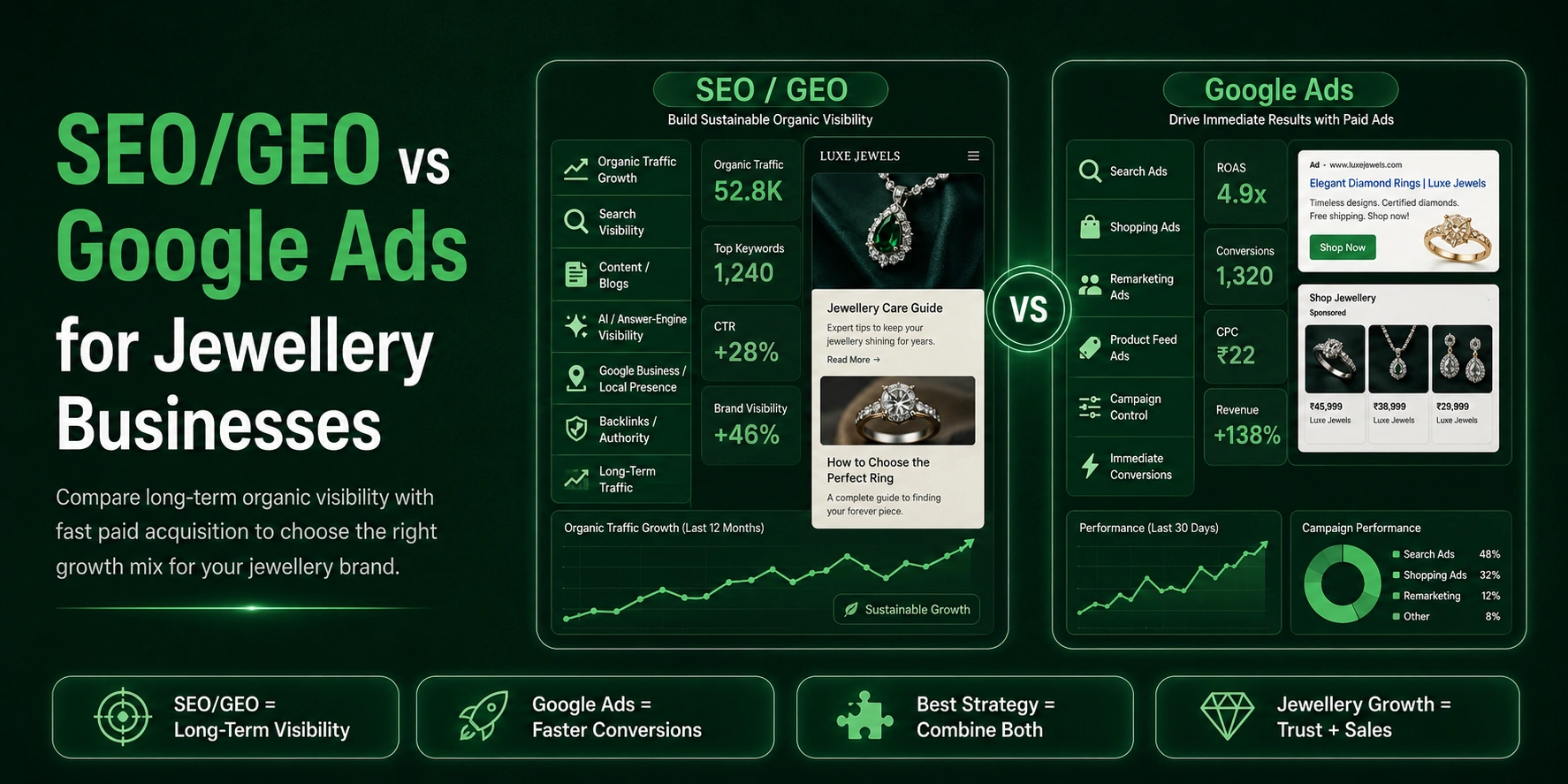
Most jewellery founders ask this question, hoping for a clean answer: pick one, save the budget, move on. The honest answer is that for a jewellery brand, SEO and Google Ads are not really rivals. Two tools capture the same kind of customer at very different speeds, costs, and levels of permanence. The brands that grow steadily are not the ones that “chose” correctly. They are the ones who understood what each channel actually does for a high-value, trust-heavy, seasonal product, and turned them on in the right order.
This guide is written for that decision. It uses real numbers, the buying behaviour specific to gold and diamond purchases here, and the festival and wedding rhythm that quietly controls jewellery demand. By the end, you will know which channel to lead with, when, and why.
The short answer
For a jewellery brand in India, Google Ads is the faster channel, and SEO is the cheaper, over time channel. Google Ads buys you visibility and sales from day one, but stops the moment you stop paying. SEO earns you visibility that compounds over the years. Still, it usually takes 6 to 12 months to generate meaningful revenue, and longer in competitive categories where Tanishq, CaratLane, and BlueStone already dominate. If you need sales this quarter, start with Google Ads. If you want to lower your cost of acquisition over the next two years, start building SEO in parallel from day one. Most serious jewellery brands run both, because each one makes the other cheaper and more effective.
That is the summary. The rest of this article explains how to apply it to your specific situation, because a new lightweight jewellery label and an established bridal house should not run the same playbook.
Why is this question different for a jewellery brand
Generic “SEO vs Google Ads” advice fails jewellery for one reason: it assumes a quick, low-trust, online purchase. Jewellery is the opposite. The buyer is comparing far more than a design. She is weighing certification, purity, price transparency, exchange policy, occasion relevance, and brand credibility before she spends a single rupee. The higher the price, the more of these signals she needs before she trusts you.
This trust gate changes everything about how SEO and Google Ads perform.
The buying journey rarely ends at the “Buy Now” button
The dominant pattern in jewellery is research online, purchase offline, often shortened to ROPO. Buyers discover and shortlist designs on Instagram, YouTube, and Google, then finish the purchase in a store, on a video consultation, or over WhatsApp. For high-value gold and diamond pieces, the online journey is about building enough confidence to walk in or to message, not always to check out on the spot. Omnichannel brands that connect these touchpoints tend to capture a noticeably larger share of customer spending than brands that treat online and offline as separate worlds.
Why this matters for your channel decision: a Google Ads click that ends in a WhatsApp enquiry or a store visit looks like a wasted click in the ad dashboard, but it can be a real sale. An SEO article that ranks for “BIS hallmark meaning” or “is a lab-grown diamond real” produces no immediate sale at all, yet it builds the trust that closes a purchase weeks later through a completely different channel. If you measure either channel only by last-click online checkouts, you will systematically undervalue both. We come back to fixing this later.
Two kinds of demand your buyer moves between
There are two types of demand in jewellery, and this is the single most useful distinction for spending your money well.
Existing demand is someone already searching: “gold mangalsutra design,” “lab grown diamond ring price,” “antique temple jewellery online.” They know what they want. Both SEO and Google Ads fish in this pond. Google Ads pays to appear at the top today. SEO earns a spot organically over months.
Latent demand is someone who will want jewellery soon but is not searching yet. She is scrolling Reels, planning a wedding, and saving outfit inspiration. You cannot catch her with a search at all. You reach her with discovery channels: Instagram, Pinterest, YouTube, and creator collaborations.
Keep this in mind, because it exposes a trap. If almost nobody is searching for your new brand yet, choosing between SEO and Google Ads is choosing between two ways to catch demand that does not exist for you. A brand-new label usually needs a discovery channel to create demand alongside whichever search channel it picks. SEO versus Google Ads is really a sub-question of “how do I capture high-intent search demand,” and it deserves an honest answer rather than a false promise that either one alone will build a brand from zero.
SEO vs Google Ads for jewellery: the honest comparison
Here is how the two channels compare on the dimensions that actually decide jewellery outcomes.
| Dimension | Google Ads | SEO |
|---|---|---|
| Speed to first results | Hours to days | Three to six months for early signals; six to twelve months for meaningful revenue |
| Cost model | Pay per click, every click, forever | Front-loaded investment, then compounding low-cost traffic |
| Typical cost | Ecommerce CPC is roughly Rs 15 to Rs 40; Shopping is often Rs 5 to Rs 15 per click | Cost of content, technical work, and authority building, not per click |
| What happens when you stop | Traffic stops almost immediately | Rankings persist and keep producing traffic |
| Best at | Capturing existing high-intent demand fast, festival spikes, and branded defence | Durable visibility, trust-building content, and lower long-term acquisition cost |
| AI search visibility | Not eligible; AI Overviews and assistants do not cite ads | The content AI Overviews, AI Mode, and assistants retrieve, summarise, and cite |
| Seasonality risk | CPCs can climb sharply around Diwali and Dhanteras for gift keywords | Content must be published months ahead to rank in time for a season |
| Competitive reality | You can outbid bigger brands on niche terms today | Outranking Tanishq, CaratLane, and BlueStone on head terms can take a year or more |
| Trust dependency | High; weak landing pages leak ad spend on high-value pieces | High, thin, or copied product content will not rank or convert |
A few specific numbers worth internalising.
Clicks here are far cheaper than in Western markets. Where a non-brand jewellery click in the United States often costs three to seven dollars, Indian ecommerce CPCs commonly sit in the Rs 15 to Rs 40 range, and Google Shopping clicks for jewellery can be lower still. India CPCs run roughly seventy to eighty-five percent below US averages, mostly because of lower auction competition and purchasing power.
There is a budgeting detail many founders miss: an eighteen percent GST applies to your ad spend billed in India. A Rs 500 daily budget is really about Rs 590, leaving your account. Build that into your planning so your reported return on ad spend reflects reality.
Your location helps you. CPCs in Tier 2 cities such as Surat, Jaipur, Indore, and Lucknow tend to run thirty to fifty percent lower than Delhi and Mumbai. If your audience or your testing can lean on these markets, your early ad rupees stretch further. Regional-language and Hindi creatives also tend to earn meaningfully higher click-through rates than English-only ads for consumer categories, which is an underused lever for jewellery here.
Finally, intent shows up in returns. For fine jewellery, brands frequently see stronger return on ad spend from Google Shopping and search, where the buyer is already looking, than from social prospecting, where you are interrupting a scroll. That gap is exactly why search channels, paid and organic, deserve a central place in a jewellery plan rather than a leftover budget.
The real question is not “which”, it is “what job and what order”
Once you accept that both channels chase the same high-intent buyer, the useful framing is to assign each one a job.
Google Ads is your demand-capture and speed engine. It is the right tool when you need revenue now, when a festival or wedding window is open, and people are actively shopping, and when you need to defend your own brand name so competitors cannot bid above you on “your-brand mangalsutra.” It is also your fastest market-research instrument. The search terms report shows you the exact phrases real buyers use before purchasing, such as “lightweight diamond necklace under 50000” or “everyday gold jhumka.” Those phrases are pure gold for your SEO roadmap.
SEO is your trust and durability engine. It is the right tool for the questions buyers ask before they are ready to spend: certification, purity, care, sizing, occasion guides, price explanations, comparisons. This content earns the credibility that high-value jewellery purchases require, ranks for the long tail that ads would bleed money on, and keeps working long after a campaign budget is spent. Over a two-year horizon, a strong organic presence is usually the lowest cost-per-acquisition channel a jewellery brand has.
The order, for most brands, looks like this. Switch on Google Ads first to generate cash flow and to harvest real search-term data. Begin SEO foundations in the very same month, because the clock on ranking only starts once the work begins, and jewellery is competitive enough that you cannot afford to start late. Feed the winning ad keywords into your content plan. As organic rankings mature, let SEO absorb more of the cheaper, high-intent traffic, and concentrate paid budget on the moments where speed matters most: new collection launches, festival and wedding peaks, and branded defence. The two channels are not a fork in the road. They are a relay.
How AI search is reshaping this for jewellery
Search itself is changing, and the shift lands squarely on jewellery. AI Overviews and AI Mode now answer many queries at the top of the page, above both the ads and the organic links, and assistants like ChatGPT, Gemini, and Perplexity do the same off Google. For a lot of categories this is gradual. For jewellery, it hits the most valuable part of the funnel.
The reason is that much of the jewellery journey is informational before it is transactional. “Is a lab grown diamond real,” “22k versus 18k gold for daily wear,” “what does a BIS hallmark mean,” “how to check gold purity,” “which metal does not irritate sensitive skin.” These are exactly the questions AI now answers in a summarised box that cites a handful of sources. If your content is the one cited, you earn visibility and trust at the moment a buyer is forming her opinion. If it is not, someone else’s content is.
Here is the part that settles the SEO versus Google Ads question: ads cannot buy you into that answer. Generative results on Google are grounded in the organic Search index through retrieval, so they draw from the same content that earns organic rankings. A citation in an AI Overview is an outcome of strong, trustworthy content, not of ad budget. The rise of AI search therefore tilts the long-term advantage further toward brands that have invested in genuinely useful content, which is the SEO side of this whole discussion.
AI also splits one question into many. For a search like “best engagement ring for an Indian wedding under one lakh,” the system quietly fans out into related questions such as natural versus lab grown pricing, ideal karat, certification, and returns, then assembles an answer. The lesson is that breadth and depth across your buyer’s real questions, not a single thin page, is what makes you retrievable.
A caution that comes straight from Google’s own guidance: there is no special trick, and chasing one will waste your money. You do not need llms.txt files, AI-only markup, content chopped into tiny chunks, or paid “mentions.” From Google’s point of view, optimising for AI search is still SEO. What wins is non-commodity content with first-hand expertise, clear structure so the key answer is easy to extract, visible trust signals such as certification and real reviews, a credible named author, and structured data that matches what is actually on the page. Jewellery is a money purchase, which places it in the territory where trustworthiness is judged most strictly, so credible sourcing counts for more here than in most categories.
One shift is specifically jewellery’s: visual and multimodal search. Buyers increasingly photograph a ring or upload an image and ask about it. Original high-quality images, descriptive alt text, supporting video, and an up-to-date product feed and Business Profile are what make your pieces surface in that kind of search, and they are the groundwork for the search agents now beginning to browse and compare on a buyer’s behalf.
What should your jewellery brand actually do? A decision guide
Your right answer depends on your stage, your price point, and your timeline. Here are the common situations.
You are a new D2C jewellery brand on a tight budget
Lead with Google Ads, but spend it narrowly. Start with branded search and tightly themed Shopping campaigns for your hero pieces rather than broad category terms you cannot yet win profitably. A realistic starting point for usable data is roughly Rs 15,000 to Rs 30,000 per month in ad spend, plus management, and remember the GST on top. In parallel, lay your SEO foundations from day one: clean site structure, fast pages, unique product and category copy, and your first trust-building guides. Because almost nobody is searching for your name yet, pair this with a discovery presence on Instagram and Reels to create the demand that search will later capture. Expect ads to carry sales in the first few months while SEO is still warming up.
You are an established brand chasing a durable, lower acquisition cost
Tilt investment toward SEO, because it compounds, and your acquisition cost falls as rankings build. Keep Google Ads running for high-intent capture, festival spikes, and branded defence, but treat it as a sharp instrument rather than your whole engine. This is the stage where content depth, original photography, and genuine expertise pull away from competitors who only ever rented traffic.
You sell bridal or high-AOV fine jewellery
Respect the cycle. Brides often research six to twelve months before purchase, and the journey is relationship-driven. Here, SEO, educational content, real-customer stories, and WhatsApp consultations matter more than a checkout-first ad funnel. Use Google Ads to capture in-market intent (“bridal diamond set,” “wedding jewellery on rent” if relevant), but design your ads and landing pages to drive an enquiry, a consultation, or a store visit, not only an instant online sale. Long retargeting windows are essential, because the gap between first click and final decision is measured in months.
You sell fashion, imitation, or lightweight daily-wear jewellery
The trust barrier is lower, and the visual dependency is higher, so discovery leads. Instagram, Pinterest, Reels, outfit pairing, and micro-creator collaborations create the demand. Google Shopping then captures the ready buyers, and SEO targets category and occasion keywords (“oxidised silver jhumka,” “office wear studs”) where you can realistically rank. Purchase cycles are shorter, so paid and organic both convert faster than in fine jewellery.
You are planning for a festival or wedding season
Q4 alone can account for a very large share of annual sales for jewellery players, and the wedding calendar (Akshaya Tritiya, Dhanteras, Karva Chauth, and the marriage months) creates predictable spikes. Two timing rules follow. Ramp paid budgets and creative roughly eight to twelve weeks before each peak, and expect CPCs on gift and festive keywords to rise as competition heats up, sometimes close to double. For SEO, the content that you want ranking during Diwali must be published and indexed months earlier, because you cannot rank a guide you wrote last week in time for this week’s rush. Seasonal SEO is a spring sowing for an autumn harvest.
Always-on, regardless of stage: defend your branded searches
Whatever else you do, keep a small, permanent Google Ads campaign on your own brand name. It is inexpensive because your quality score on your own terms is high, and it stops competitors from intercepting buyers who are specifically looking for you. Let SEO own the rest of your branded results: your homepage, collections, reviews, and press. Owning both the paid and organic real estate in your own name is one of the cheapest wins available.
Measuring it honestly: the ROPO problem
If you judge SEO and Google Ads only on last-click online sales, jewellery will make both look weaker than they are, because so many purchases finish in a store, on a call, or over WhatsApp. Three practical fixes keep your decisions sane.
First, track the actions that precede an offline sale as real outcomes: WhatsApp clicks, consultation bookings, store-locator views, and call clicks. Click-to-WhatsApp flows are a major conversion path for high-value jewellery here, so treat a qualified WhatsApp enquiry as a conversion, not a footnote.
Second, look at assisted conversions and longer attribution windows, not just last click. A piece of SEO content or an upper-funnel ad often does the persuading and then hands the buyer over to a branded search or a direct visit weeks later. Short windows hide this entirely.
Third, read the channels as a blended system. The cleanest signal is whether your total qualified demand and revenue rise as you invest, and whether your blended cost of acquisition falls over time as SEO matures and reduces your reliance on paid clicks. Channel-by-channel last-click reporting will quietly push you to cut the very content that is closing your sales.
There is also a newer reason to watch value over volume. As AI Overviews answer more questions on the results page itself, raw clicks to some informational pages may dip even while the visitors who do click arrive better informed and closer to buying. For jewellery, where the serious buyers are the ones worth having, that is not necessarily a loss. Judge the channel on qualified enquiries, consultations, and revenue, not on a fall in raw sessions.
Where each channel quietly fails
Honesty about the limits is what separates a plan from a pitch.
Google Ads stops the day the budget stops; there is no residual value. Festival CPCs can erode margins if you bid into peaks without discipline. Broad jewellery terms attract bargain hunters and people hunting for a nearby local shop, both of whom waste spend unless you use negative keywords and tight targeting. And for high-value pieces, even perfect targeting leaks money if your landing page does not answer purity, certification, return, and payment questions upfront. The ad gets the click; the page has to earn the trust.
SEO is slow and, in jewellery, genuinely competitive. Early indexation signals appear in a few months, meaningful revenue usually takes six to twelve months, and head terms contested by national brands can take a year or two. Industry data suggests only a small fraction of pages, under six percent, reach the top ten results within a year, and the average top-ranking page is years old. SEO also punishes shortcuts that are common in jewellery ecommerce: manufacturer-supplied descriptions copied across many sites, thin category pages, and duplicate content will not rank and may dilute your authority. And no amount of SEO will manufacture demand that does not exist yet; that is the job of discovery, not search.
Neither channel is a silver bullet. Used together, with each covering the other’s weakness, they become a system.
How Kyros Solution approaches SEO and performance marketing for jewellery
At Kyros Solution, we work only with D2C jewellery and lifestyle brands, which is why we do not treat SEO and performance marketing as separate line items. We run them as one sequenced system built around how jewellery is actually bought in India.
In practice, that means our performance marketing for jewellery brands starts narrow and intent-led, with branded defence and Shopping for your hero pieces, mines the search-term data for the phrases your buyers really use, and plans paid spend around the festival and wedding calendar rather than against it. We account for the realities others skip: GST on ad spend, the cost advantage of Tier 2 markets, regional-language creative, and the long retargeting windows that high-AOV jewellery demands. In parallel, our SEO for jewellery brands builds the trust content and durable rankings that lower your acquisition cost over time, from certification and care guides to occasion-led category pages designed to rank before the season, not after it. That same content is built to be the kind of genuinely useful, well-structured, credible material that AI Overviews and AI assistants cite, which we earn through real expertise and clean structure rather than any AI gimmick.
Because the sale so often closes off the website, we also tighten the parts of the journey that decide whether traffic converts: conversion rate optimisation on the pages that handle objections, jewellery ecommerce development that is fast and trustworthy, and 3D renders and animations that let buyers judge a piece online with confidence. The goal is simple: capture demand today with paid, earn cheaper demand for tomorrow with organic, and make sure every rupee of attention lands on a page that closes.
If you want to map the right paid-and-organic sequence for your brand and stage, a complimentary audit is a sensible first step.
FAQs
Is SEO or Google Ads better for a jewellery business in India?
Neither is universally better; they do different jobs. Google Ads delivers visibility and sales quickly, but only while you pay. SEO takes six to twelve months to produce meaningful revenue, but then compounds at a low ongoing cost. New brands usually lead with Google Ads for cash flow while building SEO in parallel; established brands tilt toward SEO to lower acquisition cost and use ads for high-intent and seasonal moments.
How much does Google Ads cost for a jewellery brand in India?
Ecommerce cost per click in India commonly runs around Rs 15 to Rs 40, and Google Shopping clicks for jewellery are often lower. A practical starting budget for usable data is roughly Rs 15,000 to Rs 30,000 per month in ad spend, plus management fees, plus eighteen percent GST on the spend. Costs rise during festival peaks like Diwali and Dhanteras, and they are typically lower in Tier 2 cities than in Delhi or Mumbai.
How long does jewellery SEO take to show results?
Expect early indexation and ranking signals within three to six months, meaningful traffic and revenue from around six to twelve months, and twelve to twenty-four months for competitive head terms where national brands dominate. New domains take longer because they must first build trust and authority. Unique product content, strong internal linking, and technical health speed things up.
Can a small jewellery brand compete with Tanishq or CaratLane on Google?
Not on broad head terms quickly, but yes on the long tail. Large brands dominate generic, high-volume keywords, yet smaller brands can win specific, lower-competition searches (particular styles, materials, occasions, and local intent) through Google Ads today and SEO over time. Pick the niches you can realistically own rather than fighting for terms you cannot yet rank for.
Should jewellery brands run ads and SEO at the same time?
Yes, for most brands. They reinforce each other: ad search-term data sharpens your SEO content plan, SEO builds the trust that makes ad clicks convert, and as organic rankings mature, you can shift budget from paying for clicks to defending peaks and launches. Running both is usually more efficient than running either alone.
Why do my jewellery ads get clicks but few online sales?
Often, because the purchase finishes offline or over WhatsApp, which the ad dashboard does not record as a sale, and because high-value buyers need trust signals before they commit. Track WhatsApp enquiries, consultations, and store visits as conversions, use longer attribution windows, and make sure your landing pages clearly address hallmarking, certification, pricing, returns, and payment before expecting checkouts.
Will AI Overviews reduce your jewellery website’s traffic?
They can reduce raw clicks on purely informational queries, because AI answers some questions directly on the results page. The visitors who still click, though, tend to be better informed and closer to purchase, which suits jewellery’s serious, high-value buyers. The response is not to chase volume but to be the trusted source that AI cites, and to measure qualified enquiries, consultations, and sales rather than raw sessions.
How do you get your jewellery brand cited in AI search and AI Overviews?
There is no special AI trick, and no need for AI-only files or markup. AI answers on Google are drawn from the organic Search index, so the same things that earn rankings earn citations: original, non-commodity content with first-hand expertise, clear structure, visible trust signals like certification and real reviews, and high-quality images and video. Because jewellery is a financial purchase, credible sourcing and a named, expert author matter more than in most categories.