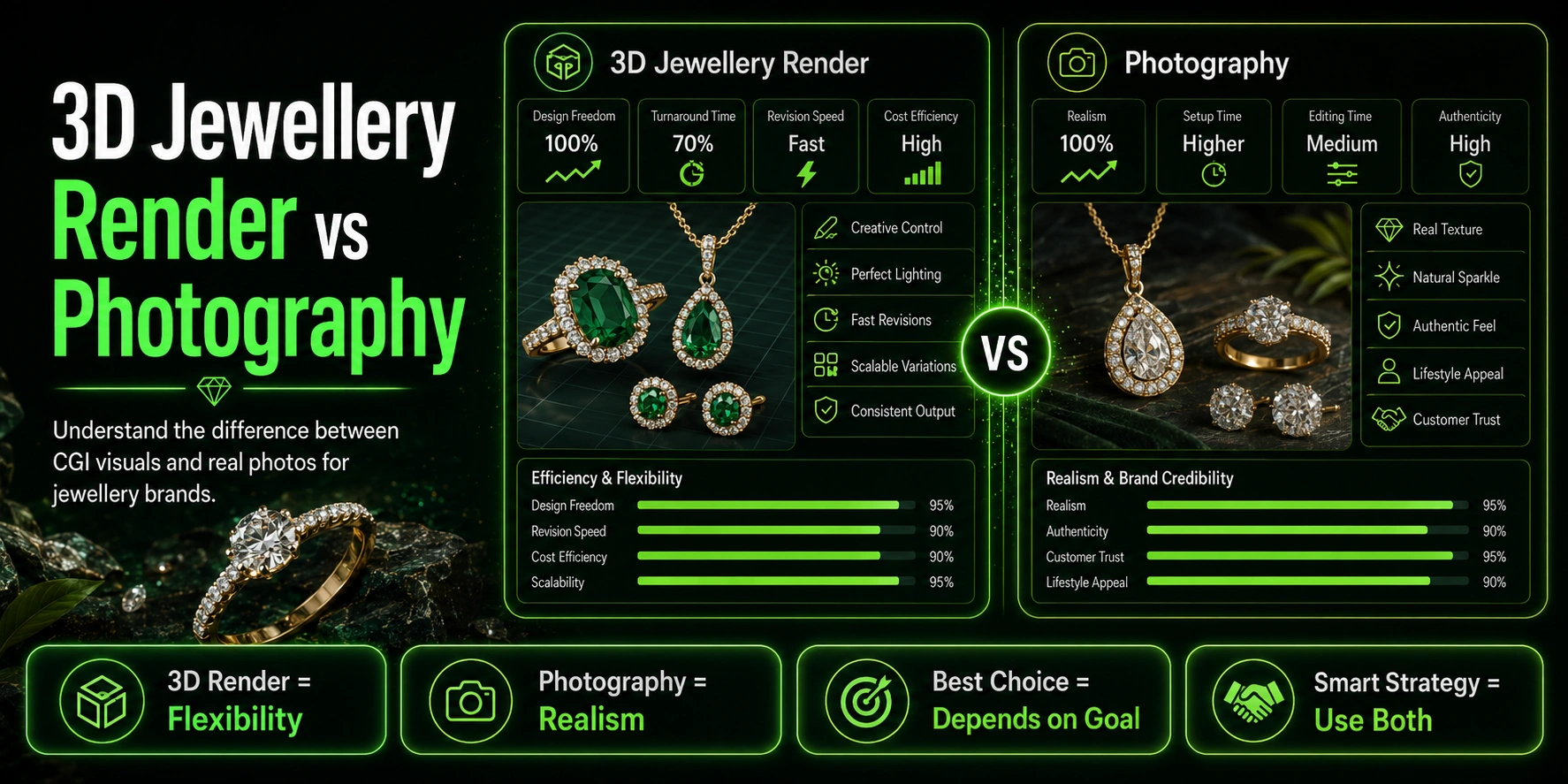
If you sell jewellery online in India, here is the honest answer to the render versus photography question. 3D renders win on catalogue scale, variant coverage, speed and pre-launch flexibility. Photography wins on human context, emotional storytelling and on-body trust. The brands growing fastest right now do not choose one over the other. They render the catalogue and photograph the brand.
That single line settles the debate for most teams, but it hides the decisions that actually matter. Which SKUs deserve a photoshoot? How do record gold prices change the maths? When does a render quietly damage trust, and how do you prevent it? This guide answers all of it with India-specific costs, examples from brands like Melorra and CaratLane, and a stage-by-stage playbook you can apply this quarter.
The short answer, before the detail
3D jewellery rendering creates photorealistic product images from a digital CAD model, which means a design can be visualised before a single gram of metal is cast. Jewellery photography captures a finished physical piece using cameras, controlled lighting and retouching. Rendering suits large catalogues, variant-heavy products and made-to-order business models. Photography suits model imagery, campaign storytelling and any content whose job is to prove the product is real and desirable on a human being.
Here is the quick verdict.
| Your priority right now | Better fit |
|---|---|
| Launching and testing designs before manufacturing | 3D render |
| Showing every metal colour and stone variant | 3D render |
| Building trust with on-model, on-skin content | Photography |
| Refreshing a festival catalogue in weeks, not months | 3D render |
| Influencer collaborations and customer content | Photography |
| AR try-on, 360 spins and interactive product views | 3D render, since it is the raw material |
| Premium bridal campaign storytelling | Photography |
| Perfectly consistent images across 1,000 SKUs | 3D render |
Why this debate changed: gold prices turned the issue into a working capital question
For years, render versus photography was treated as a creative preference. In 2026, it is a financial decision, and the reason is sitting on every jeweller’s rate board. As of July 2026, 24 karat gold in India has been trading above Rs 1.4 lakh per 10 grams, with 22 karat hovering around Rs 1.3 lakh. Prices at these levels change what a “simple photoshoot” actually costs, because photography has a prerequisite that rendering does not: the physical piece must exist.
Run the numbers on a modest sample line. Twenty designs averaging 8 grams each in 22 karat gold mean roughly 160 grams of metal, which is about Rs 21 lakh locked into samples before you add making charges, stones, hallmarking, insurance and secure transport to the studio. That capital sits in a camera tent instead of a showcase, and if half those designs never find demand, the samples must be melted or discounted. Some brands photograph silver or plated replicas to cut this cost, and it helps, but replicas introduce their own accuracy problem because the colour and finish of plated silver never quite match the final 18 or 22 karat alloy.
CaratLane’s co-founder Mithun Sacheti identified the real issue long before gold crossed the lakh mark. He pointed out that store rent is a small slice of a jewellery business’s costs, while the enormous savings opportunity sits in stock and working capital. Product imagery is part of that equation. Every design that needs a manufactured sample before it can be listed is a design that consumes capital before it earns a rupee. A render made from the manufacturer’s own CAD file consumes almost none.
This is also why made-to-order and lightweight D2C models lean so heavily on rendering. When your business promise is fresh designs every week at accessible prices, waiting for samples and studio slots breaks the model. Our complete guide to selling jewellery online in India covers the inventory and catalogue side of this shift in depth.
What 3D jewellery rendering actually is (and what it is not)
A photorealistic jewellery render starts with the same CAD file your manufacturer uses for casting, typically built in software like Rhino, Matrix or JewelCAD. A 3D artist then applies calibrated materials to that model: the warmth of 18-karat yellow gold, the blue-white face-up of a D colour diamond, the slight translucency of an emerald. Studio lighting is simulated using HDRI environments, which are essentially digital versions of a photographer’s softboxes and reflectors. The final output is rendered at high resolution as stills, 360-degree spins, or full animations.
It helps to be clear about what a render is not. It is not the grey, technical CAD screenshot that custom-jewellery customers sometimes receive as a “preview.” Wedding forums are full of worried buyers asking why their CAD preview looks blocky and heavy, and the answer is that raw CAD views are engineering documents, not marketing images. The gap between a raw CAD screenshot and a professionally lit photoreal render is the gap between an architect’s floor plan and a photograph of the finished home. When people say renders look fake, they are usually describing bad renders or raw previews, not the medium itself.
One CAD model, once built and calibrated, becomes a content engine. The same file outputs white-background catalogue images for your product pages, lifestyle-style scenes with simulated marble and silk, exploded views that show construction, spin videos for product pages, and animation clips for ads and reels. We covered the motion side of this in detail in our piece on 3D jewellery animations and Instagram engagement, because animated renders behave very differently from stills in social feeds.
What professional jewellery photography really involves
Respect where it is due: jewellery is one of the hardest categories to photograph well. Pieces are tiny, mirror-finished and full of stones that either sparkle or die depending on lighting. A competent product photographer shoots with macro lenses, stacks multiple exposures so the whole piece stays in focus, builds gradient reflections across polished surfaces so the metal reads as three-dimensional, and then retouches dust, fingerprints and casting marks from every frame. Model and lifestyle shoots add stylists, makeup artists, studio rental and day rates on top.
In India, this craft is more affordable than almost anywhere else in the world. Standard white-background ecommerce shots are commonly quoted between Rs 100 and Rs 600 per piece on B2B service marketplaces, with premium creative and editorial work priced per project or per day, and full model campaigns running into lakhs. Surat, Mumbai, Jaipur and Delhi all have deep benches of jewellery-specialist photographers because they sit inside manufacturing and export clusters.
The cost that does not appear on the photographer’s quote is the logistics. Samples must be insured, transported securely and tracked piece by piece, and for a high-value line, the risk management around a shoot can demand more attention than the photography itself. None of this makes photography the wrong choice. It makes it a deliberate investment to spend where it earns the most, which is what the comparison below is for.
3D render vs photography: the full comparison
| Dimension | 3D jewellery render | Jewellery photography |
|---|---|---|
| Physical sample needed | No, works from the CAD file | Yes, a finished piece is required |
| Typical India cost per catalogue image | Roughly Rs 100 to Rs 500 per view in volume; CAD plus photoreal packages from about Rs 1,000 to Rs 3,000 per design | Roughly Rs 100 to Rs 600 per piece for standard shots; premium and model work far higher |
| Cost of showing 9 variants of one design | Marginal, material swaps on one model | Nine physical samples plus nine setups |
| Turnaround | Days once CAD is approved, no studio booking | Depends on sample readiness, studio slots and shoot logistics |
| Consistency across the catalogue | Identical lighting and angles by default | Requires strict art direction across every shoot |
| Revisions | Re-render with new settings | Reshoot, with sample transport again |
| On-model emotional realism | Weak or expensive, digital humans rarely convince | The clear winner |
| Interactive and AR assets | Native output of the same 3D model | Not possible from flat images alone |
| Risk of misleading customers | Real if renders are prettified beyond production spec | Low for the piece shown, though retouching can also mislead |
| Best at | Scale, variants, speed, pre-launch testing | Trust, storytelling, social proof, handcrafted one-offs |
Four rows in that table deserve a closer look because the headline numbers hide the actual economics.
First, the per-image cost is nearly a tie in India, and that surprises most founders. A budget catalogue photo and a budget catalogue render cost broadly similar amounts per image. The economics diverge the moment variants enter the picture. Take one ring offered in three metal colours and three stone options. That is nine variants, and at three angles each, 27 images. Photography needs nine physical pieces manufactured, insured and shot in nine consistent setups. In 18 karat gold at roughly Rs 10,700 per gram, nine 5 gram samples lock up close to Rs 4.8 lakh in metal alone before a single frame is captured. Rendering needs one CAD model and eight material swaps. International studios often summarise this as renders cutting imaging costs by up to half, but for variant-heavy jewellery, the honest number is far larger, because the biggest saving is the samples you never manufacture.
Second, turnaround is not really about the artist or the photographer. It is about prerequisites. A photoshoot can only begin once the sample is cast, polished, set and delivered. A render can begin the moment the design CAD is approved, which, for a made-to-order brand, can be weeks earlier. During festival build-up, when every brand is fighting for the same studio slots and courier capacity, that lead time is the difference between launching a Diwali collection in September and launching it in November.
Third, consistency compounds. In a catalogue of 40 products, small differences in lighting and angle between shots are a cosmetic issue. On a catalogue of 1,000 products shot across two years and three photographers, they make the site look stitched together and quietly erode the premium feel that jewellery depends on. Renders produced from one calibrated scene are identical by default, which is why large catalogues drift toward CGI even when budgets could cover photography.
Fourth, the trust row cuts both ways. A render can mislead if the artist beautifies beyond what casting can reproduce, and later in this guide, there is a rulebook for preventing exactly that. But heavy retouching misleads too, and every experienced jewellery marketer has seen photographs polished so aggressively that the delivered piece disappoints. The medium is not the ethics. The production standard is.
Where photography still clearly wins
On-body truth is photography’s home ground. Skin tone against rose gold, the way a chain drapes at the collarbone, how a 12 mm hoop actually sits on an ear: these are questions customers answer by looking at real humans wearing real pieces. Product-only rendering is a mature craft, but rendered people are a different problem entirely. Convincing digital models remain expensive, and anything short of convincing lands in uncanny territory that hurts a premium brand more than it helps.
Social proof cannot be rendered at all. Influencer content, customer photos in reviews, unboxing videos and mirror selfies are trust assets precisely because they are unproduced. A render can anchor the product page, but it will never appear in a happy customer’s Instagram story. Brands that go all-in on CGI and neglect the photography that fuels user-generated content end up with beautiful catalogues and thin social feeds.
There is also a specifically Indian category where photography is not just better but arguably the only honest option: handcrafted and heritage work. Jadau, polki, kundan, temple jewellery and antique-finish pieces carry deliberate irregularity. The slight asymmetry of a hand-set uncut diamond is the point of the piece. Rendering that faithfully is technically possible and commercially pointless, because each finished piece is one of one. When the product is the karigar’s hand, photograph the karigar’s hand.
Finally, high-ticket purchases lean on photographic proof. A bride’s family evaluating a Rs 3 lakh set, often researching online before buying offline, wants evidence that the exact piece exists, looks the way it looks, and has been worn by someone. For bridal and investment-grade pieces, real photography and video are trust infrastructure, not just content.
Where 3D rendering clearly wins
Pre-launch demand testing is the strategic win that photography cannot match. With renders, a brand can list twenty new designs, run traffic to them, watch add-to-carts and wishlists, and manufacture only the winners. The losers cost a CAD file and a render fee instead of dead inventory that has to be melted at a loss. At current gold prices, this is not a nice-to-have. It is the closest thing jewellery has to the test-before-you-build economics that made fast fashion possible.
Variant coverage is the operational win. Metal colours, stone options, size guides, engraving previews and full product configurators all come from the same model. Customers increasingly expect to see their exact configuration before paying, and only a 3D pipeline delivers that without an explosion of physical samples.
Speed shows up hardest around India’s festive calendar. Diwali, Akshaya Tritiya, Dhanteras and the wedding window compress the entire industry’s launch schedule into a few crowded months. A render pipeline turns collection refreshes into a scheduling exercise rather than a logistics project, because there are no samples to wait for and no studios to book. Brands running renders can react to a trending motif in weeks.
Motion and interactivity are the growth wins. The same model that produced your catalogue still produces 360 spins for product pages, macro fly-through animations for ads and reels, and AR-ready assets for virtual try-on. Shopify’s data has shown product pages with 3D or AR content converting around 94 percent better on average than pages without, and merchants using AR see roughly 40 percent fewer returns. Flat photography simply cannot feed these experiences.
There is a quieter win too: compliance. Amazon, Flipkart and Google Shopping all want clean, consistent product images on plain backgrounds, and a calibrated render scene produces spec-compliant images by default, in every variant, forever.
What India’s leading D2C jewellery brands actually do
Melorra is the clearest Indian proof of what a digital-first visual pipeline unlocks. The brand built its entire model on CAD design and 3D-printed casting, publicly claiming around 300 new designs launched every month and a catalogue that has grown past 18,000 designs. That cadence is arithmetically impossible if every design needs a manufactured sample and a studio slot before it can go live. Whatever one makes of the company’s later funding journey and its early 2026 acquisition by Senco Gold, the catalogue mechanics stand: design velocity at that scale is a rendering-and-CAD story, not a photography story.
CaratLane shows the other half of the equation: 3D assets as customer experience, not just catalogue images. The brand launched a virtual try-on app back in 2015 using facial tracking and 3D imaging, and by 2018, its founder was reporting that around 40 percent of the business was flowing through the AR-powered app. Try-on experiences run on 3D models, which means every piece in the experience needs a render-grade digital twin. CaratLane paired this digital layer with physical trust mechanics like silver-replica home trials, hybrid thinking in its purest form.
The majors followed. Tanishq, Kalyan Jewellers and PC Jeweller have all rolled out virtual try-on experiences through technology partners, which tells you digital jewellery visualisation has crossed from startup experiment to industry standard. Meanwhile, growth brands like BlueStone and GIVA continue to invest heavily in model photography and lifestyle campaigns for social and brand building even as their catalogues scale. Look across the leaders and the same pattern repeats: 3D assets do the catalogue and experience work, photography does the brand and trust work. Nobody at scale is choosing just one. For how this fits into the bigger growth picture, see our guide on how to market a jewellery brand in India.
How to combine both: a stage-by-stage playbook
The right mix is not a fixed ratio. It follows your catalogue size, capital position and where trust currently comes from. Here is the sequencing we recommend.
| Brand stage | Product page imagery | Brand and social imagery | Special assets |
|---|---|---|---|
| Stage 1: pre-launch to about 100 SKUs | Render every SKU and variant from CAD | One tight photoshoot of 5 to 10 hero pieces, on model if budget allows | One 360 spin for the flagship design |
| Stage 2: scaling, 100 to 500 SKUs | Renders remain the default for all PDPs and variants | Quarterly campaign shoots; seed customer photo reviews and UGC | Animated renders for ads and reels; engraving previews |
| Stage 3: established, 500+ SKUs | Render pipeline integrated with your CAD and manufacturing workflow | Photography reserved for campaigns, bestsellers and festive storytelling | AR try-on built from render assets; full configurators |
Two principles make this playbook work. Render first; photograph what sells. Your photography budget compounds when it is spent on proven winners, so let renders carry new designs through their testing phase and give your top 20 sellers the model shoot, the campaign treatment and the video budget. And never let the catalogue outrun the trust layer. Every quarter of render-led catalogue growth should be matched with fresh photographic proof: campaign imagery, review photos, influencer content, behind-the-scenes craft. The catalogue convinces the mind, the photography convinces the gut, and jewellery is bought with both.
Your platform choice matters here as well, since variant-heavy render catalogues need product pages that can actually handle swatches, spins and configurators cleanly. We compared the options in our guide to choosing the right ecommerce platform for a jewellery website.
The trust rulebook: using renders without disappointing customers
The strongest argument against renders is not aesthetic; it is the unboxing gap. Custom-jewellery forums carry two recurring complaints: raw CAD previews that look clunky, and delivered pieces that differ from the approved visual. One widely shared story, covered by InStyle, involved a bride whose custom 3.4 carat ring arrived feeling bulkier and less comfortable than the 3D model she had signed off. Every complaint like this is avoidable, and brands that render responsibly follow a consistent set of rules.
Render to manufacturing spec, never to fantasy: Stone counts, prong thickness, band width and setting heights in the render must match the production CAD exactly. If casting cannot reproduce it, the render must not show it. The moment an artist “improves” a design beyond spec, the image stops being a product photo alternative and becomes a future refund.
Calibrate materials against real samples: Have one physical reference piece per metal and finish, photograph it under controlled light, and match the render’s shader to that reference. Indian 22 karat yellow is warmer than generic gold presets, and BIS-hallmarked 18 karat reads differently from both. Colour calibration is the single biggest quality gap between cheap renders and renders that customers cannot distinguish from photographs.
Show scale honestly: Renders float in abstract space unless you anchor them. Publish dimensions in millimetres and weight in grams on every product page, include at least one on-hand or on-ear context visual, and resist wide-angle drama that makes a 4 mm stud read like an 8 mm one.
Mix reality into the page: Place customer photos, review images and unboxing clips alongside renders. The render sells the design, the customer photo proves the delivery, and together they close the trust loop that neither closes alone.
Disclose with confidence: A simple line stating that images are computer-generated visualisations of the exact design being manufactured builds more trust than silence, and it aligns with the accurate-representation standards that marketplaces and Google Shopping already expect. Customers do not punish honesty. They punish surprises.
Photograph the one-of-ones: For jadau, polki and other handcrafted lines where each piece varies, renders are misrepresented by definition. Shoot the actual piece and say so, because in heritage categories, the variation is the value.
Do Google and AI search prefer photos or renders?
Nothing in Google’s documentation ranks photographs above renders or vice versa. What its image guidance actually asks for is mechanical and medium-agnostic: images embedded in standard HTML rather than CSS backgrounds, descriptive filenames and alt text, structured data whose claims match what is visible on the page, and imagery that accurately represents the product. A calibrated render and an honest photograph both pass every one of those tests. A misleading version of either fails them.
Generative AI search does raise the stakes on imagery, but in the same direction. Google’s own guidance for succeeding in AI-driven search results tells site owners to support strong text with high-quality images and video, keep Merchant Centre and Business Profile data accurate, and prepare for multimodal queries where a shopper photographs a piece of jewellery and asks for similar designs. A render-led catalogue actually holds a quiet advantage here, because every variant can have its own clean, accurate, well-labelled image, which is precisely the kind of coverage visual search rewards. What earns AI citations is not the medium behind the image but the substance around it: original comparisons, real pricing, first-hand expertise and pages people find genuinely satisfying. That is the same people-first standard that classic SEO rewards, a point we unpacked in our comparison of SEO vs Google Ads for jewellery businesses.
One practical note: write alt text that describes the product, such as an 18 karat rose gold butterfly stud with white sapphires, and keep the render disclosure in your visible page copy. Alt text describes what the image shows, and what it shows is your jewellery.
Where Kyros Solution fits in
Kyros Solution works exclusively with D2C jewellery and lifestyle brands, and we are headquartered in Surat, inside the ecosystem where most of India’s jewellery is actually designed, cast and exported. That matters for this topic in a very literal way: our 3D team works with the same CAD formats your manufacturer uses, so renders come from production files rather than approximations of them.
Our 3D render and animation service for jewellery covers the full asset stack this article describes: colour-calibrated photoreal stills for product pages, complete variant sets for every metal and stone option, 360 spins, macro animations built for reels and performance ads, and AR-ready models for try-on experiences. Every scene is calibrated against physical metal references, and outputs are delivered to your platform and marketplace specs.
The difference in working with us is that renders never arrive as isolated artwork. Because Kyros also runs SEO, performance marketing, UI/UX and conversion optimisation for jewellery brands, your visuals are built as parts of a system: renders structured for image search and Shopping feeds, product pages designed to carry spins and variant swatches without slowing down, and ad creative cut from the same animations. Imagery that is planned together performs together.
If you are weighing a render pipeline against your next photoshoot, send us your current product pages. We offer a complimentary audit that reviews your image strategy, PDP conversion and catalogue structure, and tells you plainly where renders would move your numbers, where photography deserves the budget, and in what order to do both.
The bottom line
Stop asking whether 3D renders or photography is better, and start asking what job each should do in your brand. Render the catalogue: every SKU, every variant, every pre-launch test, because that is where speed, consistency and capital efficiency live. Photograph the brand: your heroes, your campaigns, your customers, your craft, because that is where belief lives. At today’s gold prices, the brands that sequence these two well will out-launch and out-trust the ones still treating imagery as a single line item.
If you want a clear, numbers-backed plan for your own catalogue, talk to Kyros Solution. We will audit what you have, show you what to render, what to shoot and in which order, and build the assets that do both jobs properly.
FAQs
Is 3D rendering cheaper than jewellery photography?
Per single image in India, they cost broadly similar amounts, with basic catalogue work in the low hundreds of rupees either way. Rendering becomes decisively cheaper the moment variants, revisions or pre-launch designs are involved, because it removes the cost of manufacturing, insuring and transporting physical samples for every version you want to show.
Can customers tell the difference between a render and a photo?
A professionally calibrated render of a product on a clean background is generally indistinguishable from a photograph to shoppers. The differences appear in poor renders, in on-body imagery where digital humans still fall short, and in handcrafted pieces whose natural irregularity a render smooths away.
Are 3D renders allowed on marketplaces and Google Shopping?
Yes, provided the image accurately represents the product being sold, which is the same standard as photographs are held to. Clean, spec-accurate renders on plain backgrounds typically satisfy marketplace image guidelines easily. Misrepresentation is what gets listings in trouble, regardless of how the image was made.
How much does a 3D jewellery render cost in India?
Volume ecommerce renders are advertised from roughly Rs 100 to Rs 500 per view, while CAD-plus-photoreal packages typically start around Rs 1,000 to Rs 3,000 per design and rise with complexity, stone detail and the number of outputs. Animations, 360 spins and AR-ready models are priced on top, but reuse the same base model.
How long does rendering take compared to a photoshoot?
Once the CAD is approved, render turnarounds are measured in days and need no studio booking, sample logistics, or shoot scheduling. Photography timelines depend on the sample being manufactured and delivered first, which is usually the longest step, especially in the festive season when studios and karigars are equally overbooked.
Should a new jewellery brand start with renders or photography?
Start with renders for the full catalogue and every variant, then invest in one small, high-quality photoshoot of your 5 to 10 hero pieces for your homepage, campaigns and social proof. This sequence protects working capital while your designs are unproven and concentrates photography spend where it builds the most trust.
Do 3D renders increase returns because of mismatched expectations?
Only when renders are inaccurate. Renders built to manufacturing spec with calibrated materials set expectations correctly, and interactive 3D content has been associated with fewer returns because customers inspect products more thoroughly before buying. The return risk comes from prettified visuals, and that risk applies to over-retouched photography just as much.
Do you still need photography if you have AR try-on?
Yes. AR answers the fit and scale question, but social proof, campaign storytelling and user-generated content still run on real photography and video. Try-on and photography solve different trust problems, and strong brands run both.