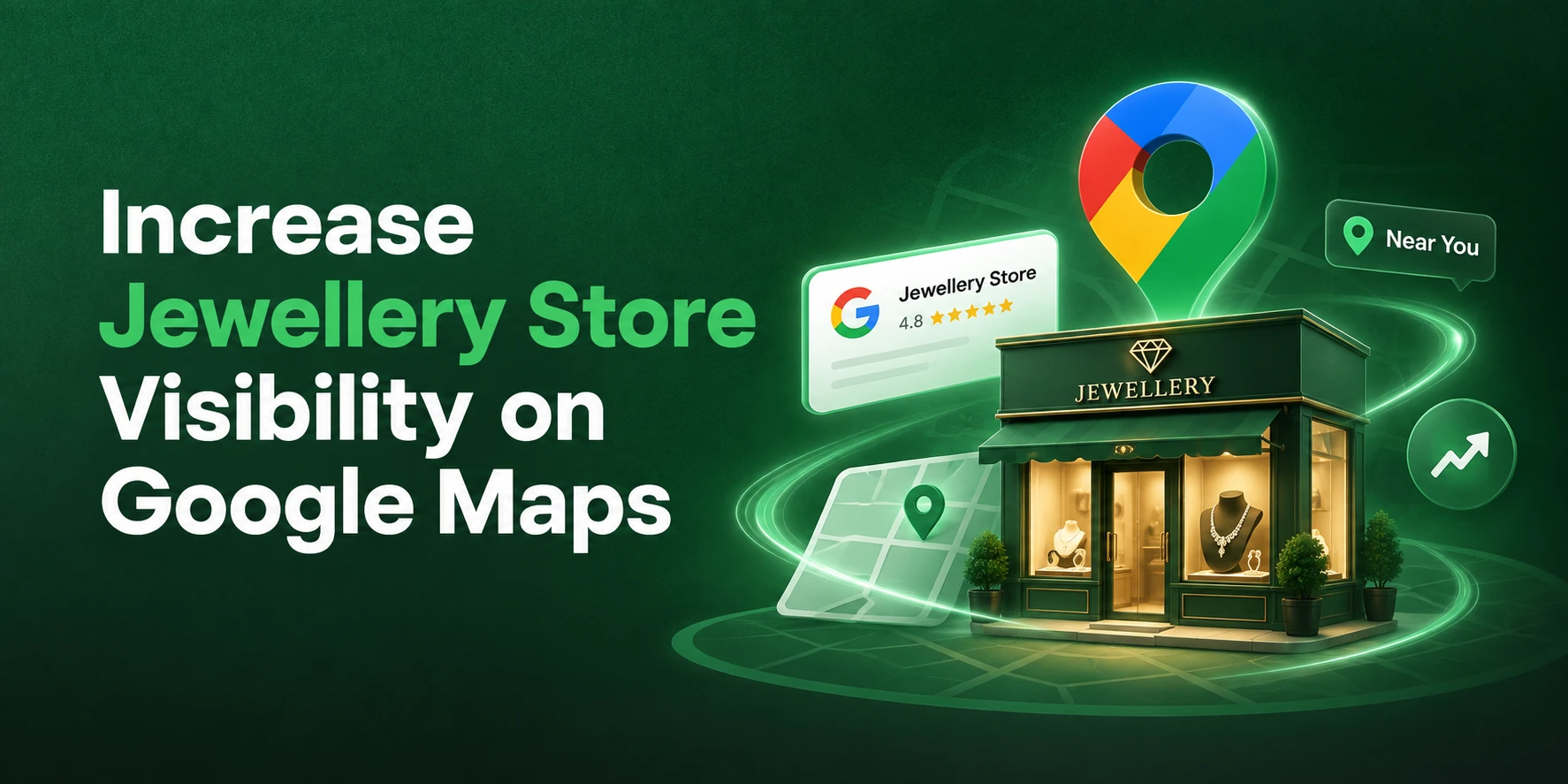
Most advice on this topic is a checklist. Fill in your categories, add photos, collect reviews, post weekly. That advice is not wrong, and it is also not why one jewellery showroom in your city pulls forty direction requests a day while the one 800 metres away pulls four.
The gap comes from something that changed and that almost nobody writing about jewellery marketing has caught up with: Google Maps stopped behaving purely like a ranked directory and started behaving like something that reads.
On 12 March 2026, Google launched Ask Maps, a Gemini-powered conversational experience drawing on over 300 million global listings and 35 million Indian places, building on earlier AI updates like local context tips for regional markets. Nobody wrote those sentences into a business profile. Gemini assembled them from what customers had already said.
Think about what that means for a jewellery store. A buyer no longer has to type “jewellery shop near me” and compare three pins. She can ask the map directly: which shop near me does old gold exchange without heavy deduction, which one has lightweight daily wear in 18k, which one will let me see the hallmark before billing. The answer gets assembled from your reviews, your photos, your product data, and your website, whether or not you ever thought of those as ranking assets.
So the real question is not “how do I rank higher on Maps?” It is “when the map is asked about jewellery near my store, is there enough evidence about my shop for it to say something specific and favourable?”
This guide answers that, in the order the work actually has to be done, with the parts that apply specifically to Indian jewellery retail: gold rate queries, hallmarking, exchange policy, making charges, festival demand, and the trust gatekeeping that comes with a 60,000 rupee average order value. There is a section at the end on what you can realistically achieve in 24 hours, because that was part of the brief and because it deserves an honest answer rather than a promise.
What actually changed in 2026, and why old checklists underperform
Three shifts matter.
Maps became an answer surface: Ask Maps is live in India on Android and iOS. Google says the feature draws on over 300 million places globally and reviews from more than 500 million contributors, plus Street View and aerial imagery. Your profile is no longer a card that either ranks or does not. It is a body of evidence that gets read, summarised and quoted.
Weight moved from prominence to popularity: Practitioners tracking the algorithm through 2026 describe a shift away from historical authority signals, such as years in business and link counts, toward live engagement: click-through rate from the local pack, dwell time on the profile, review engagement, posting cadence. BrightLocal’s 2026 factor weighting puts behavioural signals at around 8 percent averaged across local pack, organic and AI search, and Whitespark’s 2026 survey of 47 local SEO practitioners recorded behavioural signals and review signals as the two groups gaining the most ground year on year.
Citations came back, for a new reason: Citation signals had been declining in importance for local pack ranking for years. Then Whitespark’s 2026 report found that three of the top five factors for AI search visibility were citation-related. Directory listings stopped mattering much for the blue pins and started mattering for whether an AI assistant can corroborate that your business exists, where, and what.
Put together: the checklist era rewarded completeness. The current era rewards specificity plus live activity plus corroboration.
The five factors that decide whether you appear at all
Whitespark’s 2026 Local Search Ranking Factors survey ranked the top five influences on local pack and Maps rankings as:
- Primary Google Business Profile category
- Proximity of the business to the searcher
- Keywords in the business title
- Physical address in the city being searched
- Whether the business is open at the time of the search
Four of those five are settings, not campaigns. You can fix three of them this week. One of them, proximity, you cannot fix at all, and understanding that properly is the single biggest correction most jewellers need.
Proximity: you do not have a ranking; you have a map of rankings
There is no such thing as “my rank for jewellery shop near me.” There is your rank from the searcher’s exact position, and it changes street by street.
A jewellery store in, say, Ghod Dod Road in Surat might sit at position one for a buyer standing 400 metres away, position seven for a buyer two kilometres away in Adajan, and nowhere at all for a buyer in Varachha. All three of those buyers typed the same words. This is why two jewellers can both be telling the truth when one says “we rank first” and the other says “you don’t show up for me.”
The practical response is to stop measuring a single rank and start measuring a grid. Run a geo grid scan, which plots your rank from a lattice of points across your city, before you change anything. That grid is your actual visibility footprint. Everything below either widens it or does nothing.
Two consequences for jewellery specifically:
- A single flagship showroom cannot own an entire metro. If your catchment genuinely spans a city, additional verified locations are a business decision with an SEO consequence, not an SEO trick. Google’s guidelines require an actual staffed location with permanent signage at the listed address.
- High average order value works in your favour here. Buyers routinely travel further for a 1 lakh rupee purchase than for a haircut, so your effective radius is wider than a restaurant’s. That means the profile and review work below is what stretches the grid, because relevance can partly compensate for distance when the buyer’s intent is specific.
Business hours: the factor that costs rankings quietly
Whitespark’s 2026 report lists “business open at search time” as the fifth most impactful factor, with one contributor describing being at position one and then dropping 60 minutes before closing. Another factor, “proper hours set,” climbed 64 places year on year.
For Indian jewellers, this is not a small detail. Showrooms commonly close for lunch, shut on a weekday, extend hours through Dhanteras week, and open on public holidays when competitors do not. Almost none of that is reflected in their profile.
Two fixes:
- Enter real hours, including any midday break, as split hours rather than a single continuous block.
- Enter special hours in advance for Akshaya Tritiya, Dhanteras, Diwali, Pushya Nakshatra days, and local muhurat dates. A profile that says “open” during festival week when a rival says “hours might differ” wins the click before anyone compares ratings.
Primary category: the highest leverage setting you own
Primary category ranked first in the 2026 survey. Google’s own guidance is to choose the fewest categories that complete the sentence “this business is a,” not “this business has” or “this business offers.”
For jewellery retail in India, the primary category choice is genuinely consequential because the options behave differently:
- Jewelry Store is the correct primary for a retail showroom selling finished jewellery. This is the default and the right answer for most readers.
- Jeweler describes a craftsperson or workshop. Choosing it for a retail showroom narrows the queries you are eligible for.
- Gold Dealer or Silver Dealer suits bullion-led businesses. If bullion is a sideline, it belongs as a secondary category, not primary.
- Diamond Dealer, Jewelry Designer, Jewelry Repair Service, Jewelry Appraiser, and Jewelry Buyer are useful secondaries when you genuinely do the thing.
Add secondary categories only for services you actually perform on the premises. Two profiles with identical everything else will diverge on this setting alone, and it takes one minute to change.
Business title: where Indian jewellers get suspended
Google’s representation guidelines are explicit. Your name should reflect the real world name used on your storefront, website, and stationery. No taglines, no phone numbers, no URLs, no store codes, no “Best Gold Jewellery Shop in” appended to the legal name.
Keywords in the business title rank third in influence, which is exactly why the temptation is enormous and why the practice is widespread in Indian local search. The trade off is asymmetric. A keyword stuffed name may lift you for a few months. A suspension removes you from Maps entirely, and reinstatement can take weeks with no guarantee.
Two legitimate routes exist:
- If your registered, signed, invoiced name genuinely includes a descriptor, such as “Shreeji Gold and Diamonds,” you keep it. That is your name, not stuffing.
- If it does not, you change the signage, the GST invoice, and the website first, live with it consistently, and only then update the profile. Google’s test is real world consistency, and it is verifiable through photos.
Reporting a competitor who has stuffed their name is a legitimate move through the Business Profile redressal process. It works more often than jewellers expect, and it is faster than outranking them.
Reviews: stop treating them as a score; start treating them as an answer corpus
This is the section that separates a 2026 strategy from a 2022 one.
The old model: reviews are a rating and a count; they feed prominence, more is better. Still true, and the thresholds are sharp. BrightLocal’s 2026 consumer survey found 47 percent of consumers will not use a business with fewer than 20 reviews, 31 percent only consider businesses rated 4.5 or above, and 80 percent are more likely to use a business that responds to all reviews. Nineteen percent now expect a response the same day, up from 6 percent.
The new model sits on top of that: review text is the raw material Gemini reads when someone asks Maps a question. Ask Maps answers questions about parking, bargaining, specific dishes, and specific experiences because contributors mentioned them. Nothing about that mechanism is restaurant specific.
There is an important nuance here that most agencies get wrong in both directions. A well known Sterling Sky experiment, run on a Christmas tree farm across several months, found that seeding keyword rich reviews did not improve local pack rankings, and in one case the ranking slipped. Joy Hawkins’s conclusion was blunt: do not coach clients to get specific words into reviews, because it does not improve rankings.
Both things are true at once, and the distinction matters:
- Coaching customers to write your keywords does not move your rank, and it produces reviews that read as fake to humans and to review filters.
- Reviews that naturally describe specific things you did are what an AI answer layer has to work with. The way to get them is not scripting. It is asking a question at the right moment.
How to ask so you get specific text
Most jewellers ask “please give us 5 stars on Google.” That produces “good service, nice collection,” which is worth a star rating and nothing else.
Ask instead at the moment of a specific, memorable transaction, and ask about that thing:
- After an old gold exchange: “Would you mind mentioning in a Google review how the exchange valuation went? It helps people who are nervous about deduction.”
- After a custom order: “Could you describe what you got made? People searching for custom work never know who does it.”
- After a repair or resizing: “A line about the turnaround time would really help others.”
- After a first time buyer’s purchase: “If you found the hallmark explanation useful, that is worth mentioning.”
You are not supplying words. You are supplying a subject. The customer’s own language then does the work, and it is the customer’s own language that Gemini quotes back.
The four review questions Indian jewellery buyers are actually trying to answer
Every jewellery review in India is read as evidence on one of four anxieties.
Build your review acquisition around them deliberately:
- Will I be cheated on weight or purity? Reviews mentioning BIS hallmarking, HUID, the customer being shown the weighing, or purity verified elsewhere afterwards.
- What will the making charges actually be? Reviews mentioning transparent or negotiated making charges, or a printed breakup on the bill.
- What happens when I exchange or sell back? This is the largest single trust issue in Indian gold retail, and it is not hypothetical: World Gold Council reporting on the Indian market noted that over 40 percent of retailer sales were being driven by old jewellery exchange. Reviews that describe a fair exchange are commercially the most valuable reviews you can hold.
- Will they pressure me? Reviews mentioning no pressure, browsing freely, patient staff.
If your review corpus covers all four, Ask Maps has something to say about you for a wide range of questions. If it covers none, you have a 4.7 rating that says nothing.
Responses, emoji reactions and pseudonymous reviews
Respond to everything, and respond in the language the review was written in. If a review is in Gujarati or Hindi, reply in that language. Google’s 2026 feature set added emoji reactions to reviews, which is a fast way to signal responsiveness at volume, but it does not replace text: a written response is content on the profile and can itself be read by the answer layer.
Following Google’s late-2025 rollout of pseudonymous reviews, customers can post under nicknames and avatars while account identities remain verified internally by Google. Expect higher volume and more noise. Your response strategy needs to handle criticism from unidentifiable accounts without becoming defensive in public.
Two hard rules. Do not buy reviews, and do not gate them by only asking happy customers. Both violate Google’s policies, both are increasingly detectable, and in a category where the buyer is already scanning for signs of dishonesty, a review profile that looks manufactured is worse than a thin one.
For more on how review behaviour maps to jewellery buying specifically, see our piece on why customer reviews matter for your jewellery brand.
Photos, products and the justifications that appear under your pin
The line of text under a local pack result, such as “Their website mentions bridal jewellery” or “In stock,” is a justification. It is often the only descriptive text a buyer reads before choosing, and there are several types, each triggered differently.
The four that matter for jewellery retail:
- Website mentions: triggered by text on your site. This is why store location pages need real copy, not just an address.
- Review mentions: triggered when review text matches the query. See above.
- Post justifications: triggered by Google Business Profile post content, appear almost immediately after posting, and are the only justification you fully control.
- Sold here and in stock: triggered by product and inventory data.
That last pair is the one jewellers systematically ignore.
Free local listings: the underused lever
Google Merchant Center’s free local listings show your in store products across Search, Maps, the Products tab, your Business Profile and the “see what’s in store” unit. Google’s own documentation cites retailers seeing on average 16 percent more impressions on organic shopping surfaces when local inventory is provided.
For a jewellery showroom, this is meaningful because it converts a browsing query into a product level match. Someone searching “18k gold chain” near your store can be shown your actual chain, at your actual store, rather than a generic pin.
It requires product data with prices, which is the sticking point for gold, because a rate linked price changes daily.
Two workable approaches:
- Feed fixed price items first: diamond jewellery, silver, gemstone pieces, gifting ranges, lightweight fashion jewellery. These have stable prices and are exactly the categories where a price shown up front converts.
- For rate linked gold, feed the pieces you keep at a stated making charge and update the feed daily through your billing or ERP system. If you cannot automate a daily update, do not feed gold. Wrong prices cost more trust than absence costs visibility.
Photos: what helps, and one thing that does not
Add photos continuously rather than in one upload. Interior shots showing the counter and seating, the BIS hallmarking display, staff at work, the storefront from the road at the angle a driver approaches from, and the parking situation. Cover photos of a model wearing a necklace look like advertising; a buyer trying to decide whether a shop is legitimate is looking for the shop.
Now the myth. Geotagging photos before upload is sold widely in India as a ranking hack. The best available test, run by Evergrow Marketing across 27 businesses over 10 weeks with a 5 week control and a 5 week test period, found that of seven metrics tracked, only one improved (near me queries in the targeted area), while four declined, including city name queries. WhiteSpark has separately called geotagging a myth. Google strips EXIF data on upload in any case. Spend the time on photo volume and subject matter instead.
Posts, WhatsApp, and the engagement signals now being weighted
With weight moving toward live engagement, the profile features that were once marginal have become worth the effort.
Posts: Post two to three times a week, each one narrow. One post about one thing: a single bridal set, this week’s exchange offer, the new 14k lightweight range, a Pushya Nakshatra opening. Narrow posts produce clean post justifications; omnibus posts produce none. Posts also expire, which is why cadence beats quality here in a way it does not elsewhere in marketing.
WhatsApp integration: Following Google’s late-2025 rollout of pseudonymous reviews, customers can post under nicknames and avatars while account identities remain verified internally by Google. For Indian jewellery retail, this is close to a structural advantage, because WhatsApp is already where the enquiry, the photo sharing, the rate quote, and the booking happen. Connect it, staff it during showroom hours, and use quick reply templates for the three questions you get most: today’s rate, exchange policy, whether a specific design is in stock.
AI-generated Q&A: Google now generates answers to profile questions using your business data, profile content, website, and reviews, with a review gate so you approve or reject before publishing. Treat the queue as a weekly task. Unreviewed AI answers about your making charges or your exchange policy are a real risk, and the same underlying information is what feeds Ask Maps.
Products, services and attributes: GBP Services jumped from position 81 to 22 in the 2026 factor rankings, and keywords in GBP Services climbed 75 places. Fill the services section properly: old gold exchange, custom jewellery design, hallmarking, resizing, polishing, gold savings scheme, bridal consultation, valuation. Each is a query someone types.
What your website still has to do
Maps visibility is not independent of your site. According to Whitespark’s Local Search Ranking Factors survey, Google Business Profile signals remain the single largest factor group for Map Pack rankings at 30 percent, while on-page website optimization leads localized organic web results at 36 percent. Website mention justifications come from your pages. And in AI search, the split matters: research summarised by Cheers found Gemini citing business websites in roughly 80 percent of cases in their sample, while ChatGPT split closer to half between business sites and third party directories.
Three pages earn their keep:
A real store page per location: Not a contact block. Address, embedded map, parking guidance, nearest landmark, public transport, photos, the staff who work there, the services available at that specific branch, and the hours, including festival hours. Mark it up with LocalBusiness or JewelryStore schema, and make sure every field in the schema is also visible on the page, which is Google’s stated requirement.
A gold rate page: This is the most underused asset in Indian jewellery SEO. Tanishq and Josalukkas both run one, and there is a reason. Gold rate checking is a daily habit; it spikes exactly when purchase intent spikes, and for a local store it is a natural way to combine a daily query with a location. A page showing today’s 22k and 18k rate for your city, updated automatically, with your making charge policy stated plainly below it, earns repeat visits from exactly the people who are about to buy. It also gives the answer layer a fresh, unambiguous, attributable fact about you.
An exchange and making charges page: The two questions buyers will not ask in person. Publish the policy, the deduction percentage if any, the documentation needed, and what happens with non hallmarked old gold. This page will be quoted by AI assistants precisely because so few jewellers publish it.
If your site cannot support daily rate updates or clean location templates, that is a build problem before it is a marketing problem. Our web development team handles this for jewellery clients regularly.
Citations, directories and getting corroborated by AI
Citations stopped being a strong local pack factor and became an AI visibility factor. Whitespark’s 2026 report put three citation related factors in the top five for AI search visibility. The logic is straightforward: an assistant answering “best jewellery shops in Rajkot” wants more than one source agreeing on who you are.
What to do, in priority order:
- Fix consistency before adding anything: One exact name, address, and phone format everywhere. Audit what exists first; conflicting entries do more damage than missing ones.
- The Indian core: Justdial, IndiaMART where relevant, Sulekha, Yellow Pages India, plus Bing Places and Apple Business Connect. Apple matters more than Indian businesses assume, because it feeds iOS Maps and Siri.
- Jewellery and trade specific: GJEPC listings, state jewellers association directories, local trade body listings, BIS-registered jeweller listings. These are the ones your competitors do not have.
- Genuine local mentions: local news coverage of a store opening or a festival collection, sponsorship of a local event, a mention in a city guide. These are citations and links at once.
What not to do: bulk directory blasts. Hundreds of low quality listings create NAP conflicts, which is the opposite of corroboration.
Getting visibility within a day
This was part of the brief, and it deserves a straight answer, because “SEO takes six months” is true and also not the whole truth.
What cannot happen in a day: a new profile ranking in the local pack, a grid expanding, a domain earning authority. Local ranking movement from profile changes typically shows over two to six weeks.
What genuinely can happen in a day, if you have an existing verified profile:
Hour 1: Post to your Business Profile. Post justifications appear almost immediately, and posts surface on your profile the moment they are approved. One narrow post with a specific product and a clear call to action.
Hour 2: Fix hours and add special hours for the next festival date. If you are shown as closed when you are open, you are losing the fifth most influential ranking factor every day, and fixing it takes four minutes.
Hour 3: Answer every unanswered question in the Q&A section yourself, and approve or reject the AI generated ones in the queue. Ask and answer the five questions you get daily in the showroom. This is your own content on your own profile, and it is live instantly.
Hour 4: Upload ten photos taken today. Storefront, interior, counter, hallmark display, parking, staff. Dated photos signal an active business.
Hours 5 to 8: Message the last 40 customers who bought from you, individually, on WhatsApp, asking for a review about the specific thing they experienced. Not a broadcast. Individual messages get 10 times the response rate and, unlike a broadcast, do not read as a campaign. Ten new specific reviews in a week changes what the answer layer can say about you.
Same day, off Google entirely. This is the part the question was really asking about, and it is where a jewellery store has advantages a plumber does not:
- WhatsApp Status and Business broadcast lists: Your existing customer base is the highest intent audience you will ever have, and a status update about a new collection or a festival offer reaches them within hours.
- Local WhatsApp and housing society groups: In Indian cities, RWA and society groups are a genuine discovery channel for high value local purchases. One resident asking “where should I buy for my daughter’s wedding” in a 400 member group is worth more than a week of impressions.
- Instagram location tag and Reels: Tag your store location on every post and Reel. Location tagged Reels surface to nearby users, and the location page becomes a second discovery surface. Our note on the best social media platforms for jewellery brands covers the channel mix in more detail.
- Google Business Profile offers posts with an end date: Urgency posts perform, and festival timed offers on a profile convert browsers into direction requests the same afternoon.
- A paid local campaign: If you need footfall tomorrow rather than next quarter, a location targeted campaign with a tight radius around the showroom buys visibility immediately. That is what paid media is for, and it does not compete with the organic work; it covers the gap while the organic work compounds. We cover the trade-offs in Google Shopping vs. Meta Ads for jewellery brands.
Say it plainly to yourself: day one activity buys attention. The profile work buys compounding visibility. Doing only the first is a treadmill. Doing only the second means an empty showroom while you wait.
The Indian jewellery calendar, and why it changes the work
Generic local SEO advice assumes flat demand. Jewellery in India does not have flat demand, and the calendar should drive your posting, your special hours, and your offer feed.
The anchors: Akshaya Tritiya, Dhanteras and Diwali, the wedding seasons, Pushya Nakshatra days, Gudi Padwa, Ugadi, Onam, Dussehra, and regionally specific muhurat dates. Akshaya Tritiya 2026 was reported at an estimated 18 to 20 tonnes of business across India, with healthy footfalls. Those are days when search intent is already at peak, and the marginal value of being visible is highest.
The gold price environment matters too. Gold prices gained nearly 30 percent in recent years, reaching record highs between 80,000 and 97,500 rupees per 10 grams during major festive peaks. The consumer response was visible and specific: growing demand for 18k and 14k rather than 22k, gold coins nearly doubling year on year, and exchange-driven purchases above 40 percent of retailer sales.
That has direct implications for what you should be saying on your profile and your site:
- If you stock 18k and 14k, say so everywhere. That is where the volume moved.
- If you run a fair exchange policy, it is your single strongest differentiator, and almost nobody publishes theirs.
- If you sell coins, list them as products. They are a rising category with a clean fixed price, which makes them ideal for local inventory feeds.
Plan profile activity four weeks ahead of each anchor date, not on the day.
Measuring it without fooling yourself
Track four things, monthly:
Grid rank, not rank: A geo grid scan on your five most valuable queries. This is your visibility footprint and the only honest measure of whether the work is expanding it.
Business Profile actions, not views: Direction requests, calls, website clicks, messages. Views are a vanity number that moves with seasonality. Direction requests are the closest free proxy for footfall intent that exists.
Review velocity and text coverage: Not just count and rating. Do your last 20 reviews mention exchange, hallmarking, making charges, and custom work? If not, you have a rating without a corpus.
AI mention checks: Once a month, ask ChatGPT, Gemini, Perplexity, and Ask Maps the ten questions a buyer would ask in your city. Record whether you are mentioned, and what is said. This is manual, and it takes 30 minutes. It is also the only way to see the surface that is increasingly deciding who gets considered.
Where this goes wrong
Honest list, because you will meet all of these.
Competitors are spamming, and it is working: Keyword stuffed names and fake listings are common in Indian local search. Report them through the redressal form with evidence. It is slow; it sometimes works, and it is still faster than the alternative.
You get suspended for something you did not think was a problem: Most commonly, a name change, an address that does not match your signage, or a category that implies you are something you are not. Keep your GST registration, signage photos, and utility bills ready before you touch anything.
You chase reviews and get filtered: A sudden burst of reviews from accounts with no history, especially from the same device or IP, gets removed. Steady and slow survives.
You optimise the profile, and the website stays broken: If your site is slow, has no location page, and no schema, you have capped what the profile can do. On page optimisation is still the largest averaged factor group.
You hire an agency that reports rank instead of grid: A single number rank report for a local business is either naive or deliberately flattering.
You measure too early: Profile changes take two to six weeks to show. Judging in week one produces panic changes, and constant changes are themselves a problem.
Where Kyros Solution fits
We are a digital marketing agency working exclusively with D2C jewellery and lifestyle brands. The reason we are useful for this particular problem is narrow: we already know what a making charge structure looks like, why exchange policy is the trust hinge, and how festival demand moves, so the work starts at the strategy rather than at the explanation.
Our jewellery SEO and GEO service covers the full surface described here.
In practice, a Maps engagement for a jewellery client looks like this:
- A baseline geo grid scan across your five to ten commercial queries, so we both know what the footprint actually is before anything changes.
- A profile audit against the current ranking factor set: category architecture, name compliance risk, hours including festival calendar, services, attributes and products.
- A review system, not a review campaign. Who asks, at which moment in the sale, about what, in which language, and who responds within 24 hours.
- Local inventory setup where your catalogue supports it, starting with fixed price ranges and extending to rate linked gold only once daily updates are automated.
- Store pages, schema, and the gold rate and exchange policy pages that give both Google and the AI answer layers something specific to quote.
- Monthly AI visibility checks across Google AI Overviews, AI Mode, Ask Maps, ChatGPT, Gemini, and Perplexity for your city, reported as mentions and sentiment rather than a rank number.
- A quarterly festival plan, because the four weeks before Akshaya Tritiya and Dhanteras are worth more than the eight weeks after them.
You can see how we approach category problems in our case studies, and more about the team on our about page. If you want a look at your own grid before deciding anything, ask us for the baseline scan on its own. It is a short piece of work, and it tends to settle the argument about whether you have a visibility problem or a conversion problem.
When you should not hire us. If you run a single showroom, have a verified profile, and simply have not done the free work in this article, do that first. Most of it costs nothing and takes a fortnight. Hiring anyone before that is paying for execution you could do yourself. Equally, if your problem is that footfall is needed this month rather than this year, you need performance marketing more than you need local SEO, and we will tell you that in the first call rather than the third month.
If you want the wider picture beyond Maps, our guide on how to market a jewellery brand in India covers the full channel mix, and the benefits of digital marketing for jewellery brands are the starting point if you are building the case internally.
FAQs
How long does it take for a jewellery store to rank on Google Maps?
Changes to a Google Business Profile typically show effect in two to six weeks. A newly verified profile in a competitive urban market usually takes three to six months to reach the local pack for general queries, and can rank much faster for specific long tail queries such as a named service or a niche product. Proximity limits how far this extends: you will rank sooner and higher closer to your store, regardless of effort.
What is the single most important setting for a jewellery store on Google Maps?
The primary business category. Whitespark’s 2026 Local Search Ranking Factors survey ranked it as the most impactful factor for local pack and Maps rankings. For a retail showroom selling finished jewellery, Jewelry Store is normally correct, with Jeweler reserved for craft or workshop businesses.
Do keywords in Google reviews improve Maps rankings?
No. A controlled experiment by Sterling Sky found that adding keyword rich reviews did not improve local pack rankings and, in one case, coincided with a decline. Review text still matters, but for a different reason: Google’s Ask Maps and other AI answer layers read review text to answer buyer questions, so reviews that describe specific experiences make your store answerable.
Does geotagging photos help a Google Business Profile rank?
Evidence says no. A 10 week test by Evergrow Marketing across 27 businesses found only one of seven tracked metrics improved, while four declined, including city name queries. Google also strips EXIF data on upload. Photo volume, recency, and subject matter are better uses of the same effort.
Can a jewellery store appear on Google Maps without a physical showroom?
Not as a storefront listing. Google requires an actual, staffed physical location with permanent signage for a location based profile. A jewellery business operating without a public showroom can register as a service area business, but service area profiles do not display an address, and removing the address correlates with ranking loss.
How do you get your jewellery store recommended by ChatGPT or Gemini?
Through corroboration rather than optimisation. Assistants draw on business profiles, directories, review platforms, and your own website in different proportions, so the practical work is consistent citations across Indian and trade directories, a website that states your services and policies in plain text, and a review corpus that describes specific experiences. Whitespark’s 2026 research found three of the top five AI search visibility factors were citation related.
Should a jewellery store use Google Merchant Center free local listings?
Yes, for fixed price inventory such as diamond, silver, gemstone, and lightweight fashion jewellery, where they surface your actual products on Search, Maps, and your Business Profile. Google reports an average 16 percent lift in impressions on organic shopping surfaces when local inventory is provided. For rate linked gold, only feed products if you can update prices daily and automatically.
What can you do today to get more visibility on Google Maps?
Publish a Business Profile post, correct your hours and add festival special hours, answer your Q&A section including the AI generated queue, upload ten current photos, and message recent customers individually for reviews about specific experiences. Posts and Q&A appear almost immediately. Ranking movement takes longer, so pair this with WhatsApp outreach, location tagged Instagram content, and, if footfall is needed immediately, a radius targeted paid campaign.
Is it safe to add keywords to your Google Business Profile name?
No, unless the words are genuinely part of your real world business name on signage, invoices, and your website. Google’s representation guidelines require the name to match real world usage, and keyword stuffing is one of the most common causes of suspension for Indian retailers. The ranking benefit is temporary; a suspension removes you from Maps entirely.
How many reviews does a jewellery store need?
Twenty is the first meaningful threshold: BrightLocal’s 2026 consumer survey found 47 percent of consumers will not use a business with fewer than 20 reviews, and 31 percent only consider businesses rated 4.5 or above. Beyond that, steady velocity and specific review content matter more than the raw count.