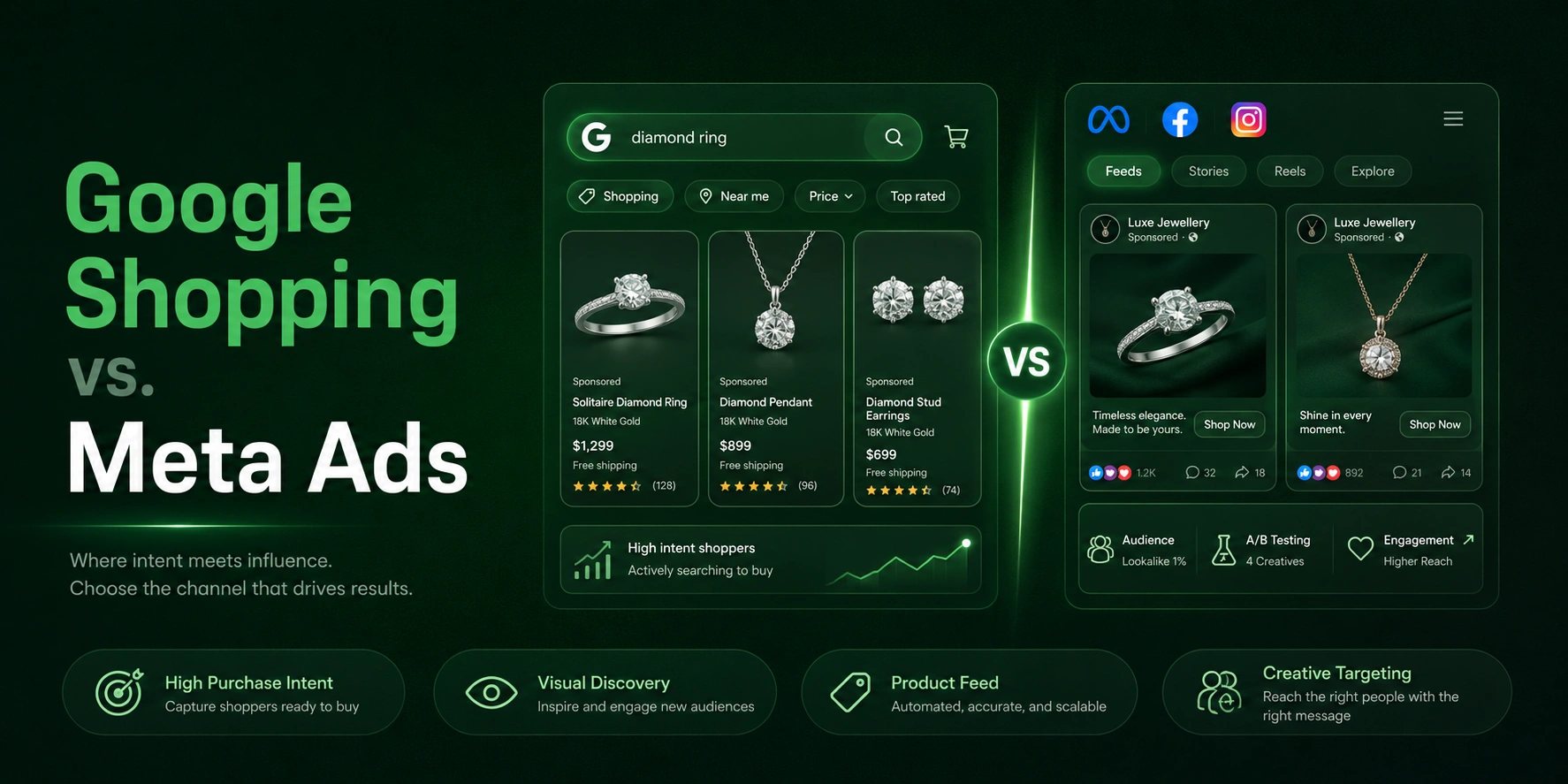
If you run a jewellery brand in India or anywhere else in the world, you have probably had this exact conversation with your team or your media buyer. The Meta Ads dashboard says reach is climbing, the Google Shopping dashboard says ROAS is healthy, and somewhere in the middle, the founder is asking the only question that actually matters: Where should my next rupee go?
The honest answer is not what most agencies tell you. It is not “run both” and it is not “pick the cheaper one.” For a jewellery brand specifically, the right answer depends on three things: how much your customer trusts buying gold or diamonds online, where she is in her decision cycle, and what your average order value (AOV) looks like.
This post cuts through the noise. We have analysed Google, founder forums, agency case studies, Reddit threads from Indian D2C operators, and real platform data from Tanishq, CaratLane, BlueStone, Joyalukkas, Kalyan, and emerging D2C labels.
Here is what actually works, and how to decide which platform deserves the larger share of your budget.
Why this question matters more for jewellery than any other category
Jewellery is not skincare. It is not fashion. It is not a phone case. Selling jewellery online means selling against four invisible walls.
The first wall is trust. The buyer wants hallmarking, BIS certification, IGI or GIA reports, video try-ons, exchange policies, and often a WhatsApp conversation before paying. The second wall is price volatility. With gold rates crossing ₹1 lakh per 10 grams in 2025, even festive buyers are more selective. The third wall is a long decision cycle. Bridal jewellery buyers may research for 6 to 12 months before purchase. The fourth wall is emotional weight. A ring or mangalsutra is not a one-time transaction; it carries memory, occasion, and identity.
Now layer on the market reality. The Indian jewellery market is valued at roughly Rs 5,562 billion, and online jewellery e-commerce is growing at a CAGR of 28%, projected to more than double its share from 2% in 2021 to 4.2% by 2025. BlueStone spent Rs 124 crore on advertising in FY24, while CaratLane spent Rs 225 crore, and Titan (which owns Tanishq, CaratLane, and Mia) raised its ad budget by 14% to Rs 1,308 crore in FY25.
That is a battlefield. So the choice between Google Shopping and Meta Ads is not academic. It decides whether your budget compounds or burns.
How jewellery buyer actually decides
Before comparing platforms, picture the journey. A 28-year-old woman in Pune sees a Reel of a stackable gold ring on Instagram. She saves it. Three days later, the algorithm shows her a similar piece from a different brand. She visits a website, scrolls, leaves. A week later she searches “everyday gold ring under 25000” on Google. Shopping ads appear with images, prices, and ratings. She clicks two, opens WhatsApp on a third, asks about hallmarking, and finally buys.
Notice what just happened. Meta created the desire. Google captured the intent. WhatsApp closed the trust gap.
Most jewellery brands in India lose money because they ignore this sequence and treat one platform as a complete funnel. It is not. Once you understand the sequence, the platform comparison becomes much simpler.
What Google Shopping does best for jewellery brands
Google Shopping is built for the moment a buyer has already decided she wants something specific. She types “rose gold solitaire ring,” “lightweight mangalsutra design,” or “diamond pendant under 30000,” and Google shows product images, prices, brand names, and ratings before she even clicks.
For jewellery, that visual-plus-price preview is gold. Buyers self-qualify. They click only if your price, design, and brand cue match their intent.
Where Google Shopping wins:
- High purchase intent: Indian fine jewellery brands typically see 3 to 6x ROAS on Meta Ads while Google Shopping can deliver 6 to 10x due to higher purchase intent.
- Best-seller velocity: If you have proven SKUs (a hero solitaire, a popular mangalsutra design, a top-selling pendant), Shopping scales them efficiently.
- Branded search defence: Once Meta builds awareness, customers Google your brand. If you are not bidding on your own name, competitors will.
- Local store footfall: “Jewellery shop near me” searches are pure intent. Local Shopping and Google Business Profile combined can drive walk-ins for offline-first brands.
- Comparison-stage capture: Buyers comparing CaratLane vs. BlueStone vs. your D2C label often start on Google. A clean Shopping listing with strong reviews wins.
Where Google Shopping struggles:
- It cannot create demand. If nobody is searching for your category yet, Google has nothing to show.
- Feed quality is the entire game. A weak feed (poor titles, missing GTIN-equivalents, low-resolution images, vague descriptions) silently kills performance.
- CPCs are higher. Google Search CPC in India is ₹20 to ₹50, going up to ₹100 plus in competitive industries, while jewellery falls firmly in the competitive zone.
- Limited storytelling. A 700×700 product image cannot communicate craftsmanship, founder story, or occasion the way a Reel can.
In short, Google Shopping is a closer, not a creator.
What Meta Ads does best for jewellery brands
Meta Ads (Facebook plus Instagram plus Reels plus Audience Network) is the discovery engine. It is where a buyer first sees your brand. It is also where she sees you the seventh time, the fifteenth time, and the thirtieth time before her wedding.
For visual, emotional, occasion-led products like jewellery, this matters enormously.
Where Meta Ads wins:
- Lowest discovery cost in India: Meta’s CPMs are among the lowest globally, with Reels CPMs in the ₹20 to ₹60 range and Facebook feed CPMs around ₹30 to ₹100.
- Visual storytelling: Try-on Reels, craftsmanship close-ups, real customer videos, behind-the-scenes founder content, all of this lives natively on Meta.
- Rich interest and behavioural targeting: You can reach “women 25 to 34 in Tier 2 cities recently engaged” with a precision Google cannot match.
- Retargeting depth: Dynamic Product Ads can show the exact ring a customer viewed last week, then add social proof the following week.
- Click-to-WhatsApp ads: For AOVs above ₹15,000, this single format converts seriously interested buyers into WhatsApp conversations where trust gets built and high-ticket sales close.
- Festive and occasion content: Karva Chauth, Akshaya Tritiya, Dhanteras, Diwali, Valentine’s Day, anniversaries, and weddings are emotional moments. Meta is where those emotions are seen and saved.
Where Meta Ads struggles:
- Lower direct intent: Users are scrolling, not shopping. ROAS attribution looks lower because the influence is upstream.
- Creative fatigue is brutal: Jewellery brands need new creatives every 1 to 2 weeks. The same hero shot stops working faster than founders expect.
- iOS attribution gaps: Without Conversions API (CAPI) properly set up, Meta under-reports conversions by 30 to 60% on iOS users, making real ROAS look worse than it is.
- Trust signals must come from the page, not the ad: Even a perfect Reel falls flat if the landing page does not answer hallmarking, return, and authenticity questions instantly.
In short, Meta is the demand creator, not the demand closer.
Quick comparison: Google Shopping vs. Meta Ads for jewellery brands
| Factor | Google Shopping | Meta Ads |
| Funnel stage | Bottom (intent capture) | Top and middle (demand creation, retargeting) |
| Buyer mindset | “I am ready to buy” | “Show me something interesting” |
| Average ROAS for fine jewellery in India | 6 to 10x | 3 to 6x |
| Cost per click (India) | ₹20 to ₹100 plus | ₹0.50 to ₹80 (varies by category) |
| Best ad format | Shopping listings, Performance Max | Reels, Carousel, DPA, Click-to-WhatsApp |
| Best for | Best-sellers, branded search, near-me intent | Brand storytelling, occasion campaigns, new launches |
| Creative effort | Feed quality and product images | High-volume video and lifestyle content |
| Decision cycle fit | Short (last 0 to 7 days) | Long (45 to 90 days plus) |
| Attribution clarity | Cleaner (last-click) | Harder (multi-touch) |
When to prioritise Google Shopping
Prioritise Google Shopping if any of these describe your jewellery brand right now.
- You already have brand awareness: If your founder has been on podcasts, your Reels are saved often, or your branded searches are growing month over month, Google Shopping captures that demand at the cheapest acquisition cost in your stack.
- You sell well-categorised products: Solitaires, mangalsutras, daily wear gold chains, lab-grown diamond rings, nose pins, anklets, and similar pieces have clear search volumes. Buyers know what they want.
- Your AOV sits between ₹3,000 and ₹50,000: Below that, margins get squeezed by CPCs. Above that, Google alone rarely closes; you need WhatsApp and longer nurture.
- You operate physical stores: Local Shopping and “near me” searches are pure intent and cannot be replicated on Meta. Brands like Tanishq and Kalyan thrive partly because Google search captures hyperlocal demand.
- You have a strong product feed: Clean titles built on a structure like Brand plus Gender plus Metal plus Product plus Stone plus Feature (“Aesha Fine Jewellery Women’s 18K Yellow Gold Solitaire Ring 0.5ct Round Diamond”). High-resolution white-background images. Accurate pricing. Real reviews.
If three or more of these are true, Google Shopping should take 50 to 60% of your paid budget.
When to prioritise Meta Ads
Prioritise Meta Ads if your reality looks more like this.
- You are a new or emerging D2C jewellery brand. Nobody is searching for your name yet. Without Meta creating demand, Google has nothing to capture. Spending 70% of a launch budget on Google Shopping is one of the most common and expensive mistakes founders make.
- Your designs are visual, distinctive, or trend-led. Stackables, mismatched earrings, lab-grown sets, fusion bridal pieces, contemporary minimal collections. The customer does not always know what to search for, but she knows it when she sees it.
- Your AOV is above ₹15,000 and you use WhatsApp. Click-to-WhatsApp ads on Meta, paired with a trained sales person who can answer questions about hallmarking, customisation, and delivery, often beats every other format for high-AOV conversions.
- You are selling for a specific occasion or audience. Bridal, Karva Chauth gifting, anniversary collections, “for self” everyday pieces. Meta’s interest plus behaviour targeting fits these segments far better than keywords.
- You have a strong creative pipeline. Try-on Reels, real Indian skin imagery, customer UGC, founder content, craftsmanship close-ups. If you can produce 8 to 12 high-quality creatives a month, Meta rewards you.
If three or more of these are true, Meta Ads should take 50 to 60% of your paid budget.
The honest verdict: layering beats picking
After analysing dozens of Indian jewellery brand campaigns, founder discussions on Reddit and IndieHackers, and agency case studies, one pattern is unmistakable.
Brands that pick one platform plateau. Brands that layer the two compound.
A practical layering model that works for most Indian jewellery D2C brands at the ₹3 lakh to ₹30 lakh per month spend level looks like this.
- Meta: 50 to 60% of budget. Reels-led prospecting, broad lookalikes, dynamic product ads for retargeting, Click-to-WhatsApp for high AOV.
- Google: 30 to 40% of budget. Shopping or Performance Max for catalogue, branded Search to defend, generic high-intent Search for category terms, Local campaigns for showrooms.
- Emerging channels: 10 to 15%. YouTube Shorts, Pinterest for bridal discovery, WhatsApp Broadcasts and creator collaborations.
The synergy is real. Meta-driven brand awareness reduces branded search CPC and increases conversion rate, and Google captures the intent Meta creates, with running both typically delivering 20 to 30% better blended MER than either alone.
That is not a guess. That is what consistently shows up in the numbers.
Common mistakes jewellery brands make
A short list of patterns that leak budget every single month.
Running ads before fixing trust signals on the product page: Hallmarking, BIS certification, IGI or GIA report links, exchange policy, return window, EMI options, and at least 5 real customer photos are non-negotiable before scaling spend. Even great ads fail without these.
Using white background product shots only: Real Indian skin tones, try-on videos, and lifestyle imagery convert dramatically better. White background shots belong in the catalogue and Shopping feed, not the social creative library.
Ignoring the long decision cycle: Most jewellery brands set retargeting windows at 30 days. Bridal buyers research for 6 to 12 months. Configure retargeting for 60 to 180 days, with creative that shifts from “remind” (days 1 to 7) to “educate” (days 8 to 21) to “convert” (days 22 to 45) to “reactivate” (days 46 plus).
Over-relying on last-click attribution: Meta will look weak. Google will look strong. The reality is that Meta is feeding the conversions Google is closing. Use a blended ROAS or marketing efficiency ratio (MER) instead of platform-by-platform ROAS.
Treating festive periods as “just discount campaigns”: Akshaya Tritiya, Dhanteras, and Diwali are not sales. They are emotional and cultural moments. Brands that combine cultural storytelling with offers (gold rate protection, exchange schemes, lightweight pieces, bigger entry points) outperform brands that just slap “20% off” on a banner. Joyalukkas reported its best-ever Akshaya Tritiya in 2025 with 43% YoY turnover growth and 36% same-store sales, while PNG Jewellers recorded single-day sales of Rs 139.5 crore, a 35% jump over the previous year.
Forgetting WhatsApp: For AOVs above ₹15,000, WhatsApp is not a side channel. It is the closing room.
A festive playbook for jewellery brands
A simplified 12-week festive ramp that works for most D2C jewellery brands during the wedding and festival season.
Weeks 12 to 9 before event: Build creatives, line up influencer collaborations, refresh feed, audit landing pages, set up CAPI, build retargeting audiences.
Weeks 8 to 5 before event: Heavy Meta prospecting on Reels and carousels with broad audiences. Goal: feed the retargeting pool. Light Google Shopping for evergreen best-sellers.
Weeks 4 to 2 before event: Increase Meta retargeting. Launch occasion-specific creatives. Ramp Google Shopping for high-intent terms. Add countdown banners.
Final week: Double down on Click-to-WhatsApp, branded Search defence, retargeting with offer urgency, local Search for store visits.
Day of event: Maximise Search and Shopping budget for “buy gold today,” “Akshaya Tritiya offers,” “Diwali jewellery near me.” Limit prospecting; everyone is now in close mode.
Week after: Reactivation campaigns for non-converters, new collection drops for next occasion, creator-led UGC repurposing.
How Kyros Solution helps jewellery brands grow profitably
Most agencies in India treat jewellery like generic ecommerce. That is the core reason most jewellery campaigns underperform. Jewellery is a trust-first, occasion-led, long-cycle category, and it needs an agency that has seen the patterns specific to it.
Kyros Solution is a digital marketing partner built specifically to grow D2C and premium jewellery brands. The work spans the full stack a jewellery founder actually needs.
- Brand strategy and identity for D2C jewellery labels at launch and growth stages, including logo systems, typography, packaging design, and brand guidelines that stay consistent across website, social, and physical touchpoints.
- Performance marketing across Google Ads (Search, Shopping, Performance Max, Local) and Meta Ads (Reels, Advantage Plus Shopping, Dynamic Product Ads, Click-to-WhatsApp), tuned for Indian jewellery buying behaviour.
- SEO for category, occasion, and bridal keywords with content that drives organic discovery long after paid spend ends.
- Social media management with platform-specific content strategies for Instagram, Pinterest, Facebook, and WhatsApp.
- Influencer marketing with structured micro-creator collaborations, tracking, and creator-specific codes.
- E-commerce build and CRO so your product pages convert the traffic the ads send.
- 3D product renders for premium catalogue and ad creatives.
- Content marketing that builds trust around hallmarking, certification, craftsmanship, and care.
The internal philosophy is simple: every rupee should compound, not just spend. Brands working with Kyros have seen 200% plus ROI on tailored SEO, influencer partnerships, and ecommerce work, with one handcrafted jewellery brand growing online orders by 150% in six months through Google Ads and Instagram strategy.
If you are deciding between Google Shopping and Meta Ads for your jewellery brand, the smarter conversation is not about platforms. It is about building a system where both feed each other. That is what Kyros Solution builds for jewellery founders who are tired of guessing and ready to scale.
Book a free strategy session for your jewellery brand.
Final word
The question “Google Shopping or Meta Ads” is the wrong question for a jewellery brand. The right question is: where is my customer in her journey, and which platform meets her in that moment?
Meta meets her when she is scrolling, dreaming, and deciding she wants something. Google meets her when she is searching, comparing, and deciding what to buy. WhatsApp meets her when she needs reassurance before paying. Your job is not to pick one. Your job is to build a system where each plays its role.
If you want a partner that has built that system specifically for Indian jewellery brands, Kyros Solution is one of the few teams in India focused entirely on this category. Strategy, ads, SEO, content, influencer, and CRO under one roof, tuned to how Indian buyers actually decide.
Your next sale is not waiting on a bigger budget. It is waiting on a smarter mix.
FAQs
Which is better for a new jewellery brand: Google Shopping or Meta Ads?
Meta Ads. New brands have no search demand yet. Spend 60 to 70% on Meta to build awareness and a retargeting pool, and reserve a small slice for branded Search to defend your name. Once branded searches start growing, gradually shift more to Google Shopping.
What ROAS should an Indian jewellery brand expect?
Fine jewellery sees 3 to 6x ROAS on Meta and 6 to 10x on Google Shopping in well-managed accounts. Lab-grown diamond and lightweight categories sit at the higher end; bridal sits at the lower end because of the long decision cycle.
How much should you budget to start?
Realistically, ₹1.5 to ₹3 lakh per month minimum for meaningful data across both platforms. Lower budgets force compromises that hurt learning.
Is Performance Max worth it for jewellery brands?
Yes, but only after Standard Shopping is already converting and you have strong creative assets (videos plus lifestyle photos). Use Performance Max to scale, not to learn.
Should you run Click-to-WhatsApp ads?
For AOVs above ₹15,000, yes. WhatsApp is where high-ticket trust gets built before checkout. Pair it with a sales person trained on hallmarking, customisation, and delivery questions.
How often should you refresh creatives?
Every 1 to 2 weeks for Meta, every 4 to 6 weeks for Google Shopping feed updates. Creative fatigue is the single biggest reason jewellery accounts decline.
Do you need both platforms, or can you pick one?
You can pick one to start, but at scale, layering wins. The smartest brands use Meta to create demand and Google to capture it. Together they typically deliver 20 to 30% better blended efficiency than either alone.