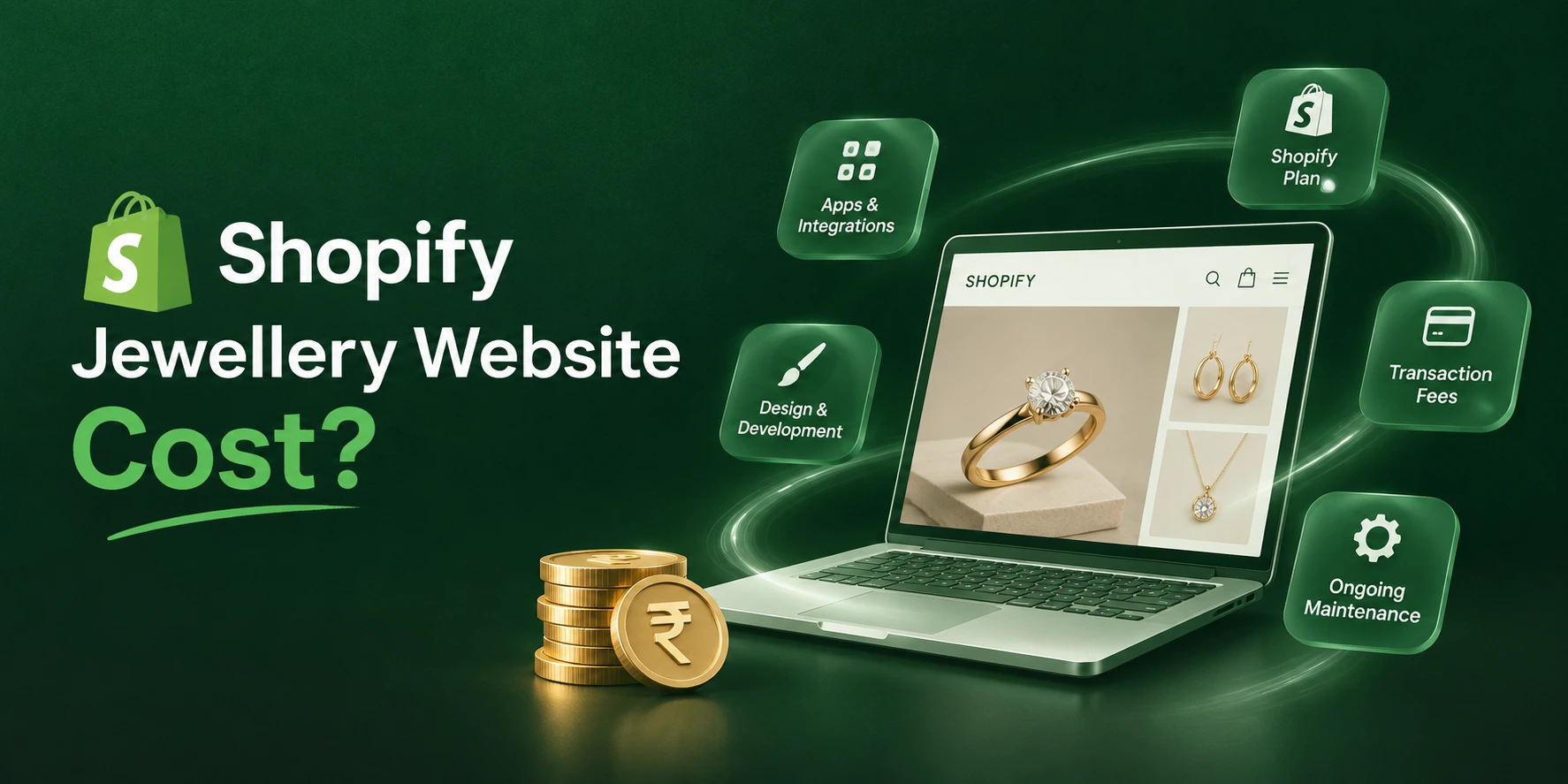
Ask five agencies what a Shopify jewellery website costs and you will hear five numbers, anywhere from ₹30,000 to ₹15 lakh. Most of them are quoting the same thing: the build. For a jewellery brand, the build is usually the smallest part of the bill.
This guide prices the whole thing as it stands in 2026: what you pay to build, what you pay every month, and the fees that grow with every order. It is written for Indian jewellery founders, family jewellers taking their stores online, and marketing heads who need a budget they can defend in a review meeting.
The short answer (India, 2026, before 18% GST):
- Build: about ₹50,000 to ₹1.5 lakh for a fixed-price launch store, ₹1.5 lakh to ₹4 lakh for a branded fine jewellery store, and ₹5 lakh to ₹12 lakh or more for a store priced from the daily gold rate and connected to your showrooms.
- Shopify plan: ₹1,499, ₹5,599 or ₹22,680 a month on yearly billing for Basic, Grow and Advanced. Shopify Plus starts at about ₹1,75,000 a month.
- Apps and upkeep: roughly ₹8,000 to ₹85,000 a month, depending on how much changes on the site each month.
- Fees on every prepaid order: Shopify Payments is not available in India, so Shopify adds 2%, 1% or 0.6% (by plan) on top of your payment gateway’s fee, which is usually around 2%.
- Over three years, the build came to about 15% of the total in all three of our worked examples below. The plan you choose and the fees on each order matter more than the design quote.
Key takeaways
- Price your website by your average order value and how your prices are calculated, not by the number of pages.
- On Shopify Basic, one ₹80,000 prepaid order pays Shopify ₹1,600 in transaction fees, which is more than the ₹1,499 monthly plan.
- A fine jewellery brand selling ₹25,000 pieces usually saves money on Grow once it passes about 16 prepaid orders a month. A gold jeweller selling ₹80,000 pieces gets there at about 5.
- Gold-rate pricing, HUID details, certificates and lab-grown labelling are product data jobs. Cheap to plan at the start, expensive to retrofit.
- UPI allows jewellery payments of up to ₹2 lakh per transaction. Above that, your checkout needs cards, net banking or EMI to work smoothly.
- Most apps bill in US dollars, so their rupee cost rises when the rupee weakens.
- Budget for at least one forced platform change a year. In 2026, there were two that touched checkout and tracking.
Why Most Shopify Cost Guides Underprice a Jewellery Website
Most cost guides for this question price a jewellery store the way they would price a clothing store: theme, number of pages, number of products, a few apps. Many quote US dollar tiers. Very few mention gold-rate pricing, hallmarking, UPI ceilings or what Shopify charges Indian stores on each order.
That matters because jewellery breaks three assumptions those guides rely on.
Your fees grow with your ticket size: Shopify’s extra fee and your gateway’s fee are both percentages. A ₹2,500 silver jhumka and a ₹2.5 lakh bridal necklace go through the same checkout, but the second pays a hundred times more in fees.
Your prices may change every day: If a piece is priced from its gold weight, your website, your product feed and your price display all have to keep up with the rate. That is a system, not a theme setting.
Your product pages carry proof, not just pictures: Karat, net weight, stone details, hallmark and certificate numbers, price breakups and exchange terms all need a structured place in your product data. Retrofitting them later means re-entering data across the whole catalogue.
There is also a lot of sameness at the low end. StoreCensus counted about 3,250 Indian jewellery and accessories stores on Shopify in April 2026, and roughly a third of them ran Dawn, Shopify’s long-standing free theme. A free theme is a fine way to start. It is rarely a way to stand out.
Part 1: What You Pay to Build
The six scope decisions that move a jewellery quote
Two jewellery websites can look identical on a phone and differ by ₹5 lakh in build cost. The difference sits in six decisions. Settle them before you ask anyone for a quote.
| Decision | Simple version | Advanced version | What the advanced version adds to the build |
|---|---|---|---|
| How prices are set | Fixed prices you edit by hand | Prices recalculated from the daily gold rate, weight, making charges and stones | A pricing app or ERP integration, metafields for every product, a price breakup block, feed sync |
| How each design can be bought | One or two options, such as size | Size, karat, metal colour, plus stone quality | Variant planning, image rules per variant, possibly an app for a fourth option |
| How you prove purity | A line saying “BIS hallmarked” | Hallmark, HUID, certificate numbers and lab-grown labels in structured fields | Metafields, templates, invoice changes, piece-level stock for one-of-ones |
| How customers pay | UPI, cards and cash on delivery | Payment paths above the UPI limit, EMI, advance payments for made-to-order pieces | Checkout settings, apps for deposits, rules for cash on delivery |
| Whether the site works with your shops | Online only | Store pickup, appointments, video consultations, stock across showrooms | Inventory locations, booking tools, POS or ERP sync |
| How you show the piece | Product photos | Photos, video, 3D renders and virtual try-on | Media production, try-on setup, image performance work |
1. How your prices are set
Fixed pricing suits silver, fashion, demi-fine and many lab-grown collections. You set a price, and you change it when you choose to.
Gold-led catalogues are different. Each product needs its net weight, purity, making charge method (per gram, a percentage or flat), any wastage, stone values and GST stored as data, so the price can be recalculated when the rate moves. Founders ask in the Shopify Community how to automate exactly this.
The good news is that Shopify now has a crowded field of apps for it. Listings in 2026 include GoldSync from $9 a month, Live Gold Price Editor from $15.99, AutoPrice Pro at $20 and JewelPrice AI at $24 for its growth plan, and some, such as MetalIQ, offer free plans. Several show shoppers a price breakdown on the product page.
The app is the cheap part. The build cost sits in three places: entering clean weight and stone data for every variant, designing a price breakdown that buyers trust, and keeping your Google Merchant Centre feed in step with the site so ads never show yesterday’s price. If you already run a jewellery ERP that holds weights and rates, connecting Shopify to it is a development project in its own right.
2. How each design can be bought
A single ring can come in 12 sizes, three karats and three metal colours. That is 108 variants of one design.
Shopify raised the limit to 2,048 variants per product on every plan. Two limits still bite jewellery catalogues: a product can have only three option types, and it can hold only 250 images and videos in total. Add a fourth choice, such as diamond quality, and you need either Shopify’s combined listings, which are native only on higher plans, or an app or custom work.
Each variant also becomes its own row in your Google Shopping feed. Plan variants for the buyer and the feed together, not just for the product page.
One practical warning: in jewellery builds, collecting product data (net and gross weight, stone counts and carats, certificate numbers, size guides) often takes as long as the design work. Start it on day one.
3. How you prove purity and authenticity
Mandatory gold hallmarking now covers 398 districts after an amendment notified in 2026. Each hallmarked piece carries a six-digit alphanumeric HUID that buyers can check in the BIS CARE app.
Because a HUID belongs to one physical piece, it shapes your build. If you hold ten units of a design, you have ten HUIDs. Most stores therefore show hallmark and purity details on the product page and print the specific HUID on the invoice. One-of-one pieces can show it on the page. Decide which model you follow before the build, because piece-level stock tracking is a different setup from design-level stock.
Two more compliance points belong in your data model:
- Lab-grown labelling: Under BIS standard IS 19469:2025, the word “diamond” on its own now refers only to natural diamonds, so lab-grown stones should be labelled “laboratory-grown diamond” in titles, filters, feeds and ads.
- Silver: HUID has been mandatory on hallmarked silver since September 2025, and BIS has been assessing whether to make silver hallmarking itself mandatory. Silver brands should add a HUID field now, so a rule change does not mean a rebuild.
Add certificate numbers and lab names for diamonds and gemstones, and write exchange, buyback and return terms in plain numbers. None of this is expensive if it is planned as metafields and templates from the start.
4. How customers pay for high-value pieces
UPI is India’s default payment method, but jewellery has its own ceiling: ₹2 lakh per transaction and ₹6 lakh per day since September 2025.
That ceiling arrives sooner than many founders expect. With 22K gold at about ₹1,30,456 per 10 grams on 9 November 2026, the metal alone in a 20 gram chain is worth about ₹2.6 lakh, before making charges and GST. That buyer cannot pay by UPI in one go. Your checkout, and ideally the product page, should make cards, net banking and EMI options obvious for pieces above ₹2 lakh.
Cash on delivery needs rules too. It is exempt from Shopify’s third-party fee because no gateway processes it, but COD orders fail far more often than prepaid ones, commonly 25% to 30% against 2% to 3%. For fine jewellery, set a COD limit by order value, or switch it off for high-value pieces.
If you sell made-to-order pieces, taking an advance and collecting the balance before dispatch usually needs an app or custom flow. India-focused one-click checkouts such as GoKwik and Shopflo can help with COD risk and address quality, but most price by quote or per order, so treat them as another layer of fees.
5. Whether the website has to work with your showrooms
Family jewellers and omnichannel brands usually need the website to send buyers to stores as much as to checkout. That can mean store pickup, appointment booking, video consultations for bridal pieces and stock shown across showrooms. Shopify’s Basic, Grow and Advanced plans each allow up to 10 inventory locations, while Plus allows 200.
The expensive part is not the booking button. It is keeping stock, weights and prices consistent between your POS or jewellery ERP and Shopify. If your showroom software cannot export clean data, budget for that integration first. A strong Google Business Profile matters as much as the website for store-led brands; our guide to jewellery store visibility on Google Maps covers it.
6. How you show the piece
Media is often quoted separately, but it decides whether the site sells:
- Photography: Jewellery needs macro lighting and retouching. Indian studios commonly quote ₹300 to ₹800 per product for jewellery, more for model and lifestyle shoots.
- 3D renders: Surat CAD studios advertise basic jewellery renders from about $10 a design, while photoreal hero renders and animation cost far more. Our comparison of 3D jewellery renders and photography explains when each makes sense.
- Virtual try-on: mirrAR lists a free plan with 20 credits and a $15 monthly plan with 200 credits, plus a charge for end-to-end setup. Camweara’s Shopify listing starts at $90 a month, which covers 300 products, and its Growth plan is listed at $200 a month for 3,000 products.
Whatever you shoot, load product images as standard image elements with descriptive file names and alt text, so Google Images and Lens can find them. Our guide to Search Console’s multimodal report shows how to check this, and our jewellery photoshoot ideas by funnel stage helps you plan the shot list.
Build cost by type of jewellery business
Here is how those decisions usually add up. The ranges are indicative, based on published 2026 Indian agency rate cards (DEV Community, buildbyRaviRai) and the app price lists above. They exclude GST, product media and marketing.
| Business type | Typical catalogue | Scope that usually matters | Typical timeline | Build (one-time) | Running cost per month, before transaction fees |
|---|---|---|---|---|---|
| Silver, fashion or demi-fine D2C label | 50 to 500 fixed-price products | Free or premium theme, reviews, COD rules, WhatsApp, fast mobile pages | 3 to 6 weeks | ₹50,000 to ₹1.5 lakh | ₹10,000 to ₹25,000 |
| Fine jewellery or lab-grown D2C brand | 100 to 1,000 products with many variants | Custom design, certificates, price breakup, try-on, EMI, structured product data | 6 to 12 weeks | ₹1.5 lakh to ₹4 lakh | ₹30,000 to ₹50,000 |
| Gold-led omnichannel jeweller | 500 to 5,000 products priced by weight | Daily rate pricing, ERP or POS sync, store pickup, appointments, HUID handling | 12 to 18 weeks | ₹5 lakh to ₹12 lakh or more | ₹65,000 to ₹1.1 lakh |
Timelines reflect published ranges of 2 to 4 weeks for basic stores, 6 to 12 weeks for custom builds and 12 to 18 weeks for high-complexity Shopify projects. Jewellery projects tend to sit at the slower end because of product data.
Themes: Shopify’s Theme Store offers free themes, including the Horizon family of 10 launched in 2025, and paid themes from $100 to $500 as a one-time purchase. A well-chosen premium theme with custom sections is usually better value than a theme coded from scratch, unless your brand needs layouts no theme can handle.
Freelancer or agency: Offshore Shopify freelancers in India commonly charge $15 to $40 an hour, and general web development rates in India run under $25 an hour on Clutch’s regional data. A good freelancer is ideal for a defined task. For a build that spans pricing logic, compliance data, design and tracking, you are paying for coordination as much as code.
What about Shopify Plus? Plus starts at about ₹1,75,000 a month with a 0.2% fee on third-party gateway orders. On fees alone, moving from Advanced to Plus only pays for itself at around ₹3.8 crore of prepaid sales a month. Choose Plus for what it lets you build, such as deeper checkout customisation and scale, not to save on fees.
Part 2: What You Pay Every Month
Shopify plan prices in India
Shopify bills Indian stores in rupees and adds 18% GST to plans, transaction fees and app charges. If you have a GSTIN, you can claim that GST as input tax credit.
| Plan | Per month, billed yearly | Per month, billed monthly | Shopify fee on gateway orders | Jewellery fit |
|---|---|---|---|---|
| Starter | ₹399 | ₹399 | 5% | Built for selling through social links, not a full store |
| Basic | ₹1,499 | ₹1,994 | 2% | New stores with low prepaid sales |
| Grow | ₹5,599 | ₹7,447 | 1% | Most growing D2C jewellery brands |
| Advanced | ₹22,680 | ₹30,164 | 0.6% | High-ticket or high-volume stores |
| Plus | From ₹1,75,000 | Contract | 0.2% | Large brands with complex needs |
Prices from PayGlocal’s July 2026 breakdown. Shopify also runs introductory offers, such as ₹20 a month for the first three months on select plans. Check the live pricing page before you commit.
What every prepaid order really costs
Shopify Payments is not available in India, so every Indian store uses a third-party gateway and pays Shopify’s extra fee on prepaid orders. Razorpay’s standard rate is 2% plus GST on most domestic methods, with no setup or annual fee, and 3% for cards such as Amex and Diners.
Here is what one prepaid order costs in Shopify and gateway fees together, before 18% GST on those fees.
| Order value | On Basic | On Grow | On Advanced | Possible UPI MDR, if paid by UPI |
|---|---|---|---|---|
| ₹2,500 | ₹100 | ₹75 | ₹65 | ₹10 |
| ₹25,000 | ₹1,000 | ₹750 | ₹650 | ₹100 |
| ₹80,000 | ₹3,200 | ₹2,400 | ₹2,080 | ₹300 |
| ₹1,80,000 | ₹7,200 | ₹5,400 | ₹4,680 | ₹300 |
| ₹3,00,000 (above the UPI limit) | ₹12,000 | ₹9,000 | ₹7,800 | Not applicable |
Assumes a 2% gateway fee. Premium cards, international cards and EMI usually cost more.
The new UPI fee: Since 15 October 2026, UPI merchant payments above ₹2,000 carry a merchant discount rate of 0.4%, capped at ₹300 per transaction. The cap is reached at ₹75,000, and merchants may not pass the charge on to customers. Cashfree describes MDR as separate from a gateway’s own platform fee, so ask your gateway in writing whether it is included in your rate or added on top. Almost every jewellery order is above ₹2,000, so this matters to you more than to most stores.
A short-term saving: Razorpay is offering new merchants activated on or after 1 July 2026 a 0% platform fee on eligible domestic payments for 90 days or ₹5 lakh of sales, whichever comes first. Shopify’s own fee still applies.
The plan decision most jewellery stores get wrong
Generic advice says stay on Basic until you are big. For jewellery, “big” arrives after a handful of orders, because the saving comes from a percentage of a large ticket.
The arithmetic is simple. Moving from Basic to Grow costs ₹4,100 more a month on yearly billing and cuts Shopify’s fee by one percentage point. Moving from Grow to Advanced costs ₹17,081 more and cuts it by 0.4 points.
| Prepaid sales per month at which the higher plan becomes cheaper | Basic to Grow | Grow to Advanced |
|---|---|---|
| Yearly billing | about ₹4.1 lakh | about ₹42.7 lakh |
| Monthly billing | about ₹5.45 lakh | about ₹56.8 lakh |
| Orders a month at ₹2,500 (yearly billing) | about 164 | about 1,708 |
| Orders a month at ₹25,000 (yearly billing) | about 16 | about 171 |
| Orders a month at ₹80,000 (yearly billing) | about 5 | about 53 |
Three things to note:
- Only prepaid orders count: Cash on delivery orders do not attract Shopify’s fee, so a COD-heavy silver brand reaches these thresholds later.
- GST does not move the break-even: It applies at 18% to both the plan and the fee.
- Plan features matter too: Grow adds more staff accounts and reports, and Advanced adds deeper reporting. But for most jewellery brands, the fee arithmetic decides it.
Apps: the costs billed in dollars
Most Shopify apps bill in US dollars, with 18% GST on top. The rupee traded around 93.7 to the dollar on 9 November 2026 and was down 4.3% for the calendar year a few days earlier. A $24 app is roughly ₹2,250 a month before GST, and that figure moves with the currency.
| App category | Typical price, 2026 | When a jewellery store needs it |
|---|---|---|
| Gold and metal rate pricing | Free plans up to about $24 a month | Any catalogue priced by weight |
| Virtual try-on | Free tiers, then about $15 to $200 a month, plus setup | Earrings, necklaces and rings with steady traffic |
| Reviews, search, email, popups | A typical growth-stage stack runs ₹2,000 to ₹8,000 a month in total | Almost every store |
| GST invoicing | ₹0 to ₹2,000 a month | Stores that need GST-ready invoices from Shopify |
| WhatsApp messaging | Meta charges per message: ₹0.8631 for marketing and about ₹0.115 for utility messages in India, plus your provider’s fee | Order updates, gold rate alerts, abandoned carts |
App stack figures for reviews, email and GST come from the same 2026 rate card cited above. Two habits keep app costs honest: remove apps that duplicate what your theme already does, and check what each app loads on mobile, because every script slows the page.
Maintenance and the platform changes you cannot skip
A jewellery website changes constantly: new collections, festive banners, price updates, ring size guides, bug fixes after app updates. Published 2026 retainers in India run about ₹4,000 to ₹8,000 a month for light maintenance and ₹15,000 to ₹30,000 for active maintenance with regular collection drops. Stores that reprice gold daily or launch around every festival should expect the upper end.
Shopify also changes underneath you. In 2026 alone, Shopify Scripts stopped running on 30 June, and on 26 August Shopify automatically upgraded the Thank you and Order status pages of every non-Plus store that had not already moved, which ended the old Additional Scripts box. Any purchase tracking or checkout tweak that lived there had to be rebuilt. Plan for at least one change like this each year.
There is a positive change too. Since 24 March 2026, Shopify has switched on Agentic Storefronts by default for eligible stores, making products discoverable in AI assistants such as ChatGPT, Microsoft Copilot and Google’s AI Mode. Eligibility varies, so check your admin. What these channels read is the same thing a careful buyer reads: complete product data on metal, karat, weight, stones and certificates. Google itself says you do not need special AI files or markup to appear in its AI features. Good product data and helpful pages are the work. Our guide to how ChatGPT, Gemini, Claude and Perplexity recommend jewellery brands goes further.
Other running costs people forget
- Domain: about ₹800 to ₹1,500 a year.
- Shipping insurance: standard courier liability rarely covers jewellery. Domestic insurance premiums typically run 1% to 2% of declared value, and some parcel protection products start around 0.75%. Specialist valuables carriers price separately.
- Returns and failed deliveries: jewellery returns in India commonly run 10% to 18%. Your website’s size guides, scale photos and clear policies directly reduce this cost.
A note on GST for jewellers
Shopify’s plans, fees and apps, your gateway’s fees and your agency’s invoices all carry 18% GST. Your jewellery sales carry 3%. If you are GST-registered, you can claim the 18% as input tax credit, but jewellers with heavy service spending can build up credit they cannot fully use against a 3% output tax.
Today, refunds for this kind of build-up generally cover goods, not services. The 57th GST Council has proposed extending refunds to input services for credit taken on or after 1 November 2026, paid out over 60 months, but the change depends on notifications that had not been reported when that analysis was published. We are not tax advisers. Ask your CA how much of your website GST you can actually use before treating it as fully recoverable.
Part 3: The Three-Year Cost, Worked Out
The examples below are illustrative, built in 2026 prices and plausible assumptions. They are not client results. They exclude GST, product media, advertising and stock, and they use Razorpay’s standard 2% rate for gateway fees.
The three businesses
| A: Silver and demi-fine label | B: Fine and lab-grown brand | C: Gold-led omnichannel jeweller | |
|---|---|---|---|
| Average order value | ₹2,500 | ₹30,000 | ₹90,000 |
| Orders a month | 300 | 40 | 60 |
| Share paid online | 60% | 90% | 95% |
| Prepaid sales a month | ₹4.5 lakh | ₹10.8 lakh | ₹51.3 lakh |
| Best plan on the fee maths | Grow | Grow | Advanced |
What each website costs over 36 months
| Cost line | A | B | C |
|---|---|---|---|
| Build, one-time | ₹1,50,000 | ₹3,00,000 | ₹7,00,000 |
| Shopify plan, yearly billing | ₹2,01,564 | ₹2,01,564 | ₹8,16,480 |
| Apps (₹5,000, ₹9,000 and ₹15,000 a month) | ₹1,80,000 | ₹3,24,000 | ₹5,40,000 |
| Maintenance (₹8,000, ₹20,000 and ₹40,000 a month) | ₹2,88,000 | ₹7,20,000 | ₹14,40,000 |
| Shopify transaction fees | ₹1,62,000 | ₹3,88,800 | ₹11,08,080 |
| Total cost tied to the website | ₹9,81,564 | ₹19,34,364 | ₹46,04,560 |
| Build as a share of the total | 15.3% | 15.5% | 15.2% |
| Gateway fees, which you would pay on any platform | ₹3,24,000 | ₹7,77,600 | ₹36,93,600 |
What the numbers say
The build is about one rupee in seven. Across three very different businesses, the one-time build came to roughly 15% of the three-year total. Negotiating hard on the design quote while ignoring the plan, apps and retainer saves the wrong money.
The wrong plan costs more than a redesign. On plan fees plus Shopify’s transaction fees over three years:
- Business A pays ₹3,77,964 on Basic against ₹3,63,564 on Grow. The gap is only ₹14,400, so A can start on Basic and switch once prepaid sales pass about ₹4.1 lakh a month.
- Business B pays ₹8,31,564 on Basic against ₹5,90,364 on Grow. Staying on Basic costs ₹2,41,200.
- Business C pays ₹37,47,564 on Basic, ₹20,48,364 on Grow and ₹19,24,560 on Advanced. Staying on Basic would cost ₹18,23,004 more than Advanced, more than twice the price of its entire build.
For high-ticket stores, Shopify’s fee outgrows the build. Business C pays more in Shopify transaction fees over three years (₹11.08 lakh) than it paid to build the site (₹7 lakh).
For smaller brands, maintenance is the biggest line. For A and B, the monthly retainer is the highest single cost. What you are really buying is a team that keeps the store fast, accurate and current. Choose that team as carefully as you choose the designer.
Where to Spend and Where to Save
Spend on these, because they compound:
- Product data and the price breakdown. They feed your product pages, Google Shopping, AI shopping channels and the trust a buyer needs before paying ₹50,000 online.
- Mobile speed and image quality. Buyers usually judge a piece on a phone screen first, and image-heavy pages are slow by default.
- Payment paths for high tickets. Make cards, net banking and EMI easy for pieces above the UPI limit.
- Measurement. After the August 2026 changes, purchase tracking on Shopify runs through customer events and web pixels. Getting it right protects your ad spend; our guide to fixing your jewellery ad budget before you raise it shows what is at stake.
Save on these, at least at first:
- A theme coded from scratch. Start from a strong premium theme and customise sections, unless your brand truly needs something no theme can do.
- Virtual try-on before you have the assets. Pilot it on a free or low tier with your top categories first.
- Shopify Plus for fee savings. The fee maths alone rarely justifies it.
- Overlapping apps. Many premium themes already include mega menus, swatches and size charts.
- “AI SEO” add-ons. Paying for llms.txt files or special AI markup is not needed for Google’s AI features. Spend that budget on content and product data instead.
Questions to Ask Before You Sign a Shopify Jewellery Quote
Use these in every agency or freelancer conversation. Vague answers are your red flags.
- Which Shopify plan do you recommend at our order value, and can you show the arithmetic?
- How will prices update when the gold rate moves, and how will our Merchant Centre feed stay in step?
- Which product details will be stored as structured fields: karat, net weight, stones, certificates, hallmark and HUID?
- How will you handle designs with more than three options, such as size, karat, colour and stone quality?
- What will the checkout offer for orders above ₹2 lakh, and what are your rules for cash on delivery?
- Which apps will we need, at what monthly cost in dollars, and do any duplicate the theme?
- Who owns the store, theme code and app accounts? The Shopify account and every app should be in your business’s name, with the agency added as a collaborator.
- What does maintenance include, and how fast do you respond during Dhanteras and wedding season?
- What mobile speed targets will you commit to, and how will you measure them after launch?
- If we are moving from another platform, how will you handle URL redirects and SEO?
If you are still choosing a platform, read our guide to choosing a platform for your jewellery website first.
When Shopify, or an Agency, Is Not the Right Answer
Be honest about these cases before you spend:
- You have fewer than about 30 fixed-price products and a tight budget. Start on a free Shopify theme, set it up yourself, and pay a freelancer for small fixes.
- Most of your sales are bridal pieces above ₹2 lakh, closed in the showroom. A well-built catalogue with appointment booking and WhatsApp may earn more than a full online checkout. Measure bookings, not online orders.
- You need deep ERP integration and custom pricing logic across thousands of weight-priced products. Get a platform assessment before you commit. Headless or custom builds can be right at that scale, and they cost far more.
- You cannot commit someone to product data. Without clean weights, stone details and certificate numbers, no developer can build the site this guide describes. Fix the data first.
How Kyros Solution Builds Shopify Jewellery Websites
Kyros Solution is a digital marketing and creative agency headquartered in Surat that has specialised in D2C jewellery and lifestyle brands since 2019. You can see more in our portfolio.
What working with us looks like:
- A cost model before a quote. We start from your order values, prepaid share and catalogue, and show you which plan, apps and payment setup fit before any design work is priced.
- A jewellery data model. Our Shopify web development team sets up structured fields for karat, weight, stones, certificates and hallmark details, price breakup blocks, gold-rate pricing where you need it, and feed sync.
- Design that earns trust on a phone. Our UI and UX design team designs product pages around the questions jewellery buyers ask before they pay.
- Visibility after launch. Our SEO and GEO services build collection and product content that can rank in Google and be cited in AI answers, and our performance marketing team connects your catalogue to Google and Meta.
When we are not the right fit:
- You want the lowest possible build price and no ongoing support. A freelancer and a premium theme will serve you better.
- Your product data does not exist yet, and no one on your team can own it.
- You need a fixed launch date in under three weeks for a gold-rate-priced catalogue.
If you would like a second opinion on a quote you already have, or want to know whether you are on the right Shopify plan, talk to our team. Bring your last three months of order values, and we will show you the arithmetic.
FAQs
How much does a Shopify jewellery website cost in India?
As in 2026, expect about ₹50,000 to ₹1.5 lakh to build a fixed-price launch store, ₹1.5 lakh to ₹4 lakh for a branded fine jewellery store, and ₹5 lakh to ₹12 lakh or more for a store priced from the daily gold rate and connected to your showrooms. Monthly running costs and transaction fees come on top, and over three years they usually exceed the build.
What is the monthly cost of running a Shopify jewellery store?
Most jewellery stores spend about ₹10,000 to ₹1.1 lakh a month before transaction fees, depending on plan, apps and maintenance. On top of that, Shopify charges 2%, 1% or 0.6% of each prepaid order by plan, and your payment gateway usually charges around 2%. All of these attract 18% GST.
Does Shopify charge transaction fees in India?
Yes. Shopify Payments is not available in India, so stores use third-party gateways such as Razorpay, and Shopify adds its own fee of 2% on Basic, 1% on Grow, 0.6% on Advanced and 0.2% on Plus. Cash on delivery orders are exempt because no gateway processes them.
Which Shopify plan should a jewellery brand choose?
Choose by prepaid sales, not by size. On yearly billing, Grow becomes cheaper than Basic at about ₹4.1 lakh of prepaid sales a month, and Advanced becomes cheaper than Grow at about ₹42.7 lakh. For a brand selling ₹25,000 pieces, that first switch comes at roughly 16 prepaid orders a month.
Can Shopify update jewellery prices with the daily gold rate?
Yes, through apps or an ERP integration. Apps on the Shopify App Store recalculate prices from metal rate, weight, purity, making charges, stones and GST, with plans from free to about $24 a month in 2026. The bigger job is entering accurate weight and stone data for every variant and keeping your Google Shopping feed in sync.
Do you need to show HUID on your jewellery website?
Hallmarked gold jewellery must carry a six-digit HUID, and buyers can verify it in the BIS CARE app. Because each HUID belongs to one physical piece, most stores show hallmark and purity details on product pages and the specific HUID on the invoice, while one-of-one pieces can show it on the page. Plan this before your build.
Can customers pay more than ₹2 lakh by UPI for jewellery?
Not in a single payment. Since September 2025, UPI allows jewellery purchases of up to ₹2 lakh per transaction and ₹6 lakh per day. For higher-value pieces, your checkout should make cards, net banking and EMI easy to find.
How long does it take to build a Shopify jewellery website?
About 3 to 6 weeks for a simple fixed-price store, 6 to 12 weeks for a custom fine jewellery store, and 12 to 18 weeks for a gold-rate-priced omnichannel store. Collecting product data, such as weights, stone details and certificate numbers, is often the slowest part.
Is a free Shopify theme good enough for a jewellery store?
For a new store with a small fixed-price catalogue, yes. Shopify’s free themes are fast and well maintained. Growing brands usually move to a premium theme, which costs $100 to $500 once, or a customised design, so their store does not look like thousands of others.
How much does virtual try-on cost on Shopify?
In 2026, mirrAR lists a free plan with 20 credits and a $15 monthly plan with 200 credits, plus a setup charge for full setup. Camweara’s Shopify listing starts at $90 a month for 300 products, rising to $200 a month for 3,000 products. Pilot try-on on your highest-traffic categories before rolling it out.
Is Shopify Plus worth it for a jewellery brand?
Only for large brands that need what Plus offers, such as deeper checkout customisation and higher limits. Plus starts at about ₹1,75,000 a month. On transaction fees alone, it only beats Advanced at around ₹3.8 crore of prepaid sales a month.
Should you hire a freelancer or an agency to build your Shopify jewellery store?
A freelancer suits a defined task, such as theme tweaks or app setup, and Indian freelance rates commonly run $15 to $40 an hour. An agency suits builds that combine pricing logic, compliance data, design, tracking and ongoing maintenance. Whoever you hire, keep the Shopify account and apps in your business’s name.