Why This Topic Just Got Simpler (And Harder)
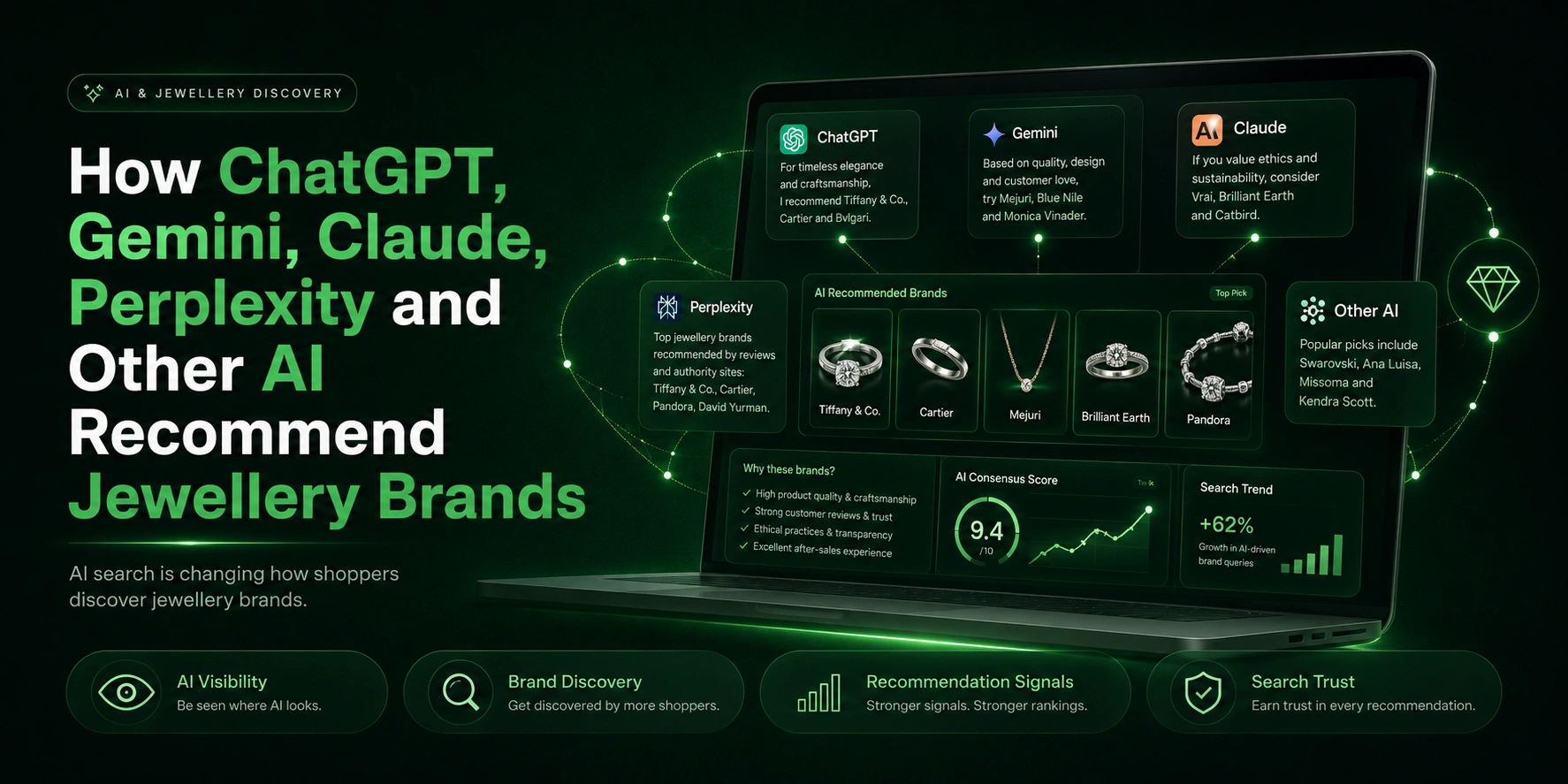
Every jeweller in India has felt the shift. A customer walks into the showroom with a phone already in hand, having asked ChatGPT, Gemini, Claude or Perplexity which brand to consider for a 22 carat bridal set, a platinum couple band or a lab grown solitaire. The shortlist is already made before you say hello.
For the last two years, the industry has been flooded with advice on how to “hack” AI visibility. Special files. Hidden markup. Long lists of mentions on random websites. In May 2026, Google published its official guide to optimising for generative AI in Google Search, and the message was refreshingly direct.
There is no magic trick. The work that earns AI recommendations is the same work that earns trust from real customers, real journalists, and the open web. This guide explains exactly what that means for an Indian jewellery brand, what to stop chasing, and what actually moves the needle.
What Google Officially Said in May 2026 (And Why It Matters for Jewellers)
Google’s new official guide on optimising for generative AI features makes a few things very clear.
SEO is still SEO: AI features inside Google Search (AI Overviews and AI Mode) are powered by Google’s existing core ranking and quality systems. The same SEO best practices that worked for organic results continue to work for AI features. There is no separate playbook called AEO or GEO that overrides standard SEO.
Two AI techniques sit underneath what users see: The first is retrieval-augmented generation (RAG), where the AI retrieves relevant pages from Google’s Search index and grounds its answer in that content. The second is query fan-out, where the model splits one user question into several concurrent, related queries and pulls additional pages to build a fuller answer. For a jeweller, this means a single bridal query can fan out into questions about hallmarking, regional design, making charges, exchange policies and buyer reviews. The brands that consistently surface across all those sub-queries are the ones the AI confidently recommends.
Several popular tactics do not help: Google specifically called out a few myths: creating special files such as llms.txt, chunking content into tiny pieces for AI to consume, rewriting content just for AI models, and chasing inauthentic mentions across the web. None of these are required, and some can actively hurt you.
A few foundations matter more than ever: Unique, non-commodity content. Clear technical structure. Strong page experience. Quality images and video. Accurate local business and product data. That is the entire list.
This guidance applies most directly to Google’s own AI features, but the same principles strongly influence how ChatGPT, Claude, Perplexity and other AI tools build their recommendations. They all read the open web. They all favour authentic, helpful, expert-led content. They all penalise mass-produced filler.
How Each AI Tool Actually Builds a Jewellery Recommendation
The four AI assistants Indian buyers use most behave a little differently. Knowing the difference helps you understand where to focus.
ChatGPT
ChatGPT is the most widely used AI assistant in India for shopping research. It blends two sources: the patterns it learned during training from a large slice of the public web, and live web search when browsing is enabled in the user’s session. For Indian jewellery queries, it tends to surface a familiar mix: legacy retail names such as Tanishq, Kalyan Jewellers, Malabar Gold and Diamonds, digital-first names like CaratLane and Bluestone, and specialist brands such as Jewelove for platinum or Zoya for luxury diamonds. ChatGPT leans heavily on third-party Indian publications, listicles, comparison guides, and well-structured brand websites.
Google Gemini
Gemini sits inside Google’s own ecosystem and is the AI most affected by Google’s official guidance. It uses Google Search ranking signals, Google Knowledge Panels, Google Business Profile data, Merchant Center feeds and structured data on websites. For jewellery, a brand that is well indexed in Google Search, has a verified Business Profile with photos and reviews, and supplies clean product data through Merchant Center has a real advantage. If you do classic SEO well, you are already optimising for Gemini.
Claude
Claude tends to give more cautious, context-aware answers. It often explains trade-offs, mentions certifications such as BIS hallmarking, and recommends asking the user about budget and occasion before naming brands. For Indian jewellery, Claude typically surfaces well-documented, established names and is slower to recommend lesser-known brands without strong evidence. Detailed, factual content explaining your craftsmanship, sourcing, and certification gives Claude the confidence it needs.
Perplexity
Perplexity is the most citation-driven of the major AI tools. Each answer comes with footnoted source links, and a single feature on a credible Indian publication can lead to your brand being cited across many user queries. Perplexity leans on listicles, comparison guides, and authoritative Indian sites such as Economic Times, Mint, YourStory, Indian Retailer, BrandzMagazine, and trade publications. If your brand has even one strong third-party feature in India, Perplexity is the AI most likely to bring it forward.
The Other AI Surfaces
Beyond these four, Google AI Overviews now appear inside Google Search itself and reach far more Indian users than any chat interface. Microsoft Copilot, built into Edge and Windows, draws on Bing’s index and is growing among working professionals. Meta AI inside WhatsApp and Instagram is being rolled out to recommend products in conversational form, which is significant because so much Indian jewellery discovery already happens on Instagram.
A brand that wants to be recommended consistently has to be visible across all of them, and the way to do that is not to chase each AI separately. It is to build a single strong, trustworthy presence on the open web that every AI can read.
What Indian Buyers Are Actually Asking AI About Jewellery
Looking at threads on Quora, Reddit communities such as r/IndiaInvestments and r/IndianFashion, Indian wedding forums, Instagram comment sections, Pinterest queries, and YouTube reactions, the pattern is consistent and very specific.
Buyers ask in conversational, layered ways. They give context about budget, occasion, family preference, region, body type, and styling. Then they ask follow-up questions to dig deeper. Common themes include:
Trust and authenticity, such as questions about which jeweller has the lowest making charges in Surat, whether a specific brand is reliable for bridal sets, and how to verify gold purity.
Budget-specific bridal queries, such as the best bridal necklace set under two lakh, lightweight bridal jewellery for a Gujarati wedding under five lakh, and South Indian temple jewellery brands within one lakh.
Occasion and design queries, such as minimalist daily wear gold rings under twenty-five thousand, polki versus kundan for North Indian brides, and antique gold haram for a Tamil wedding.
Comparison queries, such as Tanishq versus CaratLane for diamond rings, Bluestone versus Melorra for office wear, and Senco versus PC Jeweller for investment gold.
City and store queries, often with very specific intent such as the best jewellery showroom in Surat for diamond rings or the most trusted gold buyer in Coimbatore.
Resale, exchange, and investment queries, such as which brand has the best gold exchange policy, how Tanishqbuybackk works, and whether digital gold is safer than physical gold.
Lab-grown and ethical queries, which have grown sharply in 2026 as awareness has spread. Common queries include the best lab-grown diamond brands in India, ethical sourcing brands, and IGI- or SGL-certified lab-grown diamonds versus GRA-certified moissanite options.
The brands that win these queries are the ones whose websites and earned media address exactly these specific scenarios. Not generic “buy gold online” pages. Real, specific, expert-led content for each of theselong-taill buyer situations.
What Actually Makes a Jewellery Brand AI Recommendable
Based on Google’s official guidance and the patterns of who currently gets cited by AI tools in Indian jewellery queries, the picture is fairly clear.
Unique, Non-Commodity Content
This is the single biggest factor. Generic content that could appear on any jewellery site adds little. Content built on real expertise, first-hand experience, and a clear point of view is what AI systems lean toward. For a jewellery brand, this means content that draws on your actual experience: how your craftsmen finish a polki setting, what you have observed about pricing trends in your category, BIS HUID (Hallmark Unique Identification) compliance standards, the trade-offs between BIS 916 (22K) and BIS 750 (18K), and how hallmarked 22K mangalsutras wear over time compared to 18K.
Helpful, People-First Content
Google’s helpful content guidance applies fully here. The test is simple: would someone leave your page feeling they got real value, or would they need to search again? A brand that consistently passes that test builds the kind of authority AI tools recognise over time.
A Clear Technical Foundation
Pages have to be crawlable, indexable, fast, and eligible to be shown with a snippet. That sounds basic, but a large share of Indian jewellery sites still fail on one or more of these. Image-heavy product pages with minimal text, JavaScript-heavy front ends that hide product data, slow load times on mobile, missing or broken sitemaps, and noindex tags accidentally left on important pages are all common problems. None of these can be fixed by adding an AI-specific file. They are fixed by getting basic SEO right.
Strong Page Experience
Mobile responsiveness, fast loading, easy navigation, clean separation between main content and ads or pop-ups. This is now an explicit factor that affects whether AI features will surface a page. Almost every Indian jewellery customer browses on mobile first, so this is non-negotiable.
High Quality Images and Video
Google’s image SEO and video SEO guidance applies directly. Use standard HTML img elements rather than CSS background images, because CSS background images are not indexed. Provide descriptive, accurate alt text without keyword stuffing. Use real, sharp, well-lit product photography rather than generic stock. Embed videos on standalone pages near related text, with descriptive titles and descriptions. For a jeweller, a well-shot fifteen-second video showing how a clasp opens, how a polki setting catches light, or how a haram drapes on a real person is far more useful than ten more product photos. AI features can surface relevant images and videos directly, which gives jewellery brands extra opportunities to appear.
Accurate Local and Commercial Data
Google’s guidance explicitly mentions Merchant Center feeds and Google Business Profiles as critical for AI visibility for ecommerce and local businesses. For Indian jewellers, this means a fully optimised Business Profile for every showroom with current photos, hours, services, and a steady flow of authentic reviews. For brands selling online, a clean Merchant Center feed with accurate pricing, availability, GTIN where possible, and shipping and return policy data helps your products appear in AI shopping experiences.
Genuine Reputation, Not Manufactured Mentions
This is where Google was most direct. Seeking inauthentic mentions across the web does not help and can put a brand at risk. What does help is real reputation: real customers writing real reviews, real journalists writing real features because your brand actually did something interesting, real industry recognition because your work deserved it. For a jeweller, this is built through good products, ethical practice, distinctive design, and being interesting enough to write about. There is no shortcut.
The Myths Indian Jewellers Should Stop Chasing
Google’s May 2026 guidance specifically calls out tactics that are not effective. Several of these are being aggressively marketed to Indian jewellery brands right now, and many founders are paying for work that delivers nothing.
You do not need an llms.txt file. Google has stated plainly that you do not need to create new machine-readable files, AI text files, or special markup to appear in generative AI search. If an agency is selling you llms.txt as a critical AI optimisation step, that is not aligned with current official guidance.
You do not need to chunk your content into tiny pieces. Modern AI systems handle longer pages and multiple topics on the same page just fine. Write for your audience, not for an imagined chunking algorithm.
You do not need to rewrite content just for AI. AI systems understand synonyms, intent, and meaning. Writing naturally for your real reader is more effective than stuffing every possible query variation onto a page.
You do not need to chase inauthentic mentions. Buying placements on low-quality sites, paying for backlinks in widgets and footers, or seeding identical reviews across forums is treated as link spam under Google’s policies. It also fails to fool modern AI systems, which weigh authority and authenticity heavily.
You do not need to over-engineer structured data. Schema markup helps with rich results in regular Search and is generally a good idea, but it is not required for AI visibility. Add Product, Organisation, LocalBusiness, and Review schema where it genuinely reflects your visible content. Do not add markup that claims things your page does not actually show. That violates Google’s structured data guidelines.
You do not need separate pages for every fan-out query. Creating dozens of near-duplicate pages targeting tiny variations of the same buyer question is treated as scaled content abuse and can trigger demotion. One genuinely strong page on a topic beats ten thin pages every time.
JavaScript, Images, Videos and the Technical Details That Actually Matter for Jewellers
Indian jewellery sites tend to be image-heavy and built on modern frameworks that lean on JavaScript. This causes more SEO and AI visibility problems than founders realise.
JavaScript SEO
Google can process JavaScript, but it is more complex than serving plain HTML. The main risks for a jeweller are content that loads only after user interaction (so the AI never sees it), product variants and prices that only appear after a script runs, navigation that depends on JavaScript click handlers instead of real anchor tags, and lazy-loaded product galleries that do not load when the crawler visits.
Follow Google’s JavaScript SEO basics: ensure the important content is in the rendered HTML, use real anchor links for navigation, do not block JavaScript or CSS in robots.txt, and test important pages with the URL Inspection Tool in Search Console to confirm what Google actually sees. If you are on Shopify, WooCommerce, Magento, or a custom React or Next.js front end, this audit is essential before any AI optimisation work.
Images
Use standard HTML img elements. CSS background images are not indexed. Pick file names that describe the image clearly, such as polki-bridal-choker-set-amrita.jpg rather than IMG0023.jpg. Write alt text that describes what is in the image accurately, without piling on keywords. Compress images so pages load fast, especially on mobile. For responsive images, use srcset or the picture element, always with a fallback src.
Submit an image sitemap if you have a large catalogue, especially if images are served from a CDN. Add Product, Recipe, Article, or other relevant schema so eligible images can appear with rich result badges in Google Images.
Videos
Embed product videos on their own pages near the related text. Give each video a descriptive title and description, not “Video 1”. Add VideoObject structured data so Google can understand what the video is about, when it was uploaded, and what its thumbnail is. For jewellery, the formats that perform best are short clips that show how a piece catches light, how it sits on a real person, how the clasp or hinge works, and short behind-the-scenes craftsmanship reels. Hosting on your own domain (with YouTube as a secondary distribution channel) tends to give your site more direct credit for the engagement.
Page Experience
Run every important page through PageSpeed Insights. Pay particular attention to Largest Contentful Paint, Interaction to Next Paint, and Cumulative Layout Shift. Mobile load time matters most. Avoid full-screen interstitials, intrusive newsletter pop-ups, and chat widgets that block the main content. The same things that annoy customers hurt your AI visibility.
The Indian Jewellery Brands AI Tools Mention Most Often, and Why
Across the four major AI assistants, a fairly stable group of Indian jewellery brands surfaces. Understanding why is more useful than the names themselves.
Tanishq dominates because it has Tata’s brand authority, decades of media coverage, hundreds of stores, BIS hallmarking on every piece, transparent pricing, the Karatmeter trust signal, strong Knowledge Panel presence, and consistent third-party citations across credible Indian publications.
Malabar Gold and Diamonds appears often thanks to its global footprint, fair trade sourcing narrative, certified jewellery messaging, and aggressive PR around CSR and bridal collections.
Kalyan Jewellers benefits from heavy celebrity endorsement coverage, four-level certification messaging, regional collections such as Muhurat and Vedha that are extensively documented, and strong presence in Indian bridal media.
CaratLane earns mentions because of its digital-first DNA, strong content marketing, well-structured product pages, Tata association, and consistently high Google reviews. It is the first name AI tools surface for younger, urban, lightweight or daily wear queries.
Senco Gold, Joyalukkas, PC Jeweller, Bhima, GRT, Jos Alukkas, and TBZ appear regionally based on city context. Niche names such as Jewelove for platinum, Zoya for luxury diamond, Mia for everyday, ORRA for solitaires, Amrapali for artisanal, and Hazoorilal for heritage Delhi appear when queries get specific. Younger D2C brands such as Bluestone, Melorra, GIVA, and Aurelia get cited frequently in queries about online buying, lightweight pieces, silver, and contemporary aesthetics.
The pattern is consistent. Brands win AI mentions because they are well documented across the open web, have a clear, specific identity, demonstrate real expertise, and have a genuine customer reputation behind them. None of this is created by tricks. All of it is created by doing real work on the brand over time.
What Most Indian Jewellery Brands Are Getting Wrong
After auditing dozens of jewellery websites, including legacy multi-store retailers and well-funded D2C brands, the same gaps appear again and again.
Image-heavy product pages with almost no text. AI tools and search engines need text to understand what a product is. A photo alone is not enough.
Generic About pages that read like every other jewellery website. No specifics about lineage, craftsmanship, certifications, or sourcing.
Missing or shallow FAQs. A genuinely helpful FAQ section that answers real customer questions is one of the most valuable assets a jeweller can publish, and most sites either skip it or list four generic questions.
Inconsistent business listings. Different addresses or phone numbers on Justdial, Google Business Profile, Facebook, and Sulekha confuse both buyers and AI tools.
Heavy reliance on Instagram alone. Instagram builds awareness, but most AI tools cannot crawl Instagram content directly. A brand with two hundred thousand followers and a thin website is still mostly invisible to ChatGPT, Claude, and Perplexity.
JavaScript front ends that hide critical product data from crawlers. This is one of the most common technical issues among modern Indian jewellery sites.
No reviews strategy. Jewellery purchases are emotional and high-trust. Without active, authentic reviews on Google Business Profile, MouthShut, Trustpilot, and Facebook, AI tools have no third-party evidence that real customers vouch for the brand.
Outdated or thin content. A blog with two posts from 2021 helps no one. Either invest in real, ongoing content or do not run a blog at all.
A Realistic 90 Day Plan for Indian Jewellery Brands
This plan reflects Google’s current official guidance. No magic files, no inauthentic mentions, no chunking. Just the work that actually builds AI visibility.
Days 1 to 15: Audit and fix the technical foundation. Verify the site in Google Search Console. Run important pages through PageSpeed Insights and the URL Inspection Tool. Fix mobile responsiveness, slow load times, broken canonical tags, and any JavaScript that hides content from crawlers. Audit Google Business Profile for every showroom and bring it to one hundred percent completion with current photos, hours, and a steady flow of authentic reviews.
Days 15 to 30: Strengthen on-site clarity. Rewrite top twenty product pages with real text content covering metal purity, weight, certification, occasion, care instructions, and styling notes. Build a deep FAQ section that answers thirty to forty real customer questions. Add Product, Organisation, LocalBusiness, and Review schema where it accurately reflects what is visible on the page. Submit clean image and video sitemaps if you have a large catalogue.
Days 30 to 60: Build genuinely helpful content. Publish six to ten in-depth, expert-led articles that answer the specific buyer questions Indian customers actually ask. Examples: a complete primer on BIS hallmarking with photos of real hallmarks, a comparison of polki and kundan for North Indian brides written by someone who actually designs both, a city specific bridal jewellery guide grounded in real local context, an honest piece on lab grown versus mined diamonds for Indian buyers. Pair the text with strong photography and short video clips.
Days 60 to 90: Build authentic external reputation. Pursue genuine media features, founder interviews, podcast appearances, and trade publication mentions. Submit a clean product feed to Google Merchant Center if you sell online. Collect a steady stream of real, photo-rich customer reviews on Google Business Profile.
Ongoing: Track your AI visibility monthly by running brand-relevant test queries on ChatGPT, Gemini, Claude, and Perplexity. Track changes in mention frequency, accuracy and competitive position. Refresh your strongest content quarterly. Resist the temptation to chase the latest hack.
Done consistently for six to twelve months, this is what moves a jewellery brand from invisible to confidently cited.
How Kyros Solution Helps Jewellery Brands Win in AI Search
Most digital marketing agencies in India are still selling jewellery brands tactics that contradict Google’s current official guidance. A few are doing the harder, more honest work. Kyros Solution is one of the few that has built an entire practice around helping Indian jewellery brands grow through real, sustainable strategies that align with how modern Search and AI tools actually work.
What sets Kyros apart for jewellery brands:
Pure jewellery focus: From boutique D2C names to established chains, the team understands the nuances of how Indian buyers shop for gold, diamond, polki, kundan, platinum and lab grown jewellery. Strategies are built around real category behaviour, not imported from fashion or electronics.
End to end services tuned for jewellery: Brand strategy and identity, ecommerce design and development, 3D product rendering, SEO that aligns with Google’s current official guidance, content marketing rooted in real expertise, paid advertising on Google and Meta, influencer partnerships, and email and WhatsApp automation. Every piece connects.
Proven results: Kyros has helped boutique and luxury jewellers achieve strong returns through tailored SEO, influencer partnerships and ecommerce enhancements. One handcrafted jewellery brand grew online orders by one hundred and fifty percent in six months through a focused Google Ads and Instagram strategy.
Honest, Google-aligned approach: No llms.txt theatre. No inauthentic mention farms. No chunking. The work focuses on building a genuinely strong website, helpful content, accurate local and product data, real customer reputation, and earned media. The kind of presence that compounds.
Local expertise, national reach: Based in India’s diamond capital, with deep relationships across the supply chain, Kyros understands the jewellery business from the inside.
If you run or market a jewellery brand and you want a partner that takes Google’s official guidance seriously, focuses on real growth instead of trendy hacks, and understands both the craft and the commerce of jewellery, Kyros Solution is built for exactly this work.
The Bottom Line
The Indian jewellery buyer of 2026 still values family jewellers, still loves walking into showrooms, still scrolls Instagram. The change is that they layer AI on top of all of that. They ask Perplexity for a comparison, double check on ChatGPT, look up a specific design on Pinterest, then walk into a showroom or a website to buy.
The brands that win this new buyer journey are not the ones running the cleverest hack. They are the ones doing the unglamorous, compounding work of being genuinely useful: helpful content written by people who actually know the craft, fast and accessible websites, accurate local and product data, real customer reviews, and earned media that reflects real recognition.
Google’s official guidance from May 2026 made this clearer than ever. The myths are myths. The fundamentals work. And the fundamentals are what your customers wanted anyway.
When you are ready to do that work seriously for your jewellery brand, Kyros Solution’s jewellery focused digital marketing team is ready to help. Reach out for a Google-aligned AI visibility audit and a growth plan built around your buyers and the way they actually search today.
Want a personalised, Google-aligned audit of where your jewellery brand stands across ChatGPT, Gemini, Claude, Perplexity and Google AI Overviews? Connect with Kyros Solution.
FAQs
Is AEO or GEO different from SEO for jewellery brands?
Per Google’s May 2026 official guidance, optimising for generative AI search in Google is still SEO. The same foundations apply: helpful content, clear technical structure, good page experience, accurate local and product data, and genuine reputation.
Do we really not need an llms.txt file?
Correct. Google has stated that you do not need to create new machine-readable files or AI text files to appear in generative AI search. If an agency tells you otherwise, that contradicts current official Google guidance.
Does structured data help with AI visibility?
Structured data is not required for AI features specifically, but it is still a good practice because it helps your pages qualify for rich results in regular Search. Add it where it genuinely reflects what is visible on your page.
How long does this take to show results?
Foundational improvements often show benefits in four to six months. Meaningful AI citation visibility typically builds over nine to twelve months. The work compounds, so consistency matters far more than speed.
Does Instagram presence alone help AI visibility?
Mostly no. Most AI tools cannot directly crawl Instagram in detail. Instagram is excellent for awareness and conversion, but it does not feed AI training data the way well-structured websites and credible publications do.
Are smaller jewellery brands at a disadvantage compared to Tanishq or Malabar?
Less than you would expect. AI tools weigh the strength of evidence more than the size of the brand. A specialised boutique with strong content, real reviews, and authentic media coverage can outrank a much larger competitor for niche queries.
Can we pay to be placed in AI answers?
There is no paid placement inside ChatGPT, Claude, Gemini, or Perplexity recommendations the way Google Ads works. Visibility is earned through real content, real reputation, and good technical fundamentals.
Is AI-generated content for our blog a good idea?
Use it as an assistant, not as the writer. Google’s guidance is clear: content has to meet the same quality standards regardless of how it was produced. Mass-produced AI content with no expert input violates the scaled content abuse policy and can hurt your visibility.