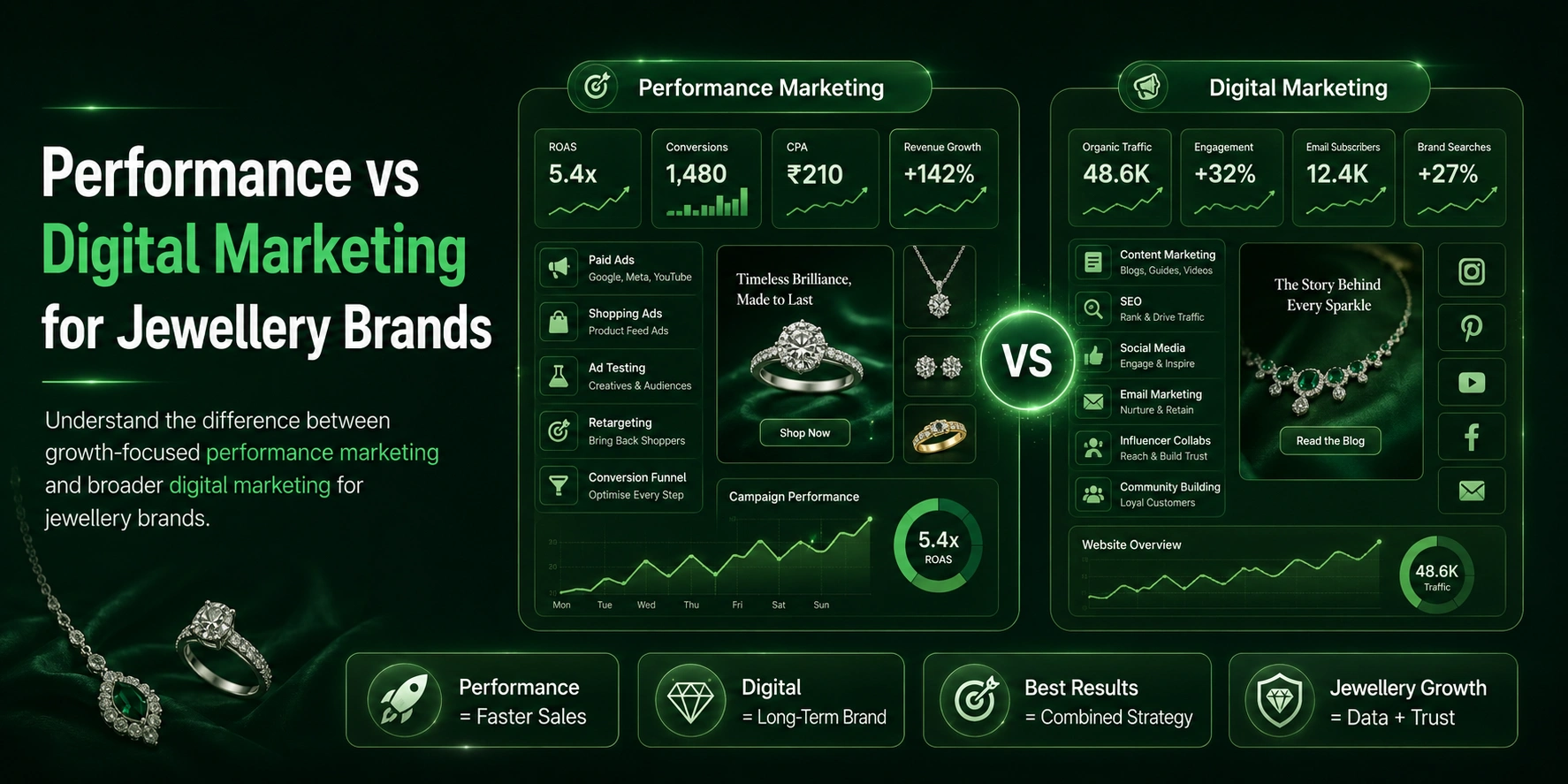
Search “performance vs digital marketing for jewellery,” or ask an AI assistant the same thing, and you get a stack of articles that mostly repeat one idea: digital marketing builds your brand slowly, performance marketing drives sales fast, so pick the one that fits your goal. Tidy in theory. Close to useless if you actually run a jewellery label in India.
Jewellery does not behave like a T-shirt or a serum. A customer can decide on a face wash in ninety seconds. A bride may research her wedding set for six to twelve months before she trusts anyone with that money. A gold chain at today’s prices is a five-figure decision, not an impulse tap. So the usual “performance versus digital” debate, written for generic D2C, quietly skips the part that decides whether your jewellery brand actually grows.
This guide fixes that. We will clear up what these two terms really mean (one of them is hiding inside the other), explain why jewellery breaks the standard playbook, and give you a practical way to split your money and attention, grounded in how Indian buyers genuinely shop.
First, the confusion almost everyone gets wrong
Performance marketing is not the opposite of digital marketing. It is a part of it.
Digital marketing is the whole umbrella: every effort that uses the internet to reach and persuade buyers. That includes your website, SEO, content, organic social, email, WhatsApp, influencer work, video, and paid ads. Performance marketing is one slice of that umbrella, the slice where you pay for a measurable action (a click, a lead, a sale) and can track the return rupee for rupee. Pay-per-click, Meta and Google ads, shopping campaigns, and affiliate payouts: those are performance marketing.
So when a founder asks, “Should I do performance marketing or digital marketing?” the honest answer is that the question is slightly miscast. You are already doing digital marketing the moment you open an Instagram account. The real decision sitting underneath that question is this:
Should I put my next rupee into ads that capture demand and sales right now, or into the slower brand, content and discovery work that creates demand and trust over time?
That is a genuinely hard, genuinely useful question. And for jewellery, the answer has a particular shape.
Why jewellery refuses to follow the standard D2C playbook
India’s jewellery market is large and resilient. IMARC pegs it at roughly USD 95 billion in 2025, with industry councils and analysts expecting it to push toward USD 130 to 150 billion by 2030, carried by weddings, festivals, premiumisation and the steady formalisation of the trade. The World Gold Council noted that several listed jewellers posted very strong revenue growth through late 2025 and early 2026, with some reporting more than fourfold year-on-year jumps in their online revenue. The shift online is real, and it is accelerating.
But four traits make selling jewellery fundamentally different from selling most things, and each one bends your marketing strategy.
It is a trust-first category: Buyers are not just choosing a design, they are deciding whether to believe you about purity and value. As BIS hallmarking and diamond grading from bodies like IGI and GIA become household reference points, Indian buyers are moving from blind trust in a family jeweller to verification-based trust in whoever can prove quality. No ad can shortcut that. Trust is earned through certification, transparent pricing, reviews, returns and consistent presence, which is brand and content work, not a one-day campaign.
The buying journey is long and offline-leaning (ROPO): Research Online, Purchase Offline is the default for high-value jewellery. Study after study finds that most Indian buyers begin online, comparing designs, prices and purity, even when they finish the purchase in a store. That single fact wrecks naive performance measurement: a campaign that “looks” like it failed (no online checkout) may have driven a showroom sale your ad platform never sees.
Average order values are high and rising: With gold near record levels in 2026 (domestic prices crossed roughly INR 1,39,800 per 10g early in the year, after a 67% surge through 2025, per the World Gold Council), a single piece is a serious outlay. High AOV means buyers take more time, demand more reassurance, and rarely convert on the first touch. It also means one wasted click costs you more, so sloppy targeting hurts faster.
Demand is emotional and seasonal: Weddings, Dhanteras, Diwali and Akshaya Tritiya concentrate intent into specific windows, and the purchase carries cultural and emotional weight that lightweight performance copy cannot carry alone. Rising prices are also nudging buyers toward lightweight, 18-karat and lab-grown diamond pieces, with diamond jewellery growing fastest, which changes both your product story and your channel mix.
Put together, these traits explain a pattern many jewellery founders learn the expensive way: pour everything into ads, get plenty of traffic, and watch very little of it turn into sales. The category does not forgive marketing that tries to skip trust.
What performance marketing does brilliantly for jewellery
None of the above means performance marketing is weak. Used well, it is one of the sharpest tools you have.
It captures ready people. When someone searches “lab-grown diamond solitaire ring price” or “antique gold jhumkas online,” Google Search and Shopping ads put you in front of high-intent buyers at the exact moment of consideration. Retargeting brings back the shopper who viewed a necklace, left to “think about it,” and needs three or four more nudges before committing, which suits a multi-touch category perfectly.
It is measurable and controllable. You can see cost per acquisition, return on ad spend, and which creative is working, then move budget toward winners. For a founder watching every rupee, that accountability is priceless. Healthy new-customer ROAS for fashion and jewellery brands often sits in the 2 to 3 range, and that can be profitable when repeat purchase rates are strong, which is exactly why the smarter operators track the LTV to CAC ratio rather than worshipping ROAS alone.
It scales the demand you have already created. This is the quiet truth about performance marketing in jewellery: it works best on warm audiences. Ads aimed at people who already recognise and trust your brand convert far more cheaply than ads thrown at cold strangers. Performance harvests demand. It is much weaker at manufacturing trust from scratch.
And that is where its limits show up.
Rising ad costs make pure performance fragile: As more jewellery brands crowd Meta and Google, CPMs climb, and acquisition gets more expensive. A setup that prints money at small spend often breaks the moment you push budgets, because creative fatigue and audience saturation arrive quickly. Practitioners running seven-figure Indian budgets describe creative fatigue as the first ceiling you hit, and the fix is a constant stream of fresh, well-shot creative, not just more spend.
It cannot buy trust: No amount of “Shop Now” will convince a careful buyer that your 22K is genuine. Certification, content, reviews and brand familiarity do that, and they sit outside the performance bucket.
Performance-only growth quietly raises your costs over time: This is the most important and least understood risk. Decades of advertising-effectiveness research by Les Binet and Peter Field for the IPA found that brands leaning almost entirely on short-term activation tend to see customer acquisition costs drift out of control within roughly 18 to 24 months, because they keep renting attention instead of building memory. Their data shows high-awareness brands enjoy meaningfully lower CAC and conversion rates well above unknown competitors. Performance without brand is, in their words, like fishing in a lake that nobody restocks.
What the wider digital engine does for jewellery
The rest of digital marketing, the slower-looking part, is what makes performance affordable and trustworthy in the first place.
Brand and premium positioning create the recognition and emotional pull that let a buyer choose you over five open tabs. In a trust-first category, a brand people already feel good about converts more cheaply on every channel. Strong, consistent premium branding is not a vanity layer for jewellery, it is direct cost reduction on your ad account.
SEO and content capture the enormous research phase that ROPO behaviour creates. Buyers Google “is it safe to buy jewellery online in India,” “BIS hallmark meaning,” “lab-grown vs natural diamond,” “lightweight gold necklace designs,” and gifting and bridal guides for months before purchase. Ranking for those questions puts you in the consideration set early, builds authority, and feeds warm traffic into your funnel that performance can later convert. Good jewellery SEO and content compounds: it keeps working long after a campaign budget is spent.
Visual and social discovery suits jewellery better than almost any product. Instagram, Pinterest and YouTube reward close-up craftsmanship, styling, occasion context and real-bride storytelling. Micro-influencers often outperform celebrities here because their audiences feel authentic and niche. And immersive formats are converting: AR try-on, used by the likes of Tanishq and Lenskart, has been linked to materially higher purchase intent among shoppers who use it, which is why high-quality 3D renders and jewellery animation increasingly do real commercial work, not just decoration.
WhatsApp, email and retention carry the long, assisted conversations that high-AOV jewellery needs, from styling help and certificate sharing to festive reminders and re-purchase nudges. Much of jewellery’s profit lives in the second and third purchase, so retention is not an afterthought.
Conversion rate optimisation (CRO) makes sure the traffic on both halves works hard to attract those who actually buy. Trust signals on the product page (hallmark and certification details, transparent making charges, return and buyback policies, reviews, secure checkout) are often the difference between a wishlist and a sale. Even a strong ad fails on a page that does not reassure. Sharpening that path is what CRO for jewellery stores is for.
The honest answer: it is sequence and ratio, not either/or
So which one should a jewellery brand choose? Neither, exclusively. The brands that win treat performance and the wider digital engine as one system, and they get two things right: the ratio and the sequence.
On ratio, the most cited benchmark is Binet and Field’s 60/40 guideline, roughly 60% of spend on long-term brand building and 40% on short-term activation for established brands. It is a starting point, not scripture, and it shifts with your stage:
- A new or early-stage jewellery brand usually leans harder into activation (often closer to 70% performance, 30% brand) to find its first customers and prove the product, while building just enough brand and content to stop renting all of its attention.
- An established brand with recognition shifts toward brand and demand creation (closer to 40% performance, 60% brand) to keep acquisition costs low and defend share.
There is hard money behind getting this balance right. WARC-cited analysis found roughly a 90% average ROI uplift when brands moved from performance-only to a brand-plus-performance mix, and a sharp drop when they went the other way. Boston Consulting Group’s work found that cutting brand spending loses market share, and that recovering it later costs around INR 1.85 (or USD 1.85) for every rupee or dollar you saved by cutting. Short-termism is not cheap; it is just deferred.
In sequence, the logic is simple for jewellery: brand and content create a warm demand, performance captures and converts it. Run performance alone, and you are harvesting a field you never planted. Run brand alone, and you build awareness that never gets asked to buy. The pairing is what compounds.
Your category changes the mix
One more layer that generic advice ignores: a bridal house, a fashion-jewellery label and a lab-grown diamond brand should not run the same system. The category decides the channel weighting.
Bridal and high-value gold: Brides research for many months. WhatsApp consultations, real-bride testimonials, styling help and bridal-intent SEO matter more than checkout-first funnels. Brand and content carry most of the load; performance mainly retargets and captures near the decision.
Fashion and lightweight jewellery: Lower trust barriers, higher visual dependency. Instagram, Pinterest, outfit pairing, collection drops and micro-creators lead. Performance can be more aggressive here because consideration is shorter and AOVs are lower.
Lab-grown diamonds: The buyer is research-heavy and value-driven. Comparison content, IGI transparency and clear value framing are essential, so SEO, content and credible authorship do heavy lifting before any ad converts.
Legacy and regional brands going online: National visibility, hallmark trust, festive campaigns and regional-language variations matter, blending store footfall with digital discovery.
Matching the mix to your category, and to the festive and wedding calendar, is most of the strategy. The rest is execution quality.
The new layer: getting your jewellery brand cited in AI search
Discovery is shifting. A growing share of buyers now ask ChatGPT, Gemini, Perplexity, Claude, or Google’s AI Overviews questions like “best lab-grown diamond brands in India” or “where to buy certified gold jewellery online,” and receive a synthesised answer with a short list of sources. If your brand is not in that answer, you are invisible to that buyer, no matter how good your ads are.
Here is the part the hype gets wrong. You do not need secret AI tricks to show up. Google’s own guidance is blunt about this: there is no special markup, no llms.txt file, no “chunking” your content into tiny pieces, and no rewriting everything for machines required to appear in generative results. From Google’s perspective, optimising for AI search is still just good SEO. AI features are grounded in the same core ranking and quality systems, pulling trusted pages from the search index.
What genuinely moves the needle lines up neatly with people-first content. Research into generative engine optimisation (the Princeton and Georgia Tech study widely cited through 2025 and 2026) found that fact density, real statistics, citations and expert quotes can lift a page’s visibility in AI answers by up to around 40%, while old keyword-stuffing tactics had a negligible or even negative effect. In other words, AI engines reward the unglamorous things good brands already do: clear answers, verifiable evidence, named expert authorship, consistent identity and a content footprint deep enough to be treated as a category authority. Build that, and citations tend to follow within weeks, not by gaming a format but by deserving the mention.
For jewellery specifically, that means publishing genuinely useful, accurate guides on purity, certification, care, gifting and value, attaching them to a real, credible brand identity, and keeping facts honest and aligned with what is actually on your pages. That is the same work that earns Google rankings and human trust. AI visibility is the outcome, not a separate game.
Measure it like jewellery, not like fast fashion
Three measurement habits separate jewellery brands that scale from ones that burn budget.
Track LTV to CAC, not just ROAS: A first-purchase ROAS of 2 can be very profitable if a meaningful share of buyers return for a second and third piece worth several times the first order. Judge acquisition by lifetime value against acquisition cost, not by a single campaign’s return.
Respect the ROPO blind spot: Because so many buyers research online and purchase in-store, last-click attribution systematically undercounts what your content, SEO and brand work actually drive. Watch branded search volume, store footfall, assisted conversions and overall revenue, not only on-platform checkouts. Following Google’s own newer guidance, measure the value of a visit (engagement, enquiries, sign-ups, sales), not just raw click counts.
Read performance against gold prices and the calendar: With gold volatile and elevated, a softer month may reflect price-driven hesitation or seasonality, not a broken funnel. Context prevents panic-tweaking that resets your campaigns and wastes spend.
A simple way to think about the next 90 days
If you want a practical starting frame rather than a rigid rule:
- Decide your stage and category, and set a starting split (early-stage leans to performance, established leans to brand; bridal leans to content and WhatsApp, fashion leans to social and ads).
- Fix the foundation first: a fast, trustworthy site with hallmark and certification details, transparent pricing, reviews and a clean checkout. Ads on a leaky page just lose money faster.
- Run performance on warm, high-intent audiences (search, shopping, retargeting) while you keep feeding the creative pipeline so fatigue does not become your ceiling.
- In parallel, build the compounding assets: SEO content for the research phase, strong visual and 3D storytelling, social discovery, and credible guides that earn both Google rankings and AI citations.
- Review on LTV to CAC and total revenue, allow for ROPO and gold-price context, and rebalance the split as your brand recognition grows.
Do that consistently, and the false choice between performance and digital marketing simply dissolves. You end up with one engine where each half makes the other cheaper and stronger.
Where Kyros Solution fits in
This is the exact problem Kyros Solution was built to solve. We are digital and creative agency that works only with D2C jewellery and lifestyle brands, so the trust-first, ROPO-heavy, festive-driven realities above are not theory to us; they are the daily brief.
Rather than selling you “performance” or “digital” as separate packages, we build the single engine: performance marketing that captures and converts high-intent buyers on Meta, Google and Shopping; SEO and GEO that wins the long research phase and earns visibility in both Google and AI answers; premium branding and UI/UX that build the recognition and trust which make every ad cheaper; CRO that turns hard-won traffic into sales; and high-end 3D renders and jewellery rendering that make your pieces convert on screen the way they would in a showroom. Each piece is chosen to fit your category, your stage and the Indian buyer’s actual journey.
If you are tired of either burning ad budget with little to show or building lovely brand presence that never gets asked to sell, that is precisely the gap we close.
Want a split that fits your specific brand and category? Talk to the Kyros team for a straight assessment of where your next rupee should go.
FAQs
Is performance marketing better than digital marketing for a jewellery brand?
It is not a fair comparison, because performance marketing is a part of digital marketing, not an alternative to it. Performance ads capture demand and sales now; the wider digital engine (brand, SEO, content, social, retention) creates trust and demand over time. Jewellery, being a high-trust, high-value, long-consideration category, needs both, with the balance set by your stage and product type.
Why do you jewellery ads get clicks but few sales?
Usually, because the traffic is not warm or trusting enough yet, or the product page does not reassure. Jewellery buyers rarely convert on the first touch and need proof of purity, transparent pricing, reviews and a smooth checkout. Performance works far better on audiences that already recognise your brand, so building brand and content alongside ads, and tightening CRO, typically lifts conversions.
What is a good ROAS for an Indian jewellery brand?
A new customer ROAS in the 2 to 3 range is often healthy, but it depends on your margins and repeat purchase rate. The more reliable lens is LTV to CAC, since much of jewellery’s profit comes from the second and third purchase. A lower first-order ROAS can still be profitable if customers come back.
How much budget should go to brand versus performance?
The widely cited benchmark is roughly 60% brand, 40% performance for established brands, shifting toward more performance (around 70%) for early-stage brands still finding their first customers. Adjust for category: bridal and high-value gold lean toward content, WhatsApp and brand; fashion and lightweight jewellery can lean more into social and ads.
Do you need special AI or GEO tactics to appear in ChatGPT and Google AI Overviews?
No. Google has stated there is no special markup, AI file or content-chunking required. AI search runs on the same core ranking and quality systems, so genuinely helpful, fact-rich, well-structured content from a credible brand is what earns citations. The reliable path to AI visibility is strong, honest, people-first content, not gimmicks.
Does online marketing even matter if most jewellery is still bought in stores?
Yes, arguably more than ever. Most Indian buyers now research online before they buy, even when they purchase in a showroom (ROPO behaviour). Your digital presence shapes the decision long before the store visit, which is why measuring only on-platform checkouts undercounts its real impact.