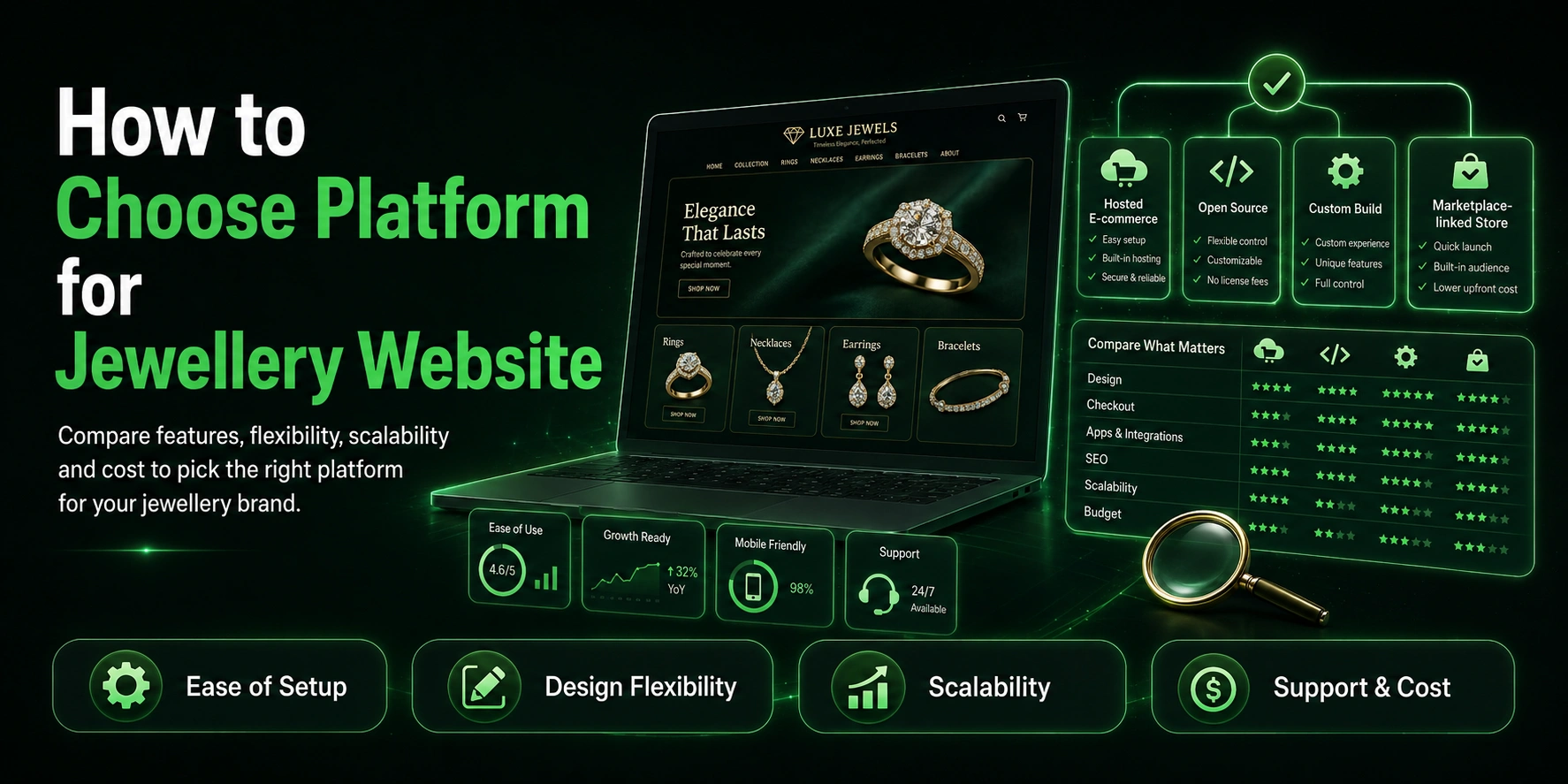
For most Indian D2C jewellery brands launching or scaling, Shopify offers the fastest, most reliable path to a polished store. WooCommerce suits content-led, SEO-first brands on a tighter budget who have some technical support on hand. Magento (Adobe Commerce) is built for large catalogues, multi-store setups and high order volumes. A custom or headless build only earns its cost once your storefront experience itself becomes a competitive advantage. But the platform name matters less than one thing most comparison articles never test for: whether it can handle gold-rate-linked pricing, weight-and-purity catalogues, certification trust signals, high-value checkout, and rich visual merchandising. Choose for fit, not for popularity.
That is the honest version. The rest of this guide explains how to apply it to your specific brand, because a 12-piece silver label and a 4,000-SKU gold house should not pick the same tool.
Why a jewellery website is not like any other online store
Walk into any “best ecommerce platform” listicle, and you will find the same three or four names ranked by features, pricing tiers and ease of use. Useful as a starting point. Misleading as a final answer, because jewellery breaks several assumptions that those lists are built on.
Trust comes before the product: Jewellery is a high-trust, high-value purchase. In India, it carries cultural, emotional and investment weight all at once. A first-time visitor is not only judging a ring; they are judging whether your brand is real, whether the gold is what you claim, and whether their money is safe. The platform you choose has to make room for hallmark certificates, purity guarantees, buyback terms and clear policies, not bury them three clicks deep.
Average order values are high, and that changes checkout: A clothing brand can lean on UPI for almost every order. Jewellery cannot always do that, and we will come back to why this single detail trips up so many Indian stores.
Buying is rarely linear: A large share of jewellery shoppers research online and then buy offline, or research offline and buy online. This ROPO behaviour (Research Online, Purchase Offline) means your website is often the consideration engine even when the sale closes elsewhere. It has to perform as a showroom, not just a checkout.
Pricing is alive: This is the big one. A cotton kurta has a fixed price. A gold pendant does not. Its price moves with the daily gold rate, metal purity, weight, making charges, and applicable taxes. A platform that cannot reflect that cleanly forces you into manual updates, pricing errors and customer distrust.
Demand is seasonal and visual: Festive and wedding cycles drive enormous spikes, and the category lives on Instagram and Pinterest, where a static photo rarely does a piece justice. Your platform needs to support strong visual merchandising and survive traffic surges.
For the bigger picture on how these dynamics shape marketing, not just websites, see our guide on the benefits of digital marketing for jewellery brands.
To put a number on the stakes: India’s gems and jewellery sector was estimated at around US$85 billion in early 2026 and is projected to reach roughly US$130 billion by 2030, according to IBEF. Online still accounts for a modest slice, with offline retail holding the large majority of sales in 2025, but the online channel is growing markedly faster than the overall market and is expected to keep gaining share. The brands that win that growing slice are the ones whose websites are built for how jewellery actually sells.
The 7 things any jewellery platform must actually handle
Before you compare names, compare capabilities. Score every platform you consider against these seven requirements. This is the framework we use at Kyros Solution, and it filters decisions faster than any feature chart.
1. Dynamic, gold-rate-linked pricing
In India, jewellery price is typically calculated as: (gold rate per gram x net weight) + making charges + wastage + GST. Tax in India is generally 3% on the market value and 5% on making charges. Gold rates move daily, sometimes more than once a day, driven by global bullion prices and currency movements.
If your catalogue is gold or has weight-based pricing, ask: can the platform update prices automatically when the rate changes, or will someone be editing hundreds of SKUs by hand every morning? Shopify and WooCommerce can both support rate-linked pricing through apps, plugins or custom development. Magento can handle it natively with development effort. A drag-and-drop website builder usually cannot, and that limitation alone can rule it out for a gold brand.
For fashion or imitation jewellery with fixed prices, this requirement matters far less, which is exactly why the right platform depends on what you sell.
2. A catalogue structure built for jewellery attributes
Generic catalogues think in size and colour. Jewellery thinks in metal type, karat or purity, gross and net weight, stone type, carat, clarity, cut, certification number and collection. Shoppers want to filter by these, and search engines reward pages that present them clearly.
Your platform needs flexible product attributes and filtering that can express this without hacks. The more your business depends on fine distinctions (diamond clarity, gemstone origin, astrological purpose), the more this matters.
3. Trust and certification signals
This is where jewellery websites either earn the sale or lose it. Your platform should make it easy to surface BIS hallmark details, diamond certificates (GIA, IGI), authenticity guarantees, plating warranties, buyback and exchange policies, and clear returns. Leading Indian brands lean heavily on certification and warranty language because it directly addresses the buyer’s biggest fear: “Am I being cheated?
A platform that treats these as afterthoughts, or makes them hard to display consistently across every product page is working against you.
4. High-value checkout that fits Indian payment reality
Here is the detail that quietly breaks many Indian jewellery stores. Shopify Payments, Shopify’s built-in checkout, is not available in India. Every Indian Shopify store must connect a third-party gateway such as Razorpay, PayU, CCAvenue or Cashfree. These integrate smoothly, with Razorpay’s platform fee commonly around 2% plus GST, but you need to plan for it rather than discover it after launch.
Then there is the UPI ceiling. The standard per-transaction UPI limit for most banks sits at Rs 1,00,000. For everyday fashion jewellery, that is irrelevant. For a high-value gold or diamond piece that crosses that figure, a UPI-only checkout will fail at the most important moment. High-AOV jewellery brands must offer cards, net banking and EMI alongside UPI, and EMI in particular can lift conversion on premium pieces.
Cash on Delivery still carries real weight in Indian ecommerce, accounting for an estimated 20% to 40% of orders depending on category and audience, so your platform and gateway should support it where it makes sense for your margins and average ticket size.
Whatever platform you pick, confirm it supports the gateways, EMI options and COD configuration you need before you commit.
5. Rich visual merchandising
Jewellery is bought with the eyes. Your platform must comfortably handle high-resolution zoom, multiple angles, 360-degree views, video, and increasingly, virtual try-on or augmented reality. Industry estimates suggest products presented with 3D or AR content can convert meaningfully better than flat images alone, and major Indian houses such as Tanishq and Kalyan Jewellers have adopted virtual try-on for exactly this reason.
Shopify, WooCommerce and Magento all support these experiences through apps or custom work, but performance matters: heavy media can slow a page, and slow pages lose buyers. If immersive product experiences are central to your brand, factor in how each platform handles media and speed. Our work on 3D jewellery animations and Instagram engagement goes deeper on the visual side.
6. GST-compliant invoicing and tax handling
Indian jewellery sales need correct GST treatment at checkout (IGST, CGST and SGST as applicable) and compliant invoices. Some platforms handle Indian tax configuration more gracefully than others, and gateways like Razorpay can capture and validate customer GST details. Confirm that your stack produces clean, compliant invoices without manual rework.
7. SEO and AI-search foundations
Your store needs to be found, both in classic Google results and in the newer AI-powered experiences such as AI Overviews. The good news, straight from Google’s own guidance, is that there is no separate “AI SEO” to chase. The same fundamentals apply: crawlable pages, fast load times, clean structure, descriptive titles and content that is genuinely helpful to a real shopper.
What you need from a platform is the ability to control titles, meta descriptions, URLs, image alt text, structured data and page speed without fighting the system. WooCommerce on WordPress is well regarded for SEO flexibility. Shopify is strong and improving, with sensible defaults. Magento offers deep control at the cost of complexity. A platform that locks you out of these basics will cap your visibility, no matter how good your jewellery is.
The platforms, judged on jewellery fit
With the framework in hand, here is how the main options actually stack up for an Indian jewellery brand.
Shopify
The default choice for most launching and scaling D2C jewellery brands, and for good reason. It is fully hosted, quick to launch, secure by default and backed by a huge app ecosystem covering try-on, rate-linked pricing, reviews and loyalty. It removes the burden of hosting, security patches and infrastructure, which lets a small team focus on selling rather than maintaining.
The signal worth noting: jewellery brand Mejuri publicly moved to Shopify with the reasoning that it is “in the business of selling jewellery and not building custom tech.” Closer to home, the Indian lifestyle brand Mulmul migrated from Adobe Commerce to Shopify and reported roughly 10x growth in online sales along with a sharp drop in technical implementation costs. Replatforming results vary, but the direction is telling.
Watch-outs: Shopify Payments is unavailable in India (use a third-party gateway), monthly and transaction costs add up as you grow, and very deep customisation eventually runs into theme limits.
Best for: new and scaling D2C jewellery brands, non-technical founders, and anyone who values speed and reliability over total control.
WooCommerce (on WordPress)
The strongest pick for content-and-SEO-led brands that want maximum control without enterprise budgets. Because it sits on WordPress, it pairs ecommerce with serious content and blogging power, which suits jewellery brands investing in education, storytelling and organic search.
Watch-outs: it is self-hosted, so you own hosting, security, updates and performance. That flexibility is a gift with technical support and a burden without it. Costs are lower on paper, but real once you account for hosting, plugins and maintenance.
Best for: budget-conscious, SEO-first brands with access to a developer or agency, and brands that want their website and content engine in one place.
Magento (Adobe Commerce)
Built for scale. Multi-store, multi-currency, large catalogues, complex pricing and high traffic are where it shines, and its native handling of intricate pricing rules suits big gold houses. It is API-first, which makes it a candidate for headless setups too.
Watch-outs: high development and maintenance costs, a steep learning curve, demanding hosting needs, and longer build timelines. It is overkill and a money pit for a small or mid-size brand. Notably, the brands above moved away from Adobe Commerce toward Shopify when agility mattered more than raw power.
Best for: large, established jewellers and multi-store operations with in-house or dedicated technical teams.
Website builders and ready-made jewellery platforms (Wix, Squarespace, niche builders)
Easy and inexpensive to start, with attractive templates and fast setup. Some India-specific ready-made jewellery platforms even promise a store live within minutes at a fixed annual price.
Watch-outs: limited room for gold-rate-linked pricing, complex catalogues, advanced SEO and serious scale. They can be a reasonable starting point for a small fashion or imitation jewellery line, but gold and diamond brands usually outgrow them quickly, and migrating later costs time and money.
Best for: very early-stage or hobby fashion jewellery sellers testing an idea on a small budget.
Custom or headless commerce
Headless separates your storefront (the frontend customers see) from your commerce engine (products, checkout, orders), connecting them through APIs. It unlocks total design freedom, top-tier performance and multi-channel reach. But it demands strong technical governance, especially for SEO, because a poorly configured headless build can quietly harm crawlability and rankings.
The honest signals that you are ready, drawn from how experienced teams assess this: annual revenue at significant scale (often quoted around the multi-million-dollar mark), a mobile PageSpeed score stuck below 60, developers spending more time working around your theme than building new features, or expansion into channels like a mobile app or PWA that must share the same data. If none of those applies, headless adds cost and complexity without a matching return.
Best for: large, fast-growing brands where the storefront experience is itself the differentiator and the budget and team exist to maintain it.
Quick comparison
| Platform | Best for | Jewellery strengths | Main watch-outs |
|---|---|---|---|
| Shopify | Launching and scaling D2C brands | Fast, secure, huge app ecosystem (try-on, rate pricing) | No Shopify Payments in India; costs scale; deep customisation hits limits |
| WooCommerce | SEO and content-led brands on a budget | SEO flexibility, content power, full control | Self-hosted; you manage security, speed and updates |
| Magento/Adobe Commerce | Large, multi-store jewellers | Handles huge catalogues and complex pricing natively | High cost and complexity; needs a technical team |
| Wix/Squarespace/niche builders | Very early fashion jewellery tests | Cheap, quick, easy templates | Limited pricing logic, SEO and scale; brands outgrow them |
| Custom/Headless | Large brands at scale | Total design and performance control | Expensive; needs strong technical and SEO governance |
Match the platform to your stage, not to the hype
The most common mistake is choosing the platform a bigger brand uses, rather than the one your current stage needs. Use this simple progression.
Stage 1: Validating, or your first real store. You are testing demand, your catalogue is small, and your budget is tight. Start with Shopify for speed and reliability, or a website builder if you are a small fashion line testing the water. Do not buy enterprise tooling to sell 30 SKUs.
Stage 2: Scaling D2C. Orders are steady, the catalogue is growing, and marketing is driving real traffic. Shopify suits most brands here; WooCommerce suits you if SEO and content are central and you have technical support. This is the stage to get serious about rate-linked pricing, trust signals, try-on and conversion optimisation.
Stage 3: Established, omnichannel or large catalogue. You run multiple stores or channels, manage thousands of SKUs, or the storefront experience is now a core differentiator. This is where Magento, Shopify Plus or a headless build starts to make sense, backed by a proper technical team.
Signs you have outgrown your platform: prices are updated manually, and errors creep in, the site slows under festive traffic, your developers fight the system more than they build, you cannot launch the experiences your brand needs, or you are blocked from basic SEO controls. When two or more of these are true, it is time to plan a move, deliberately and with proper migration support, not in a panic.
Deciding whether to handle all of this in-house or with a partner is its own question. Our breakdown of in-house digital marketing versus an agency for jewellery brands covers the trade-offs.
What choosing a platform will NOT do
It is worth being clear about the limits, because platform choice is often oversold.
A platform will not fix weak fundamentals. No tool rescues poor product photography, thin trust signals, unclear pricing or weak merchandising. The platform is the stage; your content and credibility are the performance.
A platform will not rank you on its own. There is no magic word count and no secret schema that guarantees visibility. Google has said plainly that AI search visibility comes from the same people-first fundamentals as regular SEO, not from special markup or “AEO hacks.” A well-built store on any capable platform will struggle if the content is generic. This is the difference between performance marketing and broader digital marketing, which we unpack in performance marketing versus digital marketing for jewellery brands.
Migration is a real cost. Switching platforms later means moving products, content, URLs, redirects and customer data. It is doable and often worth it, but it is not free. This is an argument for choosing with your next 18 to 24 months in mind, not for over-engineering on day one.
Headless is not automatically better. Decoupled architecture is powerful and entirely unnecessary for most brands. Chasing it before you have the revenue, traffic and team to justify it usually adds cost and fragility, not growth.
How Kyros Solution builds jewellery websites that actually sell
Most jewellery websites fail not because the founder picked the “wrong” name from a list, but because the store was never set up for how jewellery is priced, certified, photographed and sold in India. That gap is exactly what we close.
Kyros Solution is a digital agency working exclusively with D2C jewellery and lifestyle brands. Our jewellery web development services start from your stage and your catalogue, then build on the platform that fits, whether that is Shopify, WooCommerce, Magento or a headless setup, rather than forcing every brand into the same tool.
In practice, that means we set up the seven essentials this guide covers: gold-rate-linked dynamic pricing so you are not editing SKUs by hand, a catalogue structured for metal, purity, weight, stone and certification, prominent hallmark and certificate trust signals, a high-value checkout configured for Indian payment realities (the right gateway, EMI, UPI and COD), GST-compliant invoicing, and a fast, mobile-first storefront built to convert.
Because conversion and discovery decide whether the build pays for itself, our work extends naturally into SEO and AI-search visibility (GEO), conversion rate optimisation, premium UI and UX design, and 3D jewellery renders and animations for product pages and social. The website is the foundation; these turn it into a growth engine.
If you are unsure which platform fits your brand, or whether your current website is holding back your sales, we offer a complimentary website and digital audit. We will look at your platform fit, pricing setup, trust signals, checkout, speed and search visibility, and give you a clear, honest picture of where you stand and what to fix first. Request your free jewellery website audit.
FAQs
Which platform is best for a small jewellery business in India?
For most small jewellery brands, Shopify is the best starting point because it is quick to launch, secure and reliable, with apps for everything from try-on to rate-linked pricing. If you are running a small fashion or imitation line on a very tight budget, a website builder or WooCommerce can also work. Match the choice to your catalogue and growth plans rather than to what larger brands use.
Can you show live gold rates and automatic pricing on your jewellery website?
Yes. On Shopify and WooCommerce, this is handled through apps, plugins or custom development that calculate price as (gold rate x weight) + making charges + wastage + GST and update automatically when the rate changes. Magento can do this natively with development. Most basic website builders cannot, which is why gold brands usually avoid them.
Is Shopify good for jewellery brands in India?
For launching and scaling D2C brands, yes. The main India-specific point to plan for is that Shopify Payments is not available in India, so you connect a third-party gateway such as Razorpay, PayU or Cashfree. With that handled, Shopify covers most jewellery needs well, including high-value checkout, EMI and rich product media.
WooCommerce or Shopify for a jewellery website?
Choose Shopify if you want speed, reliability and minimal technical maintenance. Choose WooCommerce if SEO and content are central to your strategy, you want maximum control, and you have a developer or agency to manage hosting, security and updates. Both can run a strong jewellery store; the right one depends on your team and priorities.
Do you really need virtual try-on or AR on your jewellery website?
It is not mandatory, but it helps, especially for rings, earrings and necklaces where shoppers want to picture the piece on themselves. It can lift conversion and reduce returns, and several leading Indian brands already use it. Treat it as a high-value addition once your fundamentals (photography, trust, pricing, speed) are solid, not as a substitute for them.
How do you handle high-value jewellery payments in India?
Offer more than UPI. The standard UPI per-transaction limit is around Rs 1,00,000 for most banks, so for premium pieces above that, you need cards, net banking and EMI as well. EMI in particular can improve conversion on expensive items, and Cash on Delivery still matters for a meaningful share of Indian orders, so configure it where your margins allow.
When should you move to a custom or headless build?
Only when the signals justify it: significant revenue, a mobile PageSpeed score stuck low, developers constantly working around platform limits, or expansion into new channels that must share the same data. For most brands, a well-optimised Shopify or WooCommerce store delivers better returns than an early jump to headless.
Does your platform choice affect AI search and Google rankings?
Indirectly. What matters is that your platform lets you control titles, meta descriptions, URLs, image alt text, structured data and page speed, and that your content is genuinely helpful. Google has confirmed that AI search visibility comes from the same people-first SEO fundamentals, not from special “AI” formats or markup. Any capable platform, set up well, can rank; the deciding factor is the quality of what you publish.