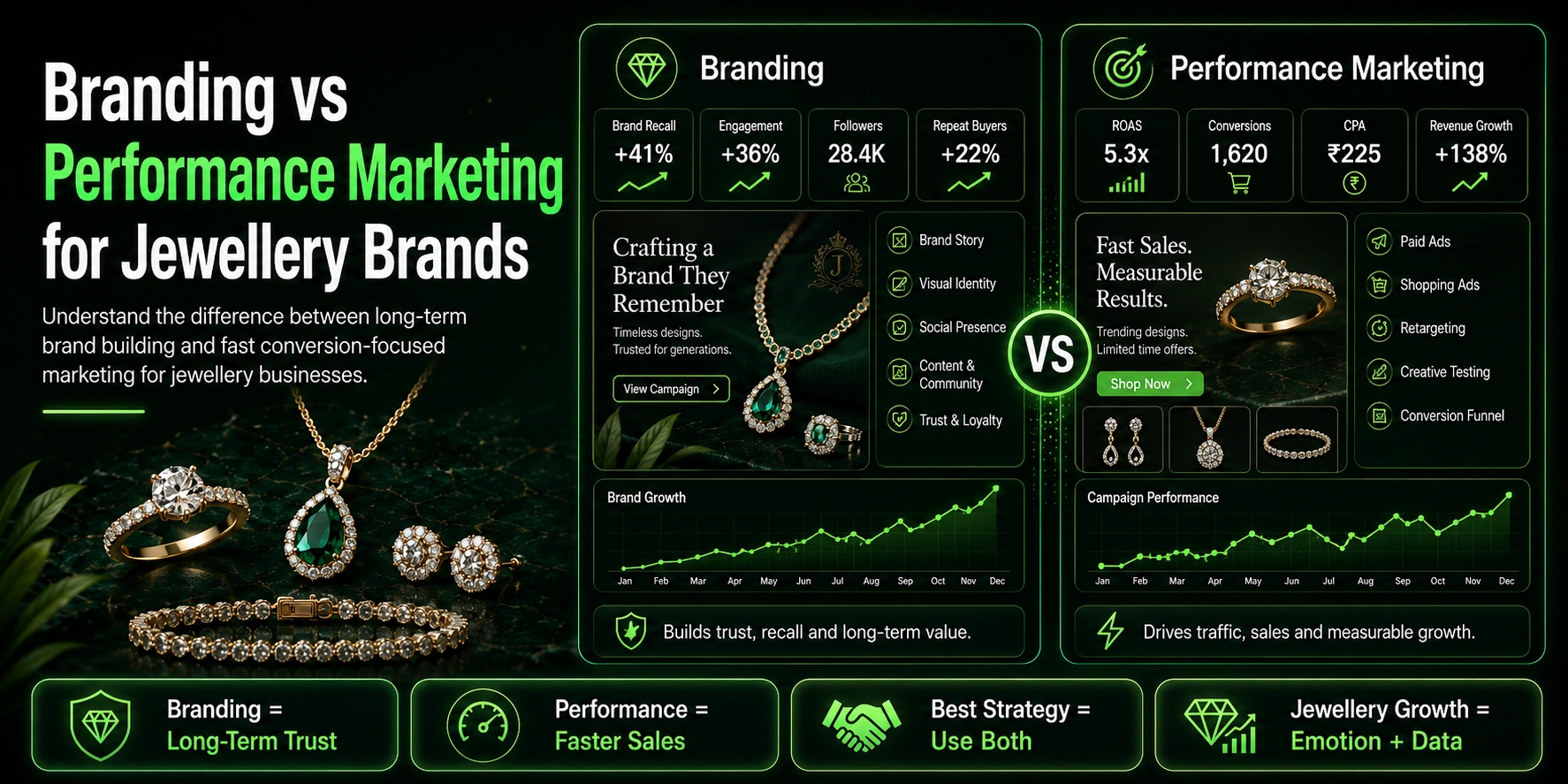
Every jewellery founder reaches this crossroads sooner or later. One advisor says put everything into ads because ads bring sales you can count. Another says build the brand first because nobody buys a fifty thousand rupee necklace from a name they have never heard of. Both sound right. Both feel expensive. And the wrong choice can quietly drain lakhs before you even notice.
So let us settle it honestly, right at the top. Branding and performance marketing are not rivals. They are two halves of a single growth system, and jewellery punishes brands that treat them as an either-or decision more brutally than almost any other category. Branding creates the trust and memory that make people willing to spend serious money with you. Performance marketing finds those people at the right moment and converts that willingness into measurable revenue. Remove either half and the system leaks money.
This guide breaks down what each discipline actually does for a jewellery business, what Indian market data reveals about the balance between them, how to split your budget at every stage of growth, and where a specialist partner like Kyros Solution fits into the picture.
The Quick Answer (If You Only Read One Paragraph)
For jewellery brands, branding and performance marketing work best as a sequence, not a contest. Build brand foundations first: clear positioning, a distinctive identity, visible trust signals, and a conversion-ready website. Jewellery is a high-value, trust-first purchase, so ads convert poorly without that groundwork. Once the foundation exists, use performance marketing to capture demand and generate revenue. Early-stage jewellery brands typically spend around 30 percent on brand and 70 percent on performance. As the brand matures, that balance gradually flips toward roughly 60 percent brand and 40 percent performance, because a strong brand keeps lowering the cost of every future sale.
What is Branding for a Jewellery Business?
Branding is the deliberate work of shaping how people perceive, remember, and trust your jewellery business before, during, and after a purchase. It is not just a logo and a colour palette.
For a jewellery brand, it covers:
- Positioning: the one clear idea you want to own in the buyer’s mind, such as everyday fine jewellery for working women, heritage bridal craftsmanship, or certified lab-grown diamonds for value-conscious couples.
- Visual identity: logo, typography, colour system, photography style, and packaging that make your pieces recognisable even without a name attached.
- Brand voice and storytelling: the way you talk about collections, craftsmanship, sourcing, and the moments your jewellery marks.
- Trust architecture: visible BIS hallmarking, IGI or GIA certification, transparent pricing, clear exchange and buyback policies, real customer photos, and founder credibility. In jewellery, these trust signals are as much a part of the brand as the design language.
- Experience design: the unboxing moment, after-sales care, and every small interaction that tells a customer they made the right choice.
Think about how the biggest Indian names use this. Tanishq built its position on purity assurance and emotional storytelling, which lets it charge confidently and win the wedding conversation. CaratLane made modern, lighter diamond jewellery feel accessible and backed it with innovations like home trials. GIVA carved out minimalist everyday silver for younger buyers. In each case, the brand does a large part of the selling before any ad is ever shown.
What strong branding delivers over time: mental availability (people think of you when the occasion arrives), pricing power (less pressure to discount), higher conversion on every channel, and a steadily falling cost of acquiring customers because trust arrives before the click.
What is Performance Marketing for a Jewellery Business?
Performance marketing is paid advertising where every rupee is tied to a measurable action: a purchase, a lead, a WhatsApp enquiry, a store-visit booking. Instead of paying for visibility and hoping, you pay for outcomes and optimise.
For jewellery brands in India, the core performance channels are:
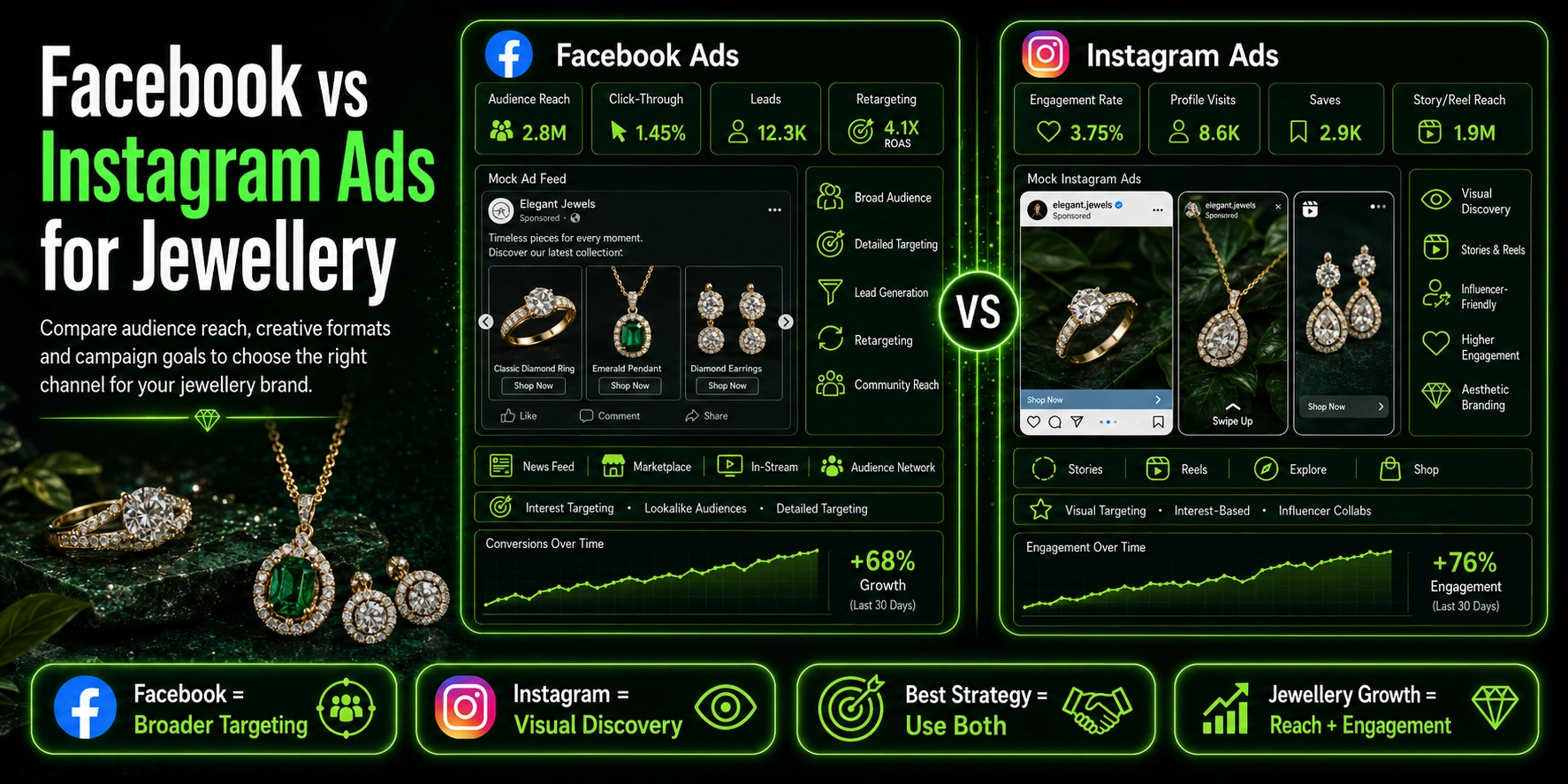
- Meta ads (Instagram and Facebook): discovery, storytelling in Reels formats, and retargeting warm audiences.
- Google Shopping and Performance Max capture high-intent searches such as engagement ring designs or gold jewellery online.
- YouTube and Shorts: consideration content for higher-ticket purchases.
- Retargeting and catalogue ads: bringing back the large share of jewellery buyers who browse, save, compare, and return weeks later.
- WhatsApp and CRM flows: converting high-value enquiries through conversation, which suits how Indians actually buy jewellery.
The metrics that matter: return on ad spend (ROAS), customer acquisition cost (CAC), marketing efficiency ratio (MER or blended ROAS), conversion rate, and average order value (AOV).
What performance marketing delivers: speed, precision, and proof. You can launch a campaign this week, see numbers by the weekend, and scale what works. For a category where festive and wedding windows decide the year, that responsiveness is priceless.
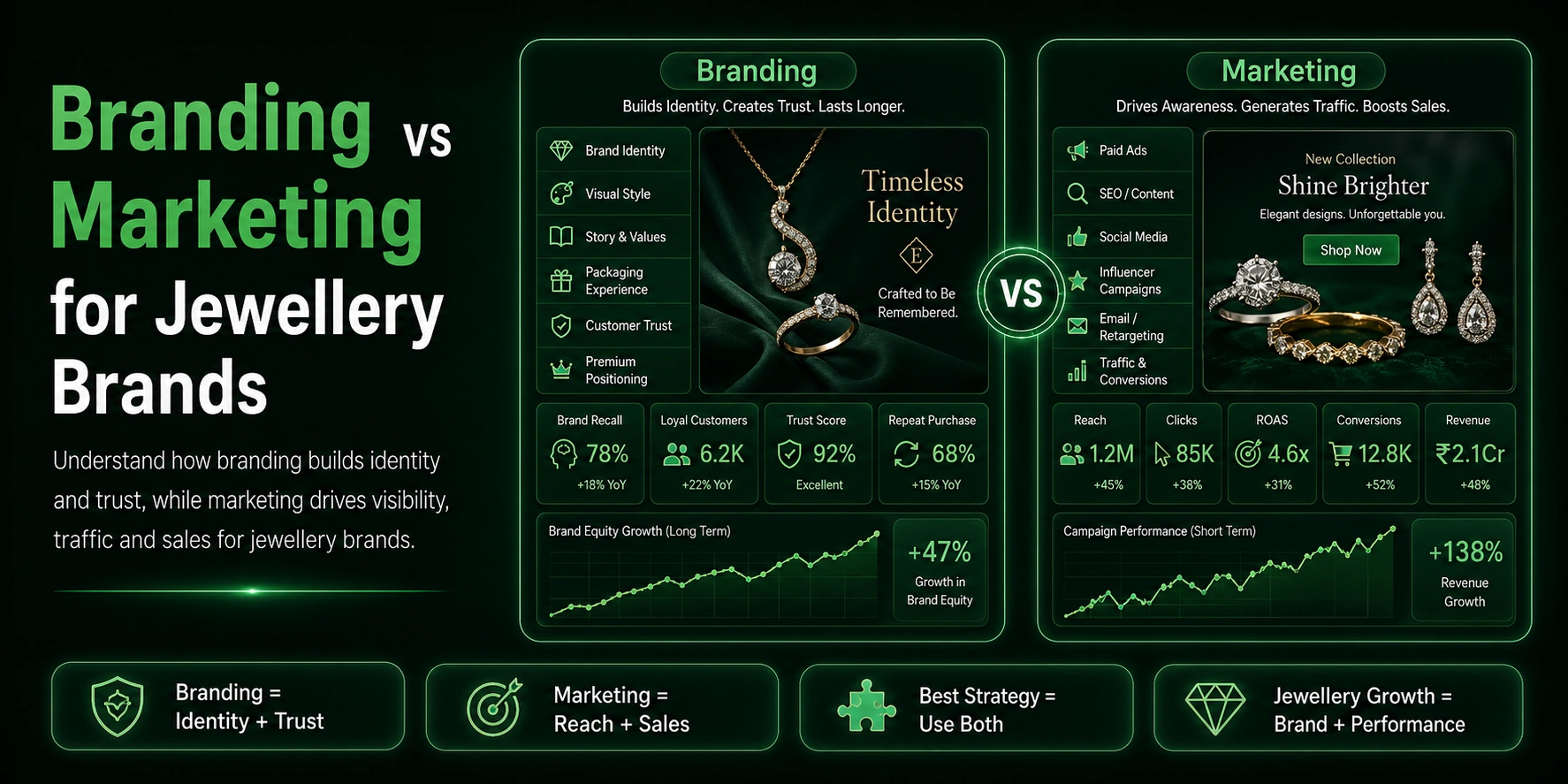
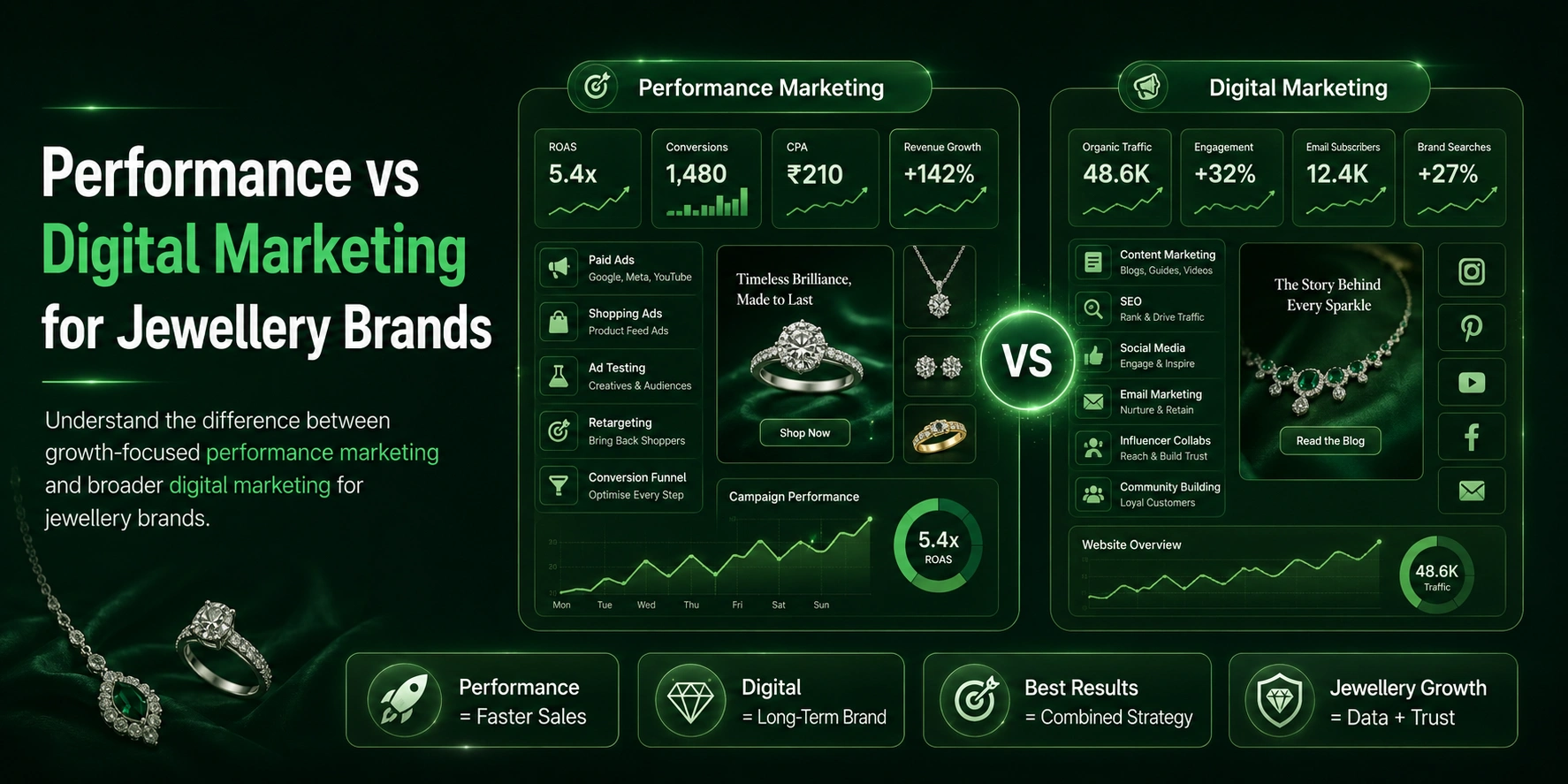
Branding vs Performance Marketing: The Key Differences at a Glance
| Aspect | Branding | Performance Marketing |
|---|---|---|
| Primary goal | Build trust, memory, and preference | Convert demand into measurable sales |
| Time horizon | Months to years, compounding | Days to weeks, immediate |
| How is it measured | Brand search volume, direct traffic, repeat rate, pricing power, share of voice | ROAS, CAC, CTR, conversion rate, revenue |
| Cost behaviour over time | Cost per result falls as equity builds | Cost per result rises as competition and CPMs climb |
| What happens when you stop | Effects fade slowly | Sales stop almost immediately |
| Biggest risk | Slow feedback, hard to attribute | Dependence on platforms, rising CAC, and discount addiction |
| Effect on pricing | Supports premium pricing | Often pressures margins through offers |
| Typical activities | Positioning, identity, storytelling, campaigns, PR, packaging | Meta and Google ads, retargeting, catalogue ads, landing page testing |
The table makes them look like opposites. In practice, each one fixes the other’s weakness, which is exactly why jewellery brands need both.
Why This Debate Hits Harder in Jewellery Than Any Other Category
Generic e-commerce advice fails jewellery brands because the buying psychology is fundamentally different.
Five realities shape everything:
1. It is a trust-first purchase: Nobody impulse-buys a one lakh rupee diamond ring from an unknown Instagram page. Before checkout, Indian buyers look for hallmarking, certification details, exchange clarity, reviews with real photos, and often a human conversation on WhatsApp. Trust is built by branding, not by bidding.
2. The ticket size is among the highest in D2C: High order values mean long consideration. A buyer may save your post, visit your product page four times, compare three competitors, ask family for opinions, and convert three weeks later. Performance marketing that only measures last click misses most of this journey.
3. Demand is occasion-led: Weddings, Dhanteras, Diwali, Akshaya Tritiya, anniversaries, and gifting seasons create sharp spikes. Brands that are already remembered when the occasion arrives win those spikes. Brands that only start advertising during the season pay peak auction prices to introduce themselves to strangers.
4. Gold carries cultural and investment weight: In India, jewellery is adornment, emotion, and an asset at the same time. Gold price movements affect sentiment, and buyers reward brands that feel stable, transparent, and permanent. Feeling permanent is a branding outcome.
5. Offline still dominates, and digital feeds it: Physical stores account for roughly 85 percent of Indian jewellery sales, according to industry research, yet a huge share of those buyers research online first. Your digital presence influences store footfall, not just website checkouts. That widens what marketing must accomplish beyond a ROAS number.
What the Indian Market Data Actually Says
If you want to make this decision with evidence rather than opinion, here is the picture the numbers paint.
The market is enormous and shifting online: India’s jewellery market was valued at around 94 to 95 billion US dollars in 2025 and is projected by research firms such as IMARC Group and Grand View Research to cross 150 billion dollars by the early 2030s. IBEF data places the gems and jewellery sector at about 85 billion dollars in early 2026, heading toward 130 billion dollars by 2030. Online is the fastest-growing channel, with global online jewellery forecasts running at double-digit annual growth. The demand is real, and it is moving into exactly the channels where branding and performance meet.
Paid acquisition keeps getting more expensive: Industry analyses estimate Meta CPMs in India rose roughly 40 to 60 percent between 2023 and 2025, driven by privacy changes and hundreds of D2C brands bidding on the same audiences. The era of cheap reach that built the first D2C wave is over. When media inflation is structural, the only durable lever is a brand strong enough to convert attention more efficiently than competitors.
Most brands plateau, and the reasons are telling: A survey of more than 100 Indian D2C founders by DSG Consumer Partners and Meta found that roughly 60 to 65 percent of brands stay stuck in the 1 to 50 crore revenue band. Around 62 percent of founders reported creative fatigue, where the same ad formats stop working despite higher spends, and about 55 percent admitted to under-investing in retention, with repeat purchase rates commonly sitting at just 10 to 30 percent. In plain words: performance-only playbooks stall, and the gap is almost always in brand, creative depth, and retention.
Jewellery ads can perform brilliantly when the foundation exists: Category benchmarks in India commonly show around 3 to 6x ROAS on Meta and 6 to 10x on Google Shopping for jewellery brands whose trust signals, product pages, and retargeting systems are in place. The same budgets produce a fraction of those numbers when the brand layer is missing. The variable is rarely the ad platform. It is what the click lands on and how much the buyer already trusts the name.
The Performance-Only Trap: What Happens When You Skip Branding
This story repeats across hundreds of Indian jewellery labels. The first campaign works. ROAS looks healthy because early ads harvest the easiest demand: people already close to buying. Encouraged, the founder scales spending. Then the pattern turns.
CPMs climb. The easy buyers run out. Creative fatigue sets in, so new ads are made, but they all say the same thing because there is no brand story to draw from, only product shots and offers. Discounts become the only reliable conversion trigger, which trains customers to wait for sales and erodes the premium feel jewellery depends on. Buyers purchase once and disappear, because nothing beyond the deal gave them a reason to belong. CAC rises every quarter even as follower counts grow.
That last symptom is the clearest diagnostic in marketing: if awareness is growing but acquisition keeps getting more expensive, you have built an audience, not a brand. You are renting customers from Meta and Google on ever-worsening terms, and the moment the ads pause, revenue stops. In a category where a single customer can be worth lakhs over a lifetime of anniversaries, festivals, and milestones, renting is the most expensive possible strategy.
The Branding-Only Trap: Beautiful but Invisible
The opposite failure is quieter but just as fatal. Some founders invest heavily in a gorgeous identity, cinematic photography, and a poetic brand story, then wait for the market to notice. It rarely does.
Jewellery has massive active demand: millions of monthly searches for engagement rings, gold earrings designs, mangalsutra styles, and lab-grown diamonds. If you are not running structured performance campaigns, competitors capture that demand while your beautiful brand sits unseen. You also lose the feedback loop. Performance data tells you which collections, price points, messages, and audiences actually pull. Without it, brand decisions are guesses. And because branding pays back over quarters rather than days, a branding-only approach starves cash flow exactly when a young business needs oxygen.
A brand nobody encounters is a private art project. Performance marketing is how it meets the market.
The Real Answer: It Is a Sequence and a System, Not a Versus
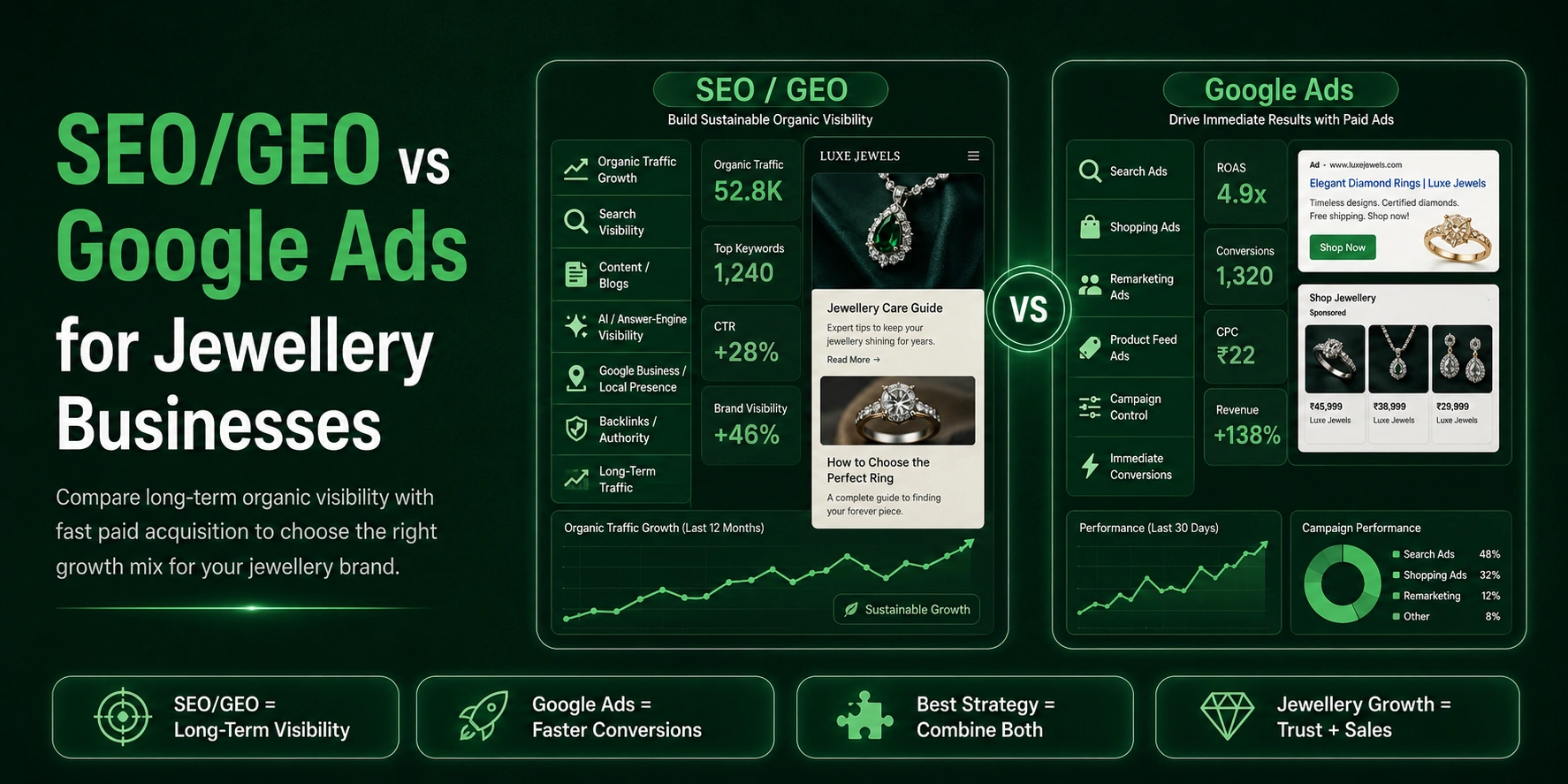
Marketing science settled the underlying question years ago. Long-term studies by researchers Les Binet and Peter Field across hundreds of campaigns found that brand building drives the majority of long-term growth while activation drives short-term sales, and that established brands grow best around a 60:40 balance between the two. The exact ratio shifts by category and stage, but the principle holds everywhere: brand makes performance cheaper, and performance makes brand affordable.
For jewellery specifically, the healthy sequence looks like this:
Step 1: Build the trust layer before spending on traffic. Positioning, identity, certification visibility, photography, and a fast, credible, conversion-focused website. Every rupee of future ad spend multiplies against this foundation.
Step 2: Switch on performance to capture existing demand. Google Shopping for high-intent searches, Meta for discovery and retargeting, WhatsApp for high-ticket conversations. This generates the revenue and the data.
Step 3: Reinvest into brand so acquisition keeps getting cheaper. Storytelling campaigns, content, creators, community, and retention. Branded search grows, direct traffic grows, repeat purchases grow, and blended CAC falls. That surplus funds more performance, which funds more brand. This is the flywheel every enduring jewellery name runs on.
A Stage-by-Stage Budget Framework for Jewellery Brands
Use these splits as starting points, not laws. They describe ongoing marketing budgets after one-time setup costs.
Stage 1: Launch (pre-revenue to about 1 crore)
Foundation first, always. Before meaningful ad spend, get positioning, naming, identity, packaging, product photography, and a CRO-ready store right. Launching ads onto a weak website is the single most common way new jewellery brands burn capital. Once live, run roughly 30 percent brand (content, organic social, creator seeding) and 70 percent performance (small, disciplined campaigns to find which products, audiences, and messages convert). The goal at this stage is learning velocity, not scale.
Stage 2: Growth (about 1 to 10 crore)
Performance remains the engine at around 60 to 65 percent of budget, but the brand share must rise to 35 to 40 percent and become systematic: SEO content clusters that answer real buyer questions, a UGC and creator engine, story-led social, and retention flows on WhatsApp and email. This is the stage where most Indian D2C brands stall, precisely because they keep the launch-stage ratio too long and hit the rising-CAC wall.
Stage 3: Scale (10 crore and beyond)
Rebalance toward roughly 55 to 60 percent brand and 40 to 45 percent performance. Category-level storytelling, seasonal brand campaigns ahead of festive windows, PR, and omnichannel presence now do the heavy lifting, while performance efficiently harvests the demand the brand creates. At this stage, brand strength is what separates names that command premiums from names that compete on discounts.
Quick self-diagnosis: which side needs attention right now?
You likely need more branding if CAC has risen for several consecutive quarters, sales depend on discounts, hardly anyone searches for your brand name, buyers compare you purely on price, and your ads only work with an offer attached.
You likely need more performance if people who discover you love you, but discovery is rare, traffic arrives with no retargeting structure behind it, festive spikes pass without a campaign plan, and beautiful content exists with no funnel underneath it.
8 Practical Ways to Make Branding and Performance Work Together
1. Put brand codes in every ad: Your palette, typography, tone, and signature visual style should appear in every performance creative. That way, even ads that do not convert today are depositing memory for tomorrow, and paid spend compounds instead of evaporating.
2. Sequence retargeting like a story, not a nag: First touch educates (craftsmanship, certification, sourcing). Second touch proves (reviews, real customer photos, press). Third touch converts (offer, urgency, easy payment options). Jewellery buyers need reassurance layered over time, and this structure respects how they actually decide.
3. Treat UGC and creator content as dual assets: A genuine customer video wearing your pieces builds brand warmth organically and becomes your highest-converting ad creative. Brief creators once, harvest twice.
4. Own your branded search: As brand campaigns grow name searches, protect those searches with inexpensive branded keywords and an organic presence, or competitors will happily buy your hard-earned demand.
5. Build SEO content clusters around buyer questions: Guides on gold purity, diamond certification, styling, and gifting capture buyers early, earn citations in AI search results, and keep lowering your blended acquisition cost. This is the most underused compounding channel in Indian jewellery marketing.
6. Run festive seasons in two waves: Brand-led storytelling four to six weeks before Dhanteras, Diwali, Akshaya Tritiya, or the wedding season builds preference while attention is cheap. Performance campaigns then harvest during the peak, when your name is already in the buyer’s shortlist, and competitors are paying peak prices to introduce themselves.
7. Fix the middle of the funnel: The website is where brand promise and performance traffic meet. Speed, mobile experience, product page trust blocks, smart filters, and effortless checkout often move revenue more than any bidding change. Conversion rate improvements make every channel cheaper simultaneously.
8. Measure blended health, not just ROAS: Track marketing efficiency ratio (total revenue divided by total marketing spend), branded search volume, direct traffic, repeat purchase rate, and contribution margin. Platform dashboards flatter themselves; blended numbers tell the truth about whether brand and performance are compounding together.
Common Mistakes Jewellery Brands Make in This Debate
Copying beauty and fashion playbooks: Those categories sell low-ticket, high-frequency products where impulse conversion works. Jewellery is high-ticket, low-frequency, and trust-gated. The funnel, the creative, and the patience required are all different.
Running catalogue-only creatives: Endless product shots with prices teach the market to treat you as a commodity. Story, occasion, and craftsmanship framing are what justify jewellery margins.
Switching everything off after the festive season: Buyers who discovered you in November convert in January and return for anniversaries in June. Always-on presence at reduced intensity beats seasonal on-off cycles.
Judging brand work with week-one performance metrics: Brand investments show up in branded search, repeat rates, and falling CAC over quarters. Killing them after two weeks of flat ROAS guarantees you never see the payoff.
Making discounting structural: Occasional festive offers are healthy. Permanent discounting signals that even you do not believe your pricing, and it attracts exactly the customers who will never pay full price.
Ignoring retention: With jewellery lifetime value spanning engagements, weddings, anniversaries, and festivals, a WhatsApp and email retention system is often the highest-ROI marketing asset a brand owns, and most brands under-invest in it.
How Kyros Solution Balances Both for Jewellery Brands
Most agencies force you to choose: a branding studio that speaks in mood boards, or a performance shop that speaks only in ROAS. Kyros Solution was built to close that gap, working exclusively with jewellery and lifestyle brands so that both disciplines are designed for how jewellery is actually bought.
On the brand side, the branding service for jewellery brands covers positioning, messaging frameworks, visual identity systems, brand voice, collection storytelling, and launch playbooks- the exact trust layer this article argues must come first. On the demand side, the performance marketing service runs a full-funnel media strategy across Meta and Google, continuous creative testing to beat fatigue, retargeting and catalogue systems, and disciplined budget scaling with weekly reporting.
The connective tissue matters just as much, which is why jewellery brands also lean on Kyros for conversion-focused web development, UI/UX design that lifts product page conversion, SEO built around jewellery buyer questions, content marketing, and social media management that balances storytelling with sales.
The results of treating brand and performance as one system show in the numbers: 120+ successful launches, a 98 percent client retention rate, and Shopify Partner status, serving jewellery brands across India and beyond. You can see the work across brand identities, e-commerce builds, and growth campaigns in the Kyros portfolio.
If your CAC is climbing, your ads feel tired, or your beautiful brand is not converting, book a strategy call with Kyros Solution. One honest conversation about your numbers will show you which side of the system needs attention first.
Final Thoughts
The question was never branding versus performance marketing. For jewellery brands, it is branding times performance marketing: one multiplies the other. A brand without performance is invisible. Performance without brand gets more expensive every quarter until the maths stops working. The brands that will own India’s next decade of jewellery growth, both online and in stores, are the ones building trust and capturing demand as a single, deliberate system.
Start with the foundation, switch on the engine, and reinvest what the engine earns into the foundation. If you want a partner that has run this exact loop for jewellery brands more than a hundred times, talk to Kyros Solution.
FAQs
Which is better for a jewellery brand: branding or performance marketing?
Neither is better; they solve different problems. Branding builds the trust and memory that make people willing to buy high-value jewellery, while performance marketing converts that willingness into measurable sales. Jewellery brands that run both as one system consistently outgrow brands that pick a side.
What budget split should a jewellery brand use between branding and performance?
As a starting point: around 30 percent brand and 70 percent performance at launch, 35 to 40 percent brand during growth, and 55 to 60 percent brand at scale. The right split depends on your CAC trend, repeat rate, and how much branded search you already command.
How long does branding take to show results for a jewellery business?
Expect early signals in three to six months (branded search growth, better ad conversion, stronger engagement) and compounding financial impact over 12 to 24 months through lower acquisition costs, higher repeat purchases, and pricing power. Branding is slower than ads, but its effects stack instead of resetting.
What is a good ROAS for jewellery ads in India?
Well-run jewellery brands in India commonly see around 3 to 6x ROAS on Meta and 6 to 10x on Google Shopping. If your numbers sit far below these ranges, the problem is usually trust signals, product pages, or creative depth rather than the ad platform itself.
Can a small jewellery brand start ads without doing branding first?
You can, but expect expensive lessons. Ads pointed at a store without clear positioning, certification visibility, and credible product pages convert poorly, and the data you collect will be muddied by fixable trust problems. Even a lean brand foundation before launch multiplies every rupee of ad spend afterwards.
Why does my jewellery brand’s CAC keep increasing?
Rising CAC usually combines market-wide media inflation with a brand-specific gap: if awareness grows while acquisition gets pricier, your brand is not building enough trust to convert attention efficiently. Creative fatigue, discount dependence, and weak retention accelerate the problem. The durable fix is strengthening the brand layer, not just optimising bids.
Does this apply to offline jewellery stores too?
Completely. Most Indian jewellery buyers research online before visiting a store, so branding shapes which showroom they walk into and performance campaigns can drive appointments, footfall, and WhatsApp enquiries rather than only website checkouts. Omnichannel jewellers arguably benefit from this system more than anyone.