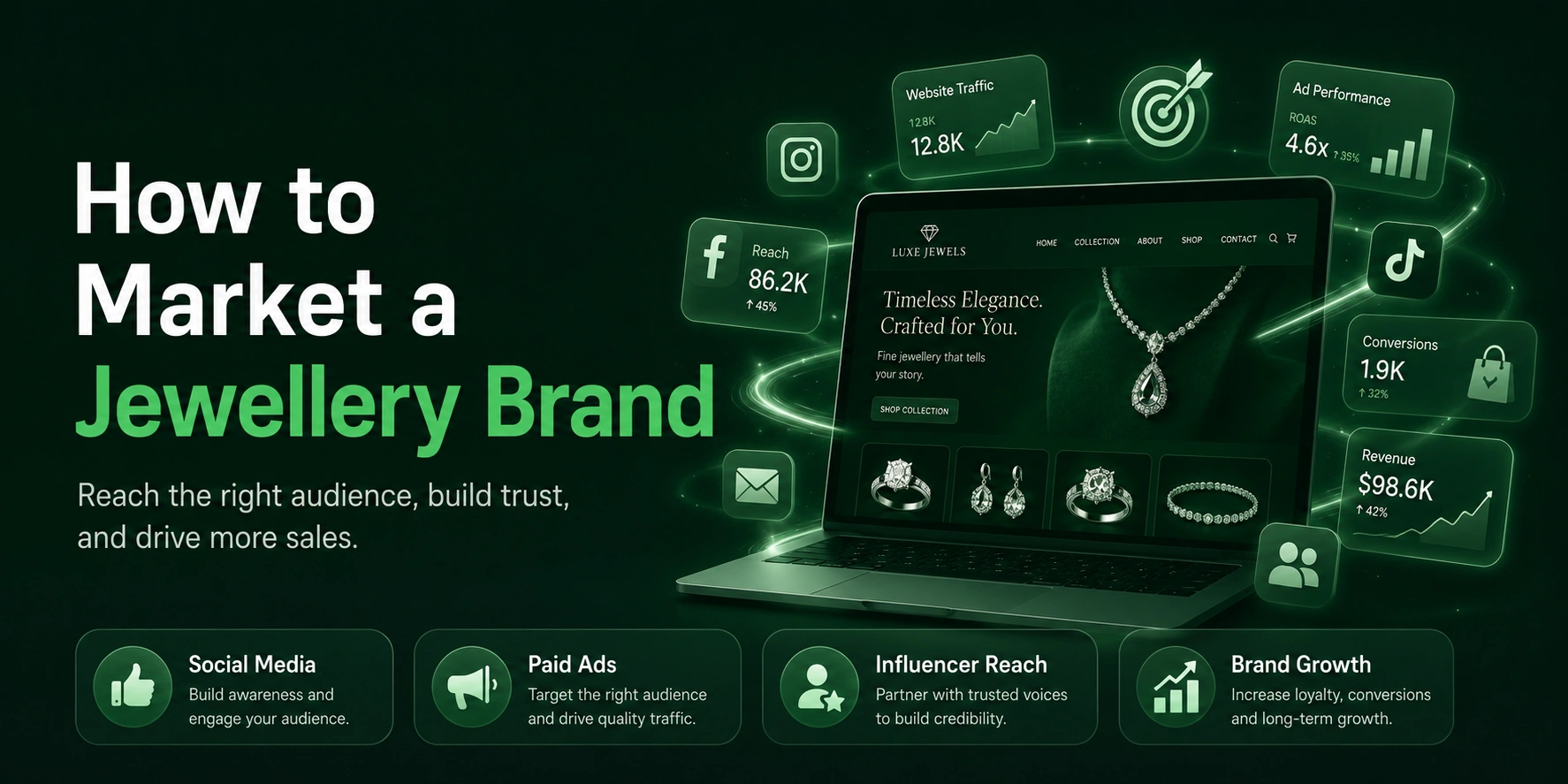
Marketing a jewellery brand is not the same as marketing a shampoo, a sneaker, or a phone case. The order value is high, the decision is emotional, the buyer rarely converts on the first visit, and trust has to be earned before a single rupee changes hands. Get the trust part wrong, and no amount of ad spend will save you. Get it right, and marketing becomes the quiet system that moves someone from a Reel they liked at 11 pm to a purchase they feel proud of.
This guide is written for founders and marketers building jewellery brands in India, whether you sell silver everyday pieces, fine gold and diamond, bridal sets, or lab-grown stones. It covers what to say, where to say it, and in what order, grounded in how Indians actually discover and buy jewellery.
The short answer
To market a jewellery brand in India, build visible trust first (hallmarking, certification, clear pricing, exchange and buyback terms, real customer photos and reviews), then match each channel to the job it does across a long buying journey. Use Instagram and Pinterest for discovery, SEO and Google Shopping to capture people already searching, WhatsApp and try-at-home to convert high-value buyers, and email plus WhatsApp to bring them back. Sell design, meaning, and everyday wearability rather than gold weight, because record gold prices in 2026 have shifted many buyers toward lighter, lower-cost, design-led pieces. Do all of this with genuinely useful content, and your visibility on Google and AI search will follow, because that is what those systems now reward.
The rest of this article turns that answer into a plan you can act on.
Why jewellery marketing works differently
Most ecommerce marketing advice assumes a short, fairly rational purchase. Jewellery breaks those assumptions in four ways, and understanding them is the difference between spending well and spending fast.
First, the price is high, and the decision is slow. A buyer may spend forty thousand rupees on a pendant or several lakhs on a bridal set. Brides often research for six to twelve months before committing. Nobody makes that call after one advertisement. Your marketing has to show up repeatedly, across weeks, with the right message at each stage.
Second, the purchase is emotional and identity-driven. People buy jewellery to mark a milestone, to gift love, to feel like themselves, or increasingly to reward their own wins. The most successful Indian jewellery marketing of the last decade leaned into this. CaratLane shifted the story from jewellery as a gift a man buys for a woman to jewellery a woman buys for herself, and built an everyday-wear category around that idea. Emotion is not decoration on top of the product. It is the product.
Third, trust is the real barrier, not price. Indians have bought gold from a trusted family jeweller for generations. Asking someone to buy online, or from a brand they met on Instagram last week, means asking them to trust you with something both financially and emotionally significant. This is why the early D2C jewellery brands spent years solving the trust deficit before scale followed.
Fourth, the journey is multi-touch and crosses the online and offline line constantly. A common path looks like this: a buyer discovers you on Instagram, searches your name on Google, reads reviews, asks a question on WhatsApp, maybe visits a store or books a try-at-home, and only then buys, sometimes on the website and sometimes in person. Roughly a third to half of high-value jewellery buyers check a brand in a showroom or over WhatsApp before purchasing online. Marketing has to serve the whole path, not just the first click.
If you take one idea from this section, take this: your job is not to sell a product in a single ad. Your job is to remove hesitation at every step of a long, emotional, high-value decision. That reframing is what separates jewellery brands that grow profitably from those that burn cash chasing clicks. We explored a related version of this idea in our piece on branding versus marketing for jewellery brands.
What record gold prices in 2026 changed
You cannot plan jewellery marketing this year without understanding what gold has done. Prices surged more than sixty percent through 2025, the strongest annual rise in decades, and kept climbing into 2026, with domestic prices touching record highs near one point seven to one point eight lakh rupees per ten grams at their peak before a correction. Even after that pullback, prices have stayed high.
The effect on buying behaviour is measurable and important for how you market. In early 2026, gold jewellery volumes fell around nineteen percent compared to the previous year, one of the weakest quarters on record, yet the value of what people spent rose sharply because each gram cost so much more. Meanwhile, investment demand through coins, bars, and gold ETFs climbed to nearly seventy percent of total gold demand, with jewellery falling to about thirty percent, the lowest share in more than two decades. Digital gold bought through UPI multiplied several times over. In plain terms, a large chunk of the country started treating gold as an asset to invest in rather than an ornament to wear.
For a jewellery brand, this splits your market and changes your message. Buyers are still spending, but they are buying smarter. They favour lighter pieces, lower-carat options, silver, and lab-grown diamonds that deliver the look at a friendlier price. They accumulate in stages rather than in one large purchase, even for weddings. They lean on old-gold exchange, which in some markets now accounts for a large share of transactions.
So this year, marketing that leads with gold weight and investment value fights an uphill battle against actual gold bars and ETFs, which do that job better. Marketing that leads with design, craft, meaning, everyday wearability, and value-for-money wins the buyer who wants to own and wear something beautiful without overpaying for metal. This is exactly the window in which silver, demi-fine, and lab-grown brands are taking share, and it is the message legacy-minded brands should be adapting to as well. Notably, online and e-commerce jewellery channels grew fast through this period even as overall volumes softened, which tells you the digital-first opportunity is still very much open.
Map the buyer journey before you pick a channel
The most common mistake is picking channels first (we should be on Instagram, we need Google Ads) and then wondering why the money does not convert. Start with the journey instead, then assign channels to stages.
| Stage | What the buyer is doing | What your marketing must do | Primary channels |
|---|---|---|---|
| Discovery | Scrolling, getting inspired, noticing a style | Get seen with beautiful, scroll-stopping, saveable content | Instagram Reels, Pinterest, influencer content, top-of-funnel Meta ads |
| Research | Comparing, searching for specifics, and reading reviews | Answer questions, show proof, appear in search | SEO and blog content, Google Search, review platforms |
| Validation | Checking if you are trustworthy and real | Remove doubt with certification, policies, and real customers | Product pages, WhatsApp, try-at-home, testimonials |
| Purchase | Ready to buy, needs the final push | Make buying easy and reassuring | Website, Google Shopping, WhatsApp, retargeting, EMI and exchange offers |
| Retention | Owns the piece, may buy again or refer | Stay in touch, reward loyalty, invite advocacy | Email, WhatsApp, loyalty, UGC campaigns |
When you see the journey laid out, two things become obvious. A single channel cannot do everything, and the stage most brands neglect is validation. That is the stage where trust is either built or lost, so we start there.
Build your trust infrastructure first
Before you spend on a single ad, make sure that when an interested buyer inspects you closely, everything they find reassures them. Trust signals are not a nice-to-have in jewellery. They are the highest-leverage marketing you can invest in, because they lift the conversion rate of every other channel at once.
At a minimum, make the following visible and easy to find. Show BIS hallmarking clearly, and for diamonds, show IGI or GIA certification on every relevant product. Publish transparent pricing that separates metal cost from making charges, so buyers understand what they are paying for. State your return, exchange, and buyback terms plainly, in writing, because fear of being stuck with the wrong piece is a major reason people hesitate. Show real customer photos on real Indian skin tones, not only studio shots on white backgrounds, because buyers want to see how a piece actually looks on someone like them. Collect and display reviews and ratings. Tell the story of your craft and sourcing, because provenance creates emotional reassurance that a spec sheet cannot.
None of this is glamorous, and that is precisely why many brands skip it and keep pouring money into ads that then leak away at the product page. A buyer who arrives ready to spend fifty thousand rupees and finds no hallmark information, no clear return policy, and no real customer photos will simply leave. Fixing that is cheaper and more profitable than acquiring another visitor to replace them. If your product pages and site experience are not built to reassure, that is where a conversion rate optimisation partner earns its keep.
Match each channel to the job it does
With trust in place, here is how to use each channel for what it is good at. Resist the urge to make every channel do everything.
Instagram and Reels: discovery and desire
Instagram is where most Indian jewellery discovery happens, and video is the format that travels. Post short Reels several times a week, and prioritise saves over raw reach, because a save is a stronger signal of purchase intent than a like. The content that works is not endless product-on-white shots. It is jewellery in motion and in life: try-on videos, styling ideas, close-up craftsmanship, the making of a piece, and short stories about a design or an occasion. Carousels are worth using too, since they tend to earn strong engagement by inviting people to swipe through details. Reels consumption is now a pan-India habit, growing fast in Tier 2 and Tier 3 cities, so you are not only reaching metros.
Pinterest: bridal and inspiration search
Pinterest behaves less like social media and more like a visual search engine for planning. People use it to plan weddings, festive looks, and gifts, often months ahead. Create boards by collection and occasion, write keyword-rich pin titles, and link each pin to the right product or category page. For bridal and occasion jewellery, this is a patient, high-intent discovery channel that keeps working long after you post.
SEO and content: capture the people already searching
The large majority of online shoppers begin on Google or AI before they ever click an ad or open a marketplace. That is the demand you want to capture with search or AI-optimised content, and it compounds. A product or category page that ranks in the top few results for a buying-intent query can keep delivering qualified buyers for a year or more with only light upkeep, which is a very different economic profile from ads that stop the moment you stop paying.
Think in terms of the full funnel of searches, not just one keyword. Informational queries like how to choose an engagement ring or the difference between lab-grown and natural diamonds are where you build authority and meet buyers early. Commercial queries like best silver jewellery brands in India or a lightweight gold necklace under a certain price are where comparison and value content win. Transactional queries like buy gold pendant online are where your product and category pages must rank. Give every important page one clear target so your own pages do not compete with each other, write titles and descriptions for humans rather than stuffing keywords, and back it all with genuinely useful copy. If SEO is competing with paid search in your plan, our comparison of SEO versus Google Ads for jewellery businesses breaks down when each pays off.
AI search: an outcome of good content, not a separate trick
There is a lot of noise about optimising for AI Overviews and answer engines. Here is the honest version, and it matches Google’s own guidance. Optimising for AI search is still SEO. There is no special file, no secret schema, no AI-only writing format that gets you cited. AI features are built on the same ranking and quality systems as regular search, and they pull from content that is already indexed and trustworthy. Advertisements do not earn AI citations. Only strong organic content does.
What earns a place in AI answers is content that adds something a summary cannot: a clear point of view, first-hand expertise, specific and accurate detail, and a direct answer to the exact question a person asked. AI answers appear most often on informational and comparison queries, which is a real opening for smaller jewellery brands, because these are the questions where a thoughtful, specific piece can outrank a generic one. Product pages written as genuinely helpful mini-guides, covering materials, care, sizing, certification, and meaning, give both buyers and AI systems the context to choose you. In short, write the best, most specific, most trustworthy answer to the questions your buyers ask, and AI visibility follows. Chasing hacks instead is wasted effort. This is also why our approach to SEO and generative engine visibility treats the two as one discipline rather than two.
Google Shopping and Google Ads: intent at the point of decision
When someone searches for a specific type of jewellery, they are close to buying. Google Shopping puts your product, price, and image directly in front of that intent, and for fine jewellery, it tends to deliver strong returns because the searcher already wants the thing. Search ads capture branded and high-intent queries. The key is to structure campaigns around margin and order value, not vanity return numbers, which brings us to measurement later in this guide.
Meta Ads: the full-funnel engine with jewellery-specific retargeting
Meta (Facebook and Instagram) ads work across the whole funnel, but jewellery needs a different setup from fast-moving products. Because the decision is slow, standard seven or fourteen day retargeting windows cut off most buyers before they decide. Extend your windows to thirty, sixty, and even ninety days, and match the message to the stage. Early on, remind and inspire. In the middle, educate with craft, provenance, and certification content and invite a try-at-home or showroom visit. Near the end, convert with payment flexibility, exchange offers, limited-stock nudges, and occasion-based urgency.
One India-specific point that many brands miss: high-value jewellery is often a family decision. The person who wears the piece may not be the person who signs off on the spend. Run parallel messaging that speaks to the wearer for discovery and to the decision-maker, often a partner or parent, for the final purchase. For deeper context on how paid social fits alongside the rest of your mix, see performance marketing versus digital marketing for jewellery brands.
WhatsApp: where high-value jewellery quietly closes
In India, a large share of jewellery sales move through WhatsApp conversations, and this is underutilised by most brands. For higher-order values, Click-to-WhatsApp ads move a serious buyer into a personal conversation where you can answer questions, share a catalogue, explain certification, and build the confidence needed for a big purchase. Respond quickly, ideally within a few minutes; keep any checkout short, and use WhatsApp again after purchase for order updates and gentle repeat-purchase nudges. Treated as a full commerce channel rather than a support inbox, WhatsApp becomes one of the most effective conversion and retention tools you have.
Influencers and creators: relevance beats reach
Influencer marketing suits jewellery because the category is visual and aspirational, but the instinct to chase the biggest name is usually wrong. A single mega-celebrity campaign often generates reach without revenue, while a bridal stylist or an ethnic-fashion creator with a smaller, highly relevant audience can drive actual sales. User-generated and creator content also tends to influence purchase decisions far more than polished celebrity endorsements, because it feels believable. A practical model is to seed a batch of eight to twelve relevant micro-creators, secure the rights to reuse their content, identify which pieces of content perform, and then amplify the winners with a paid budget. That turns influencer work from a gamble into a repeatable system.
Email and WhatsApp retention: the profit lever nobody brags about
Acquisition gets the attention, but retention gets the profit. Most Indian D2C brands see repeat purchase rates in the fifteen to twenty-five percent range, which means the single biggest lever on profitability is getting more customers to come back. Retention channels like email and WhatsApp are also your highest-return channels because you are marketing to people who already trust you. Build post-purchase flows, occasion reminders, care tips, early access to new collections, and a simple loyalty structure. A buyer who trusted you with a first purchase is far more likely to trust you with a bigger second one.
Match your strategy to your segment
Not all jewellery brands should market the same way. Your segment determines what to emphasise and where to invest first.
| Segment | Typical buyer | What to emphasise | Where to invest first |
|---|---|---|---|
| Fashion, silver, everyday | Younger, self-purchase, style-led | Design, affordability, everyday wearability, trend | Instagram and Reels, influencer seeding, fast site experience |
| Fine gold and diamond | Considered, higher AOV, milestone-led | Trust, certification, craft, value framing, EMI | SEO and Google Shopping, trust signals, WhatsApp |
| Bridal | Research-heavy, long cycle, family involved | Real-bride proof, consultation, styling, provenance | Pinterest and SEO, WhatsApp consultations, longer retargeting |
| Lab-grown diamond | Value-driven, informed, sustainability-minded | Education, certification transparency, and upgrade value | Comparison content, SEO, Google Shopping |
The pattern to notice is that lower-priced, style-led segments lean on discovery and speed, while higher-priced and bridal segments lean on trust, education, and patient nurture. Knowing which one you are stops you from copying tactics that fit a different kind of brand.
Plan around the Indian calendar
Jewellery demand in India is deeply seasonal, and planning creativity and budget around the calendar is one of the easiest wins available. Prepare campaigns, landing pages, and creator content eight to twelve weeks before the big moments rather than scrambling at the last minute.
The peaks to build around include Akshaya Tritiya in spring, considered the most auspicious day to buy gold and worth enormous single-day sales; the wedding seasons that run across large parts of the year and drive engagement, mehendi, sangeet, and reception purchases; the festive stretch of Dhanteras and Diwali, when gifting is a cultural norm; Raksha Bandhan gifting from mid-year; and occasion-led moments like Valentine’s Day and Karva Chauth that support pendants, rings, and personalised pieces. Between these peaks, personalised and life-event pieces such as birthdays, anniversaries, and self-reward purchases keep demand alive year round, so you are never entirely dependent on a festival.
Measure what matters, not just ROAS
Return on ad spend is a seductive number that can hide a losing business. A ten times return can still lose money if your cost to acquire a customer is too high relative to your margin. Digital advertising costs in India have risen roughly forty to sixty percent over three years, so disciplined measurement matters more than ever.
Track cost per acquisition against your true margin, not against revenue alone. Because jewellery order values are high, brands with healthy AOV can profit at lower return multiples than low-ticket sellers who need much higher returns just to break even. Watch average order value, since lifting it even modestly can improve profitability without extra ad budget. Follow customer lifetime value and repeat purchase rate, because those reveal whether you are building a compounding business or renting revenue from ads. And respect assisted conversions, because a buyer might see an Instagram ad, search on Google, ask on WhatsApp, and only then purchase. Judging each channel in isolation will lead you to cut the very touchpoints that make the others work. Look at blended performance across the whole funnel.
What the winners actually did
Two Indian brands illustrate the principles above at different price points.
CaratLane, founded in 2008 and later majority-owned by Titan, grew into a brand valued in the thousands of crores with more than two hundred and fifty stores and a topline in the region of three thousand crore rupees. What is instructive is not the scale but the method. It attacked the trust problem head-on with transparent pricing and technology, built the world’s first virtual 3D jewellery try-on and a try-at-home service across many cities, and adopted a research online, try offline, buy anywhere model that lifted conversion well above standalone ecommerce. It’s marketing-led with emotion and everyday self-expression rather than luxury and occasion. Trust plus emotion, executed across online and offline, is the throughline.
GIVA, founded in 2019 in Bengaluru, grew into a brand worth several hundred crore rupees within a few years by taking a different route to the same principles. It modernised silver as an affordable, everyday alternative to gold for young Indians, then expanded into gold and lab-grown diamonds as customers built trust and graduated up. It leaned hard on digital and content early, signed a relatable celebrity ambassador, ran participation-driven social campaigns, and combined online reach with a fast-growing store network so buyers could touch the product. Solve the trust deficit, meet a changing buyer where they are, and let people move up the range over time.
Neither brand won by finding a clever hack. They won by understanding the buyer and building trust patiently, which is available to any brand willing to do the work.
A simple 90-day starting sequence
If you are early or resetting, do not try to switch on every channel at once. Sequence the work so each phase makes the next one more effective.
- Days 1 to 30, fix trust and foundations. Make hallmarking, certification, pricing clarity, and return and exchange terms visible on every relevant page. Replace white-background-only images with real photos on real skin. Turn on reviews. Set up your website analytics and WhatsApp Business properly. This alone lifts the conversion of everything you do later.
- Days 31 to 60, build discovery and search. Establish a consistent Reels and Pinterest rhythm, publish your first cluster of genuinely useful blog and buying-guide content mapped to real buyer questions, and set up Google Shopping. Begin seeding a small group of relevant micro-creators and gather the right to reuse their content.
- Days 61 to 90, layer paid and retention. Introduce Meta prospecting and long-window retargeting with stage-matched creative, add Click-to-WhatsApp for higher-value pieces, and launch your first post-purchase and occasion email and WhatsApp flows. Now that trust, discovery, and search are working, paid spend has something solid to amplify instead of leaking away.
How Kyros Solution helps jewellery brands grow
Everything above is doable in-house with enough time, skill, and patience. Where a specialist partner earns its place is in doing it faster, with fewer expensive mistakes, and with an understanding of jewellery specifically rather than generic ecommerce.
Kyros Solution works exclusively with D2C jewellery and lifestyle brands, which means the trust dynamics, gold-price sensitivity, seasonality, and family-decision behaviour described here are the daily material of the work, not a learning curve. The services map directly onto the plan in this guide: SEO and generative engine optimisation to capture search and stay visible on AI answers, performance marketing tuned to jewellery order values and long retargeting windows, premium branding and UI and web development so your site reassures rather than leaks, conversion rate optimisation to turn traffic into buyers, and 3D jewellery renders so your pieces look their best without an endless photoshoot budget.
If you would like an outside read on where your own funnel is leaking, whether that is trust signals, product pages, channel mix, or seasonal readiness, Kyros offers a complimentary jewellery marketing audit. Weighing whether to build a team or bring in a partner is itself a real decision, and we laid out the trade-offs in in-house versus agency digital marketing for jewellery brands.
FAQs
How do you start marketing your jewellery brand online in India?
Start with trust, not ads. Make hallmarking, certification, transparent pricing, and clear return and exchange terms visible, and add real customer photos and reviews. Then build a steady presence on Instagram and Pinterest, publish useful search-focused content, and only after that layer on Google Shopping and Meta retargeting. Building on a shaky foundation wastes ad money.
Which channel is best for marketing jewellery in India?
There is no single best channel because each does a different job. Instagram and Pinterest drive discovery, SEO and Google Shopping capture people already searching, WhatsApp and try-at-home convert high-value buyers, and email and WhatsApp bring customers back. The winning approach is a coordinated mix, not one channel.
Is it profitable to sell jewellery online in India?
It can be, but only with strong trust signals and disciplined economics. Because order values are high, brands with a healthy average order value can profit at more modest return multiples than low-ticket sellers. The main challenges are the long decision cycle and rising acquisition costs, which is why retention and conversion optimisation matter so much.
How should recording gold prices change your marketing?
Lead with design, craft, meaning, and everyday wearability rather than gold weight or investment value, because coins and ETFs now serve the investment buyer better. Highlight lighter pieces, lower-carat options, silver, and lab-grown diamonds, and make old-gold exchange and staggered payment easy, since buyers are spending more carefully at high prices.
Do influencers work for jewellery brands?
Yes, when relevance is prioritised over follower count. A bridal stylist or ethnic-fashion creator with a smaller, well-matched audience often drives more sales than a single celebrity campaign. Seed several relevant micro-creators, reuse the content that performs, and amplify the winners with paid budget.
How do you get your jewellery brand cited in Google AI Overviews?
Write the clearest, most specific, most trustworthy answer to the questions your buyers ask, and make sure your site is technically sound and indexable. AI features run on the same quality systems as normal search, so there is no separate trick, no special file, and no AI-only format. Ads cannot earn citations. Only strong organic content can.
How long does jewellery SEO take to show results?
Typically three to six months to see meaningful movement, depending on competition and the state of your site, with results compounding after that. A page that ranks well for a buying-intent query can keep bringing qualified buyers for a year or more, which is why SEO is best treated as infrastructure rather than a quick campaign.