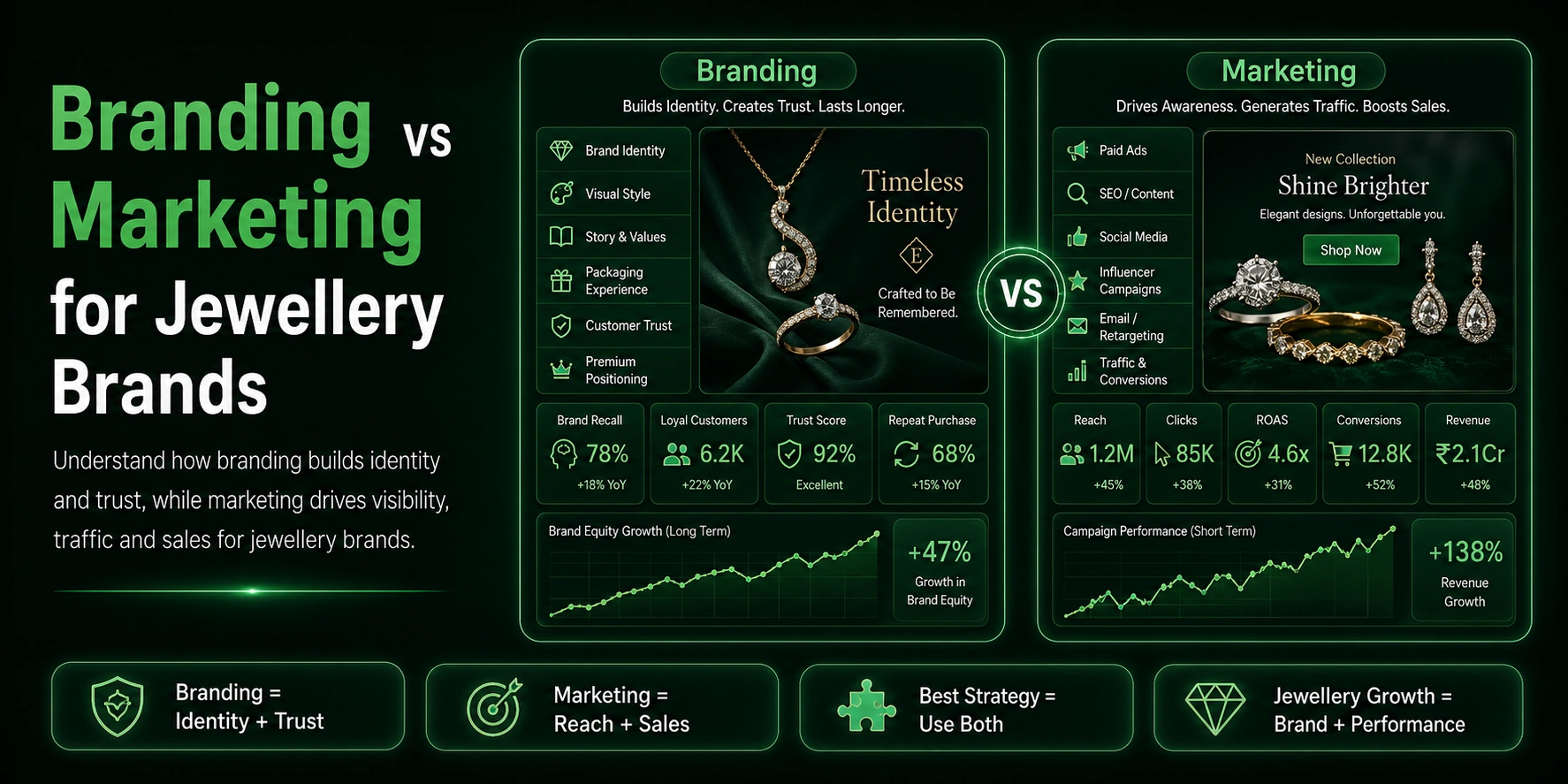
Short answer: Branding is the long-term work of defining who your jewellery brand is, what it stands for, and why a buyer should trust it. Marketing is the activity of putting that brand in front of the right people and prompting them to act. Branding builds the asset; marketing puts the asset to work. In jewellery, where the metal and the stones are close to commodities, and trust is the real bottleneck, branding carries an unusually large share of the selling. That is why the sharpest jewellery brands in India invest in both and never treat them as an either-or choice.
If you run a jewellery brand and you have ever felt that your ads are bringing traffic but not loyalty, or that customers compare you only on making charges and walk to whoever quotes a slightly lower rate, the root cause is almost always the same. You are marketing hard on top of a brand that has not been built. This guide explains the real difference between the two, why the gap matters more in jewellery than in almost any other category, and what to actually do about it in today’s Indian market.
The “versus” is the wrong frame
Most articles set branding and marketing against each other as if you have to pick a side. You do not. They are not competitors. They are two different jobs that answer two different questions.
Branding answers, “Why this brand, and why should anyone care or trust it?” Marketing answers, “Here we are, here is what we have, now act.” One creates value and meaning. The other extracts the value and turns it into demand. The Indian Institute of Gems and Jewellery puts it succinctly: branding creates value, and marketing extracts it. Get the order wrong, and you end up paying to send strangers toward a brand that gives them no reason to stay.
A simpler way to hold the distinction in your head: your brand is the reputation that walks into the room before you do. Your marketing is the conversation you start once you are in the room. In jewellery, the reputation does most of the work, because the customer is nervous about purity, price, and being cheated, and a trusted name calms all three before a single word of ad copy is read.
So the useful question is never “branding or marketing.” It is “are we building the asset and deploying it, in the right sequence, with the right balance.” That reframe changes how you spend every rupee.
What branding actually means for a jewellery brand
Branding is not your logo. Your logo, your packaging, your store layout, your typography, and your colour palette are the visible expression of your brand, but they are not the brand itself. The brand is the personality and the promise underneath all of it: your mission, your point of view, the feeling people get when they think of you, and the trust they extend to you without consciously deciding to.
For a jewellery brand specifically, branding is built from a few things working together:
A clear point of view: Strip the logos off ten jewellery feeds in India, and most are indistinguishable: gold-toned product shots, a model touching her collarbone, a caption about timeless elegance, and a heritage line about three generations of craftsmanship. Craftsmanship and heritage are the minimum, not a differentiator, because every serious brand claims them. A real brand has an opinion about what jewellery means in someone’s life. CaratLane decided jewellery should be everyday self-expression rather than an occasion-only, man-buys-it-for-a-woman ritual. That single conviction shaped everything that followed.
A trust infrastructure: In jewellery, trust is not a soft brand value; it is the product. Hallmarking, transparent pricing, certification, buyback and exchange clarity, and consistent quality are brand assets because they remove the buyer’s biggest fear. The reason organised, branded players keep clawing share from the unorganised trade is exactly this: buyers will pay a premium for the confidence that they are not being short-changed on purity or rate.
A consistent identity: The same voice, the same visual world, and the same values across your store, your website, your Instagram, your packaging, and your customer service. CaratLane’s lavender-and-beige palette with serif type and warm, lifestyle photography is recognisable in a feed within a second. Consistency is what turns a name into a brand people remember.
An emotional position: Jewellery is rarely a need. It is bought to celebrate, to mark a milestone, to gift love, to signal status, or to express identity. The brands that win decide which emotion they own and commit to it. That emotional ownership is the part that competitors cannot copy by lowering their rate.
If you want help defining this layer, that is the core of what a specialist jewellery branding service does: positioning, brand strategy, visual identity, and the trust signals that make a premium feel justified.
What marketing actually means for a jewellery brand
Marketing is everything you do to get the right people to discover the brand and move toward a purchase. It includes your performance ads on Google, Meta, and Instagram, your SEO and content, your email and WhatsApp flows, your influencer and creator collaborations, your offline activations and exhibitions, your store footfall drivers, and the analytics that tell you what is working.
Marketing is measurable, time-bound, and tactical. A campaign has a start date, a budget, a target, and a number you can read at the end. This is its strength and its trap. Because marketing is so measurable, it is tempting to pour money into it and ignore branding, which pays back slowly and is harder to attribute. The brands that do this acquire customers who have no reason to be loyal, which means they have to keep buying the next customer at full price, forever.
Done well, marketing for a jewellery brand is not just lead generation. It is the engine that takes a buyer through a long, trust-heavy consideration cycle. Indian jewellery buyers research online and very often purchase offline, a pattern shorthand as ROPO, research online, purchase offline. They spend time, they compare, they involve family, and they want to touch and try before they commit to a high-ticket item. Good marketing maps to that journey across discovery, consideration, reassurance, and conversion, rather than expecting a cold ad to close a wedding-set sale.
For how the channels fit together across that funnel, our guide on the benefits of digital marketing for jewellery brands goes deeper, and SEO vs Google Ads for jewellery businesses explains how to balance the two so you are not renting all of your visibility.
Branding vs marketing, side by side
| Question | Branding | Marketing |
|---|---|---|
| Core job | Build the asset: who you are, what you mean, why to trust you | Deploy the asset: reach people and prompt action |
| Question it answers | “Why this brand?” | “Here we are, now act” |
| Time horizon | Long term, compounding | Short to medium term, campaign-based |
| What it produces | Recognition, trust, preference, pricing power | Traffic, leads, footfall, conversions, sales |
| How you measure it | Recall, recommendation, share of search, margin held | CTR, CAC, ROAS, conversion rate, revenue |
| What happens without it | Marketing becomes a price war you cannot win | A great brand nobody discovers |
| In jewellery, it governs | Whether you compete on rate or on preference | Whether the right buyers ever find you |
The table makes the relationship obvious. They are not rivals. They are the reservoir and the tap. Branding fills the reservoir of trust and preference; marketing opens the tap so it reaches people. Spend everything on the tap, and the reservoir runs dry. Fill the reservoir and never open the tap, and nothing flows.
Why branding carries more weight in jewellery than in most categories
In many industries, you can win on a better product, a sharper feature, or a lower price. Jewellery breaks most of those levers, which pushes far more of the burden onto the brand.
The product is close to a commodity. Twenty-two carat gold is twenty-two carat gold, wherever you buy it. A half-carat diamond of a given grade is the same stone across sellers. When the underlying material is standardised, the only thing that is not a commodity is the brand. This is why a branded piece can command a margin a loose-market seller cannot, and why the entire premium-jewellery business model rests on brand rather than metal.
Trust is the bottleneck, not awareness. Buyers are not short of jewellery options; they are short of jewellers they trust on purity and price. Branding, expressed as hallmarking, transparent rate cards, certification, and a name people recommend, is what resolves that anxiety. Marketing can put your name in front of a buyer, but only the brand decides whether that buyer relaxes enough to purchase.
The purchase is rare, high-value, and emotional. People buy jewellery a handful of times in their lives at meaningful ticket sizes, often tied to weddings, festivals, and milestones. A rare, expensive, emotional decision is exactly the kind where a known, trusted brand wins over an unknown one, no matter how good the unknown one’s ad is. You are not buying a repeat-purchase consumable where a trial is cheap. You are making a considered bet, and brand is how you de-risk it.
Design is where margin lives, and design is a brand decision. CaratLane made roughly nine in ten of its pieces diamond rather than gold, deliberately. Gold is a commodity where you compete on weight and making charges at thin margins, and the customer picks whoever is cheapest. Diamond and design-led jewellery let the same stone become a very different price based on setting, craftsmanship, and brand, which is where healthier margins sit. That is a branding and positioning choice that directly produced a stronger business, not a marketing tactic.
Put together, jewellery is a category where the brand is doing the heavy lifting at the moment of sale, and marketing is the system that brings the buyer to that moment. Treating marketing as the whole job is the single most common and most expensive mistake in this industry.
Why this matters more in 2026 than ever
There is a specific, timely reason this is urgent right now, and it is the gold price.
Gold has been on a historic run. The World Gold Council recorded a 67 percent gain in 2025, the strongest annual rise since 1979, with domestic prices pushing past INR 139,000 per ten grams and setting fresh records into 2026. The consequence for jewellers is stark. In the first quarter of 2026, jewellery volumes in India fell about 19 percent year on year to one of the lowest first-quarter figures since 2000, yet value demand rose roughly 47 percent to a record near INR 999 billion. People are buying fewer grams but spending more rupees, and a large share of transactions, reportedly 40 to 60 percent at retail, are old-gold exchanges as buyers trade in to offset higher prices.
Read what that does to your competitive position. When gold is this expensive, mass-market buyers shift to lighter pieces and lower carats, and the temptation across the trade is to fight on the one number everyone can compare: making charges. That is a race to the bottom, and on a commodity input, you cannot win it for long. The brands holding margin in this environment are the ones whose customers are not buying on weight at all. They are buying design, identity, and a name they trust. That is branding doing its job. When you cannot win on price, the brand premium is not a luxury; it is the business model.
You can see brands engineering around the squeeze. As gold climbed, CaratLane introduced nine-carat gold collections, with less gold for the same diamond sparkle, to stay accessible without slashing prices. New launches keep tilting toward design-led and studded categories. Titan entered lab-grown diamonds with a new brand, beYon, aimed at affordable everyday wear, and lab-grown players are expanding fast. Every one of these moves is a positioning and branding decision first, with marketing deployed to communicate it second.
The broader market backdrop reinforces the point. India’s gems and jewellery market stood at about USD 85 billion in early 2026 and is projected toward USD 130 billion by 2030, per IBEF, and the organised, branded segment keeps gaining share from the unorganised trade precisely because buyers want transparency and trust. The growth is real, but it is flowing to brands, not to generic sellers. If you want a share of it, the brand has to be built, then marketed.
What the market is teaching us right now
The clearest lessons in Indian jewellery over the last few years come from watching what happened when brands got the balance right and when they got it wrong.
CaratLane is the textbook case of branding and marketing working as one. The brand decisions came first: reframe jewellery as everyday self-expression, de-link it from gold-as-investment, lead with transparency and trust, and build a recognisable, warm, modern-Indian visual identity. The marketing then deployed that brand with emotion-first storytelling, the well-known everyday jewellery campaigns, creator collaborations, and a try-at-home model that solved the touch-and-feel problem online buyers face. By 2026, the brand was posting quarterly revenue around INR 1,537 crore at roughly 42 percent year-on-year growth across 370-plus stores, with about 60 percent of sales coming from women buying for themselves. None of that works if the marketing sits on top of an undefined brand.
GIVA shows positioning as a growth engine. Rather than fight CaratLane and BlueStone on gold and diamonds, GIVA built its brand around silver and affordable everyday pieces in the roughly INR 1,000 to 20,000 range, where larger players started higher. The strategic logic behind the positioning was sharp: silver buyers purchase three to four times a year, against one to two times for gold, which lifts purchase frequency and lifetime value. That brand and category choice, then marketed and taken omnichannel, carried GIVA past INR 500 crore in revenue faster than older rivals reached the same mark.
And the market also teaches the cost of imbalance. Melorra, an early D2C jewellery brand built on fast, weekly, lightweight designs, raised at a valuation reported around INR 1,000 crore in 2022, yet is reported in Indian business media to be in talks for an acquisition at a small fraction of that, a steep fall, even as the category around it grew. The reported diagnoses point to a brand that scaled on acquisition and online presence without building a durable trust infrastructure and the touch-and-feel retail experience that jewellery buyers in India insist on. The lesson is not that marketing failed. It is that marketing without a defensible brand and the right retail trust signals does not compound, and in jewellery, the trust gap is unforgiving.
Two failure modes fall out of this, and they are worth naming because most brands are quietly stuck in one of them. The first is marketing without branding: strong ad spend, real traffic, but customers who compare you only on rate, do not return, and cost full price every time. The second is branding without marketing: a beautiful, well-defined brand that almost nobody discovers, because no one is doing the work of putting it in front of buyers. The fix for the first is to build the brand. The fix for the second is to market it. Most brands need to honestly diagnose which one they are.
How branding and marketing actually work together
The relationship is not a one-time sequence; it is a loop, but the loop has a starting point.
You start with brand, at least the foundation of it. Before you spend on ads, you need clarity on who you are for, what you stand for, what you believe about jewellery that others do not, your visual identity, and your trust signals. Marketing into an undefined brand wastes money, because the most expensive part of acquisition, persuading a stranger to trust you on a high-value purchase, is the part the brand is supposed to have already done.
Then marketing carries the brand into the market and brings back data. Which messages land, which audiences convert, what objections recur, and where buyers drop off in the ROPO journey. That data feeds back into the brand: it sharpens your positioning, surfaces the trust gaps you need to close, and tells you which emotional angle actually moves your buyer.
Then the loop repeats, and each turn compounds. A stronger brand makes every marketing rupee more efficient, because warm, trusting buyers convert at a lower cost than cold ones. More efficient marketing funds more brand building. Over time, the gap between you and the brand, still treating marketing as the whole job, widens into a moat. This is why integrated brand-and-performance partners exist: the two functions inform each other, and splitting them across teams that do not talk usually leaves value on the table. If you are weighing how to resource this, our breakdown of in-house vs agency digital marketing for jewellery brands is a useful starting point.
Branding, marketing, and AI search: the new discovery layer
There is a newer reason the brand-and-content foundation matters, and it is changing how buyers discover jewellery. Discovery has moved beyond the search bar. People increasingly find and shortlist jewellery through AI-assisted search, the AI Overviews and AI Mode experiences that summarise and recommend before a buyer ever clicks through to a store.
It is worth being precise here, because the space is full of bad advice. There is no special AI-only writing format, no secret schema, and no machine-readable file that buys you a place in AI answers. Google has said this directly. Generative features are built on the same core ranking and quality systems as normal search, which means the way to be surfaced and cited is the same as it has always been: be a recognisable brand with a clear point of view, publish genuinely useful and original content, keep your information accurate and consistent across your site, and make sure your pages are crawlable and fast.
Notice what that rewards. It rewards exactly the things branding and good content marketing produce: a distinct identity, expertise that is visibly your own, trustworthy and well-structured pages, and consistency. A generic seller with no point of view and thin, copied content is invisible to AI search for the same reason it is invisible in a crowded Instagram feed. And there is a hard line that matters for budgeting: organic brand presence and helpful content can earn AI citations and recommendations, but paid ads cannot. You can buy your way to the top of an ad slot. You cannot buy your way into being the brand an AI answer recommends. That is earned through brand and content, which is one more reason performance spend alone is a fragile strategy.
The practical takeaway is reassuring rather than gimmicky. You do not need AI tricks. You need a strong brand and genuinely helpful content, which is what you should be building anyway. Get those right, and AI visibility follows as an outcome. This is the GEO and SEO foundation we build through our SEO and GEO work for jewellery brands, and it is the same foundation that protects you as discovery keeps shifting.
Where should a jewellery brand focus first?
Use a simple diagnostic. Ask which of these sounds like your business.
If customers find you but compare you only on making charges and rarely come back, your problem is the brand. You are being treated as a commodity because you have not given buyers a non-price reason to choose and stay. Invest in positioning, trust signals, and a distinct identity before adding more ad spend.
If you have a clear, well-defined brand and loyal customers but growth is flat, your problem is marketing. The brand is built; it is just not reaching enough of the right people. Invest in performance marketing, SEO and content, and a discovery engine that brings new buyers into the trusted experience you have already created.
If both feel shaky, start with the brand foundation, then layer marketing on top, and run them as a loop rather than two disconnected projects. And if you are early and unsure where the leaks are, an audit is the cheapest way to find out before you commit budget.
Most jewellery brands are over-indexed on marketing and under-invested in brand, which is why so many are stuck in the price war the gold market is making more painful by the quarter. The way out is not more ads. It is a brand worth marketing.
How Kyros Solution approaches branding and digital marketing for jewellery
Kyros Solution works only with jewellery and lifestyle brands, which is the reason our approach to this question is not generic. We have seen, across Indian jewellery brands, that the gap is almost never a missing channel; it is a missing brand under the channels. So we build both, and we run them as one system.
On the branding side, we work on the layer that decides whether you compete on rate or on preference: positioning and a genuine point of view, brand strategy, premium visual identity, packaging and UI/UX, and the trust signals, transparency, certification clarity, and consistency, that let a buyer relax on a high-value purchase. On the marketing side, we run the discovery and conversion engine that carries that brand to the right buyers: SEO and GEO so you are found in both traditional and AI search, performance marketing across Google and Meta mapped to the long, trust-heavy jewellery consideration cycle, CRO to convert the traffic you already pay for, and high-end product visuals and 3D renders that make a screen do justice to a piece designed to be touched. Because we do branding and digital marketing under one roof, the brand work and the performance work inform each other instead of pulling in different directions.
If you are not sure whether your bottleneck is brand or marketing, that is exactly what a complimentary jewellery brand and marketing audit is for. We will look at your positioning, your discovery footprint across search and AI, your conversion path, and your visuals, and tell you honestly where the leak is and what to fix first. You can also explore our digital marketing services for jewellery brands and our 3D jewellery rendering work to see how the pieces fit together.
The brands winning in Indian jewellery right now are not the ones spending the most on ads. They are the ones who built a brand worth trusting and then marketed it well. In a market where gold keeps getting more expensive and AI is reshaping how buyers discover you, that combination is no longer optional. It is the whole game.
FAQs
What is the main difference between branding and marketing for a jewellery brand?
Branding defines who your jewellery brand is, what it stands for, and why a buyer should trust it. Marketing is the activity of putting that brand in front of the right people and prompting them to buy. Branding builds the asset; marketing deploys it. In jewellery, branding does more of the selling because the product is close to a commodity and trust is the buyer’s biggest concern.
Which comes first for a new jewellery brand, branding or marketing?
Branding, at least the foundation of it. Marketing into an undefined brand is expensive, because the hardest part of selling jewellery, persuading a buyer to trust you on a high-value purchase, is the job the brand is meant to have already done. Define your positioning, identity, and trust signals first, then deploy marketing to carry that brand to buyers, and run the two as a continuous loop.
Why is branding more important for jewellery than for other products?
Because jewellery breaks the usual ways to win. The metal and stones are standardised, so the brand is the only thing that is not a commodity. Trust on purity and price is the real bottleneck, and the brand resolves it. The purchase is rare, high-value, and emotional, which favours known, trusted names. And design, where margin lives, is itself a brand decision.
Can you just spend on ads instead of building a brand?
You can, but it rarely compounds in jewellery. Marketing without a brand acquires customers who compare you only on making charges, do not return, and cost full price every time. With gold at record highs, that price war is harder to survive. A brand gives buyers a non-price reason to choose and stay, which is what makes marketing efficient.
Does branding help with AI search and AI Overviews?
Yes, indirectly and powerfully. AI search runs on the same core quality systems as normal search, so it rewards recognisable brands with a clear point of view, accurate and consistent information, and genuinely useful content. There is no AI-only trick or special markup. Importantly, organic brand presence and helpful content can earn AI citations and recommendations, while paid ads cannot.
How does the gold price affect whether you focus on branding or marketing?
Record-high gold prices push the whole trade to compete on making charges, which is a race to the bottom on a commodity input. The brands holding margin are the ones whose customers buy design, identity, and trust rather than weight. When you cannot win on price, the brand premium is the business model, which makes branding more urgent, not less, with marketing deployed to communicate it.
Should branding and marketing be handled by the same team or agency?
Ideally yes, or at least by teams that talk constantly. The two functions feed each other: marketing data sharpens the brand, and a stronger brand makes marketing more efficient. Splitting them across disconnected teams usually leaves value on the table. An integrated brand-and-performance partner keeps both pulling in the same direction.