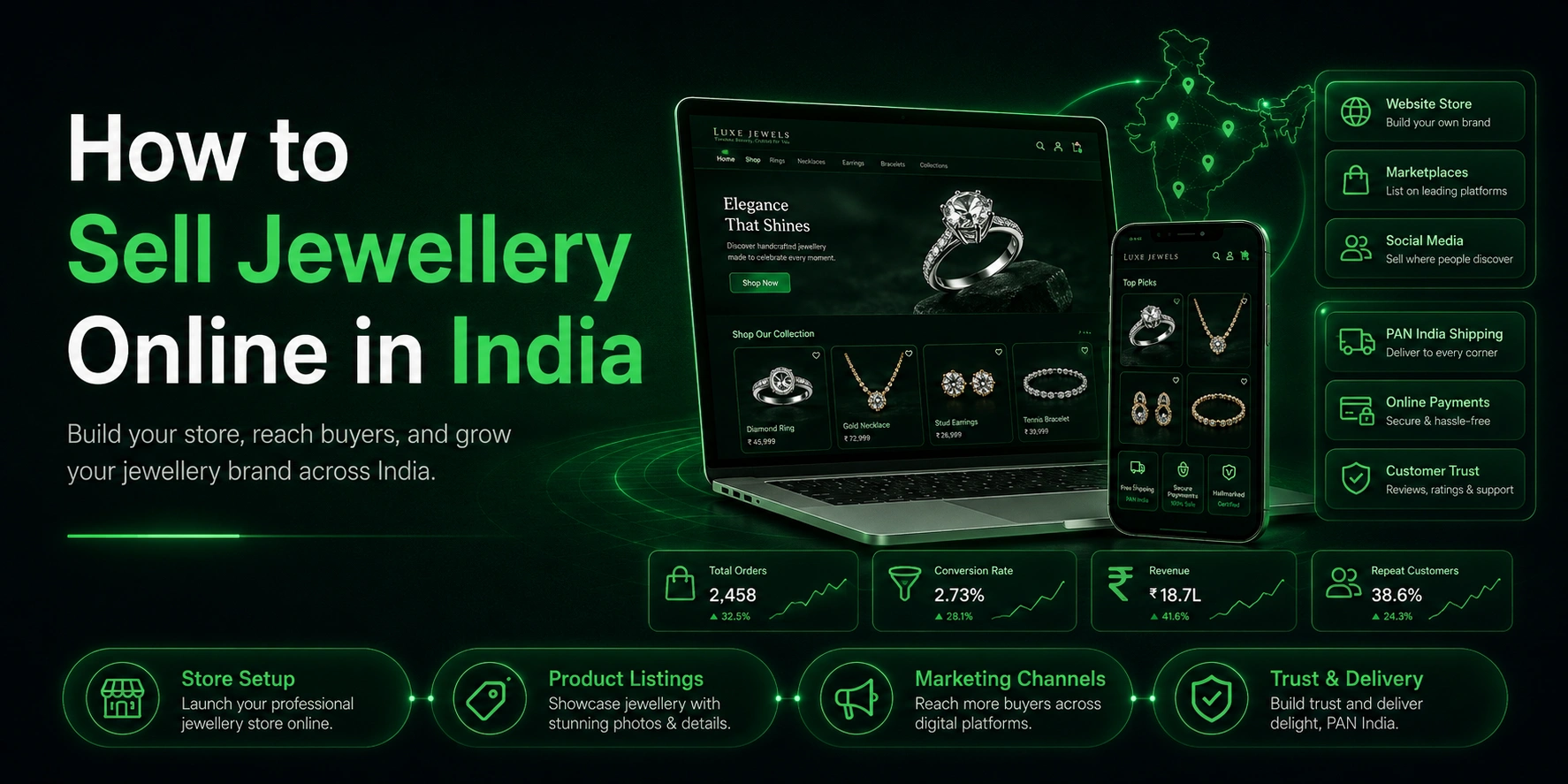
Selling jewellery online in India is no longer a side hustle reserved for hobbyists. It has become a serious, branded, multi-crore opportunity. The country’s overall jewellery market surpassed USD 95.10 billion in 2025 and is projected to reach USD 151.37 billion by 2034, with online sales expected to grow at over 8% CAGR. India is also the world’s gold-loving capital, contributing close to a quarter of global jewellery consumption.
So the demand is real. The hard part is winning a customer who cannot touch the piece, weigh it, or hold it under store lighting. This post is built for exactly that challenge. It walks you through how to set up, price, photograph, market, and scale an online jewellery brand in India, written for founders, retailers, and craftspeople who want substance over hype.
Understand the Indian Online Jewellery Buyer (Before Anything Else)
Forget templates. The Indian online jewellery shopper is not one person; she is many.
The everyday buyer wants daily-wear gold studs, light chains, or lab-grown solitaires under ₹50,000. She buys on her phone, during lunch, after seeing a Reel.
The bridal buyer researches for 6 to 12 months. She compares purity, hallmark, exchange policy, and per-gram pricing across three or four brands before walking into a store or making a call.
The gifting buyer, typically a husband, father, brother, or NRI son, needs reassurance, easy returns, and gift packaging. Festivals like Akshaya Tritiya, Karva Chauth, Dhanteras, and the wedding season drive most of the year’s revenue.
The lab-grown and value buyer is younger, often Gen Z or millennial, who treats jewellery as fashion plus a light investment. He or she is data-loving, IGI-certificate aware, and Instagram-trained.
The artificial/fashion jewellery buyer wants design variety, trend-led drops, and prices under ₹2,000. Meesho, Amazon, and Instagram win here.
Once you know which of these you are speaking to, every other decision (platform, photography, ad creative, packaging) becomes easier.
Pick a Niche That You Can Actually Win
Trying to sell “all jewellery to everyone” is the fastest way to disappear in search results.
Pick a defined niche:
- 22K/18K fine gold jewellery with BIS hallmark
- Lab-grown or natural diamond jewellery with IGI/SGL/GSI certification
- 925 sterling silver (oxidised, temple, daily wear)
- Polki, Kundan, Meenakari, Jadau (heritage and bridal)
- South Indian temple jewellery (Coimbatore and Chennai style)
- Artificial/fashion jewellery (American diamond, brass, gold-plated)
- Demi-fine/minimalist (the Mejuri-style Indian equivalent)
- Custom/personalised (name pendants, couple bands, zodiac, birthstones)
- Men’s jewellery (rings, bracelets, kadas, chains, an underserved category)
The narrower your niche, the more believable your story, the cheaper your customer acquisition, and the easier your SEO.
Sort Out the Legal, Compliance, and Sourcing Foundation
This is the part most “start your jewellery business” videos skip. It is also the part that separates a brand from a side gig.
Business setup
- Register as Proprietorship, LLP, or Private Limited (Pvt Ltd is preferred for outside funding or D2C growth)
- GST registration is mandatory if turnover exceeds the threshold, and practically required for marketplaces like Amazon, Flipkart, and Meesho
- Trademark your brand name and logo under Class 14 to protect against copycats
- MSME/Udyam registration for benefits
BIS Hallmark and HUID Since 2021, BIS hallmarking with a 6-digit HUID (Hallmark Unique Identification) is mandatory for selling gold jewellery of 14K, 18K, 20K, 22K, 23K, and 24K in India. Selling non-HUID stock can trigger BIS enforcement action, with inspections possible without prior notice. For online sellers, this is non-negotiable. Apply for a BIS registration certificate, hallmark every piece, and display the HUID number on the product page.
Diamond and gemstone certification for lab-grown and natural diamonds. Get pieces above 0.20 carats certified by IGI, SGL, GIA, or GSI. Upload the certificate to the product page. BlueStone builds trust by certifying its jewellery through BIS Hallmark, SGL, IGI, and GSI, and you should follow the same playbook.
Sourcing
- Surat for diamond cutting, polishing, and lab-grown stones
- Jaipur for coloured stones, kundan, polki, and meenakari
- Mumbai (Zaveri Bazaar) for gold wholesale and bridal
- Rajkot for sleek gold and silver designs
- Coimbatore and Trichy for temple and traditional South Indian work
- Hyderabad for pearls
Whether you manufacture in-house, contract with karigars, or buy wholesale, document your sourcing carefully. Customers, journalists, and AI search systems all reward transparency.
Where Should You Sell? Choose Your Sales Channels Strategically
You do not have to choose one. The strongest Indian jewellery brands run a hybrid stack.
Your own website (the long-term asset)
This is the home of your brand. You own the customer data, the pricing power, and the experience.
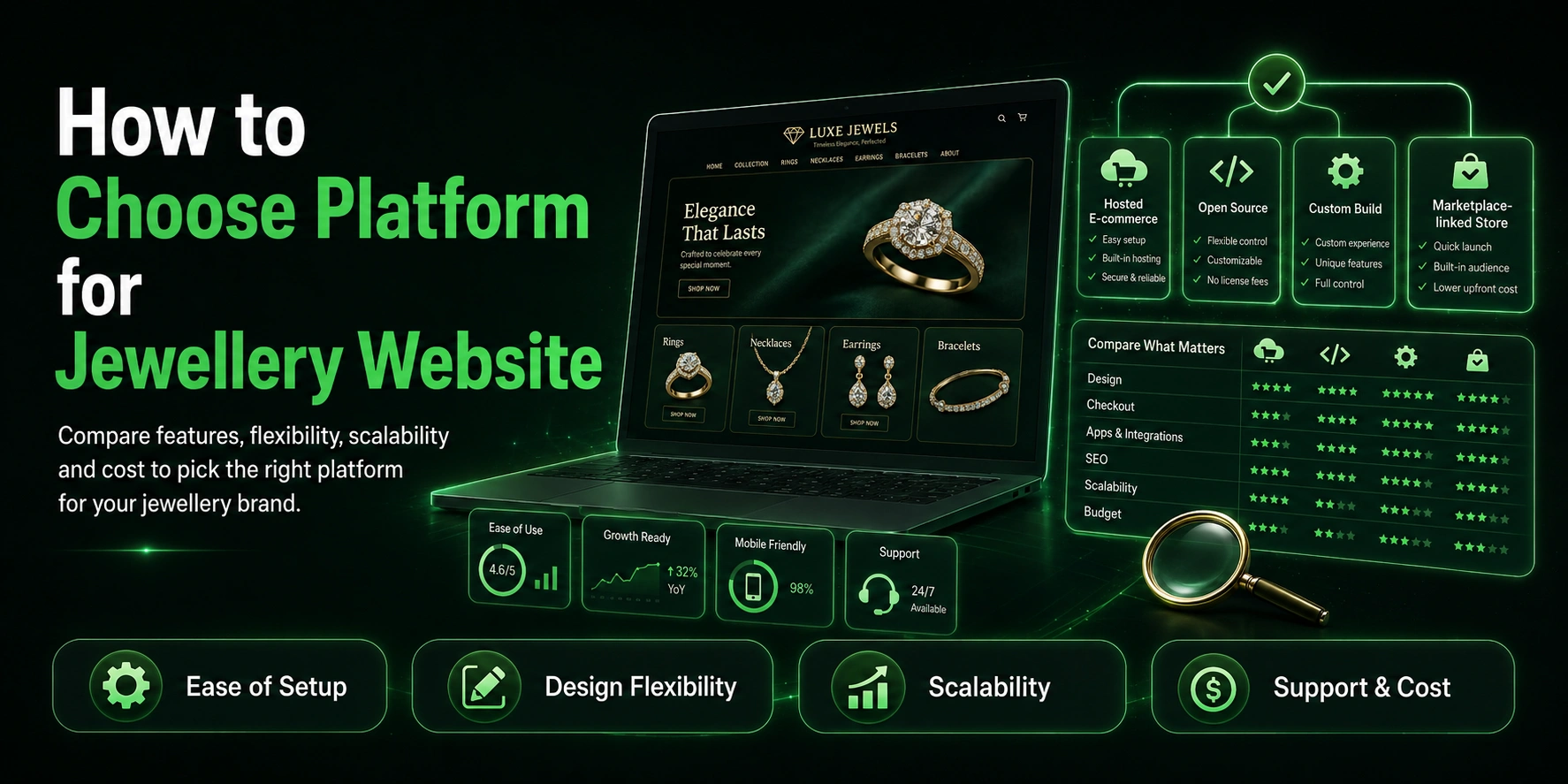
- Shopify: the go-to choice for most jewellery brands because of its ease of use, visual themes, inventory management, and large app ecosystem. Best if you want a clean launch in weeks, not months.
- WooCommerce on WordPress: more flexible, better blogging power, lower transaction fees, but you handle hosting, performance, and security.
- Magento (Adobe Commerce): built for scale. Worth it once you cross 10,000+ SKUs or multi-region operations.
- Custom MERN/headless: only if you have a tech team and a strong reason to leave templates behind.
For 90% of Indian jewellery founders launching, Shopify, with a jewellery-optimised theme plus 4 or 5 well-chosen apps (review, wishlist, currency switch, WhatsApp chat, COD), is the right starting line.
Marketplaces (for cash flow and discovery)
- Amazon Karigar/Amazon.in for nationwide reach and Prime buyers
- Flipkart for tier 2 and tier 3 cities
- Meesho for affordable artificial and silver jewellery, especially for resellers
- Myntra and Ajio for fashion-forward jewellery
- Etsy for international handmade and artisanal buyers
Marketplaces give you volume early, but never let them become your only channel. The commission, the lack of customer data, and the price wars will hurt margins in the long run.
Social commerce
- Instagram Shop for catalogue tagging and direct DM orders
- WhatsApp Business for India’s favourite high-trust sales channel
- Facebook Shop and Pinterest for repurposed catalogues
Many Indian boutique jewellers do 30 to 60% of their revenue on WhatsApp alone. Treat it like a real sales channel, not an afterthought.
Build Product Pages That Actually Convert
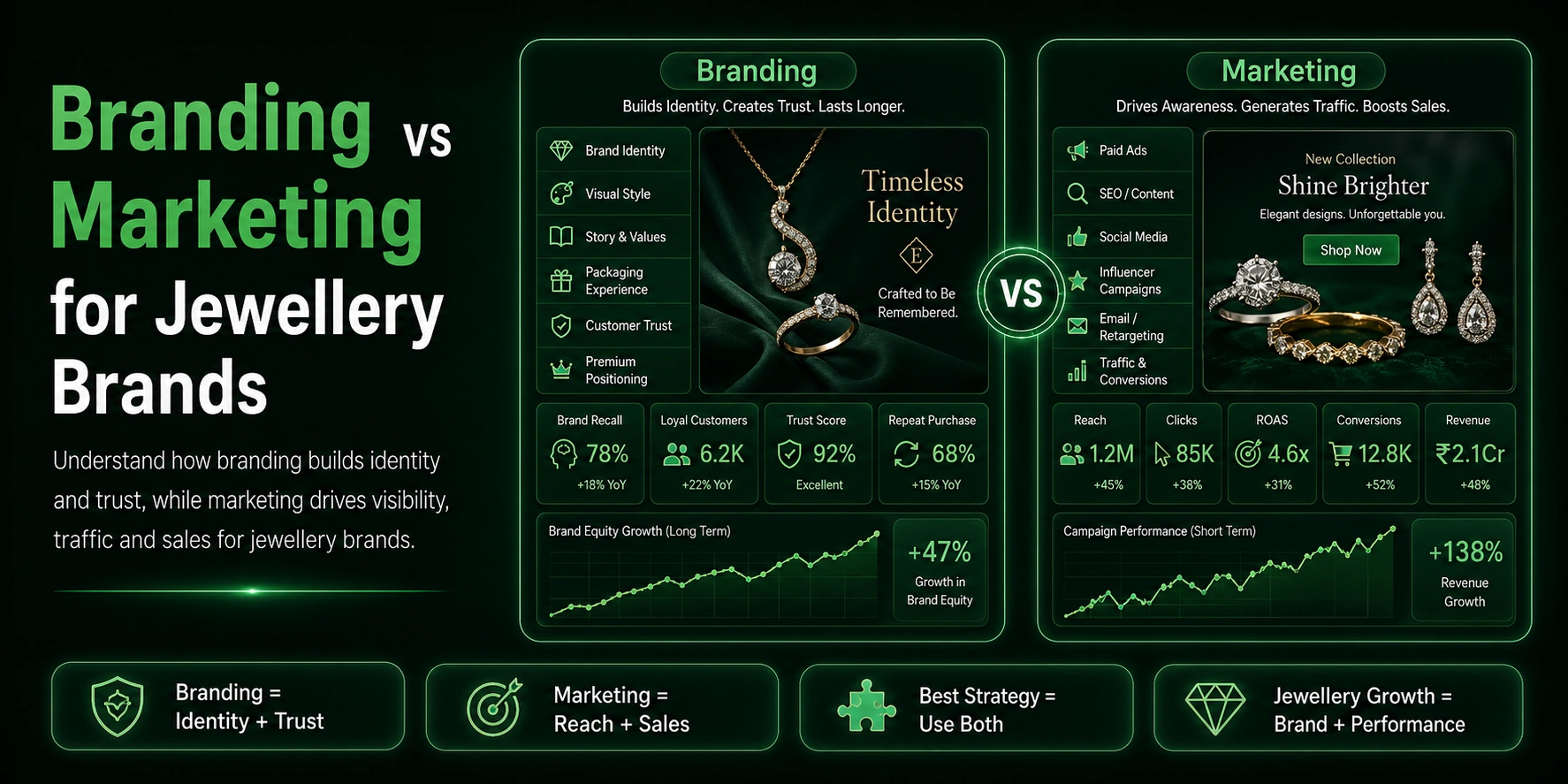
Most jewellery brands spend lakhs on traffic and pennies on the product page. That is backward. For jewellery, where the average ecommerce conversion rate sits at a notoriously low 1.19%, visual presentation is the primary lever you have to turn browsers into buyers.
A high-converting jewellery product page includes:
Photography (your single biggest conversion lever)
- 4 to 8 high-resolution images per product
- One clean white-background hero shot for the listing thumbnail
- Close-up macro of stones, hallmark, and clasp
- A 360-degree spin or short video
- A model/lifestyle shot showing scale and how it sits on the body
- Consistent lighting, angles, and aspect ratios across the catalogue
Information that removes hesitation
- Material breakdown (gold purity in karats, total weight, diamond carat, stone clarity and colour)
- BIS HUID number printed visibly
- Certificate (IGI, SGL, GSI) is downloadable on the page
- Size chart and ring sizing guide
- Making charges shown clearly
- Final price with GST included, plus EMI options
- Delivery timeline (in-stock vs made-to-order)
- Return, exchange, and lifetime buy-back policy
- Care instructions
Trust elements
- Verified customer reviews with photos
- Hallmark and certification logos (BIS, IGI, SGL)
- Secure payment icons and money-back assurance
- “Try at home” or COD options where applicable
- A real human contact (phone number, WhatsApp button, chat)
Calls to action
- Primary CTA: Add to Cart / Buy Now
- Secondary CTA: Talk to a stylist / Book a video consultation
- Tertiary CTA: Save to wishlist
Take a look at how Blue Nile, BlueStone, CaratLane, and Mia by Tanishq structure their pages. They have spent millions optimising every section. Borrow the structure, then add your own brand voice.
Search Engine Optimisation: Win Google and AI Overviews Together
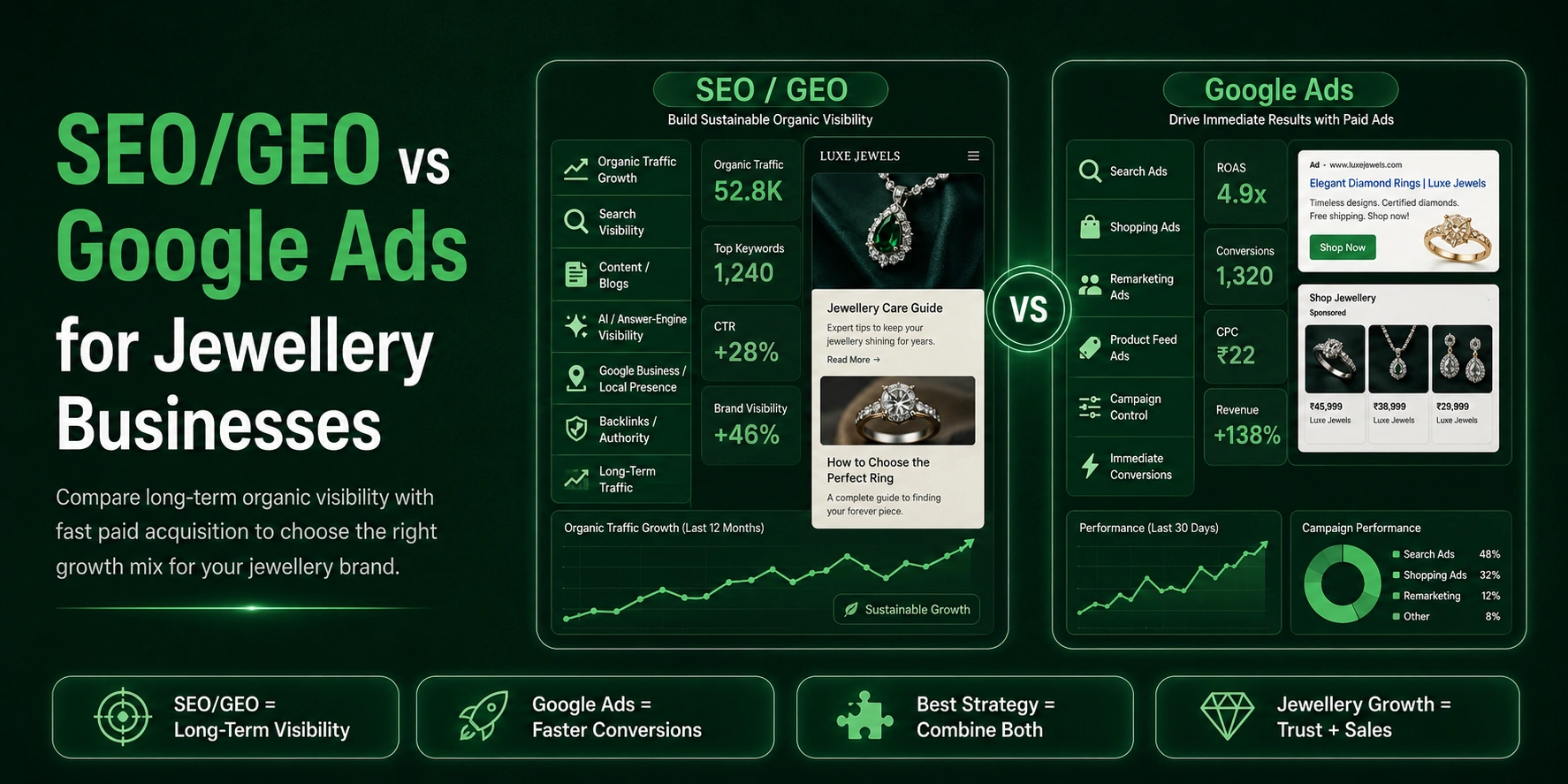
Google AI Overviews and AI Mode are now part of how Indian users find jewellery. The good news is that SEO best practices continue to be relevant because Google’s generative AI features rely on core Search ranking and quality systems to retrieve relevant pages. There is no separate “AEO” or “GEO” playbook. There is only good SEO, done well.
Keyword strategy
Map keywords to intent:
- Informational: how to check gold purity, what is HUID, difference between 18k and 22k gold, lab-grown vs natural diamond
- Commercial: best gold earrings under 20000, lightweight mangalsutra designs, lab-grown diamond ring price in India
- Transactional: buy diamond stud earrings online, gold nose pin online India, sterling silver toe rings
- Branded: your brand name plus product variations
- Local: gold jewellery online Surat, lab-grown diamond Mumbai
Use a mix of head terms and long-tail phrases. Users in AI search ask longer and more specific questions, and follow up to dig deeper, so write content that answers the next three questions a buyer would ask.
On-page SEO checklist
- Unique title tag per page, 50 to 60 characters, brand name at the end
- Unique meta description that describes the page, includes material, weight, occasion
- One clear H1 per page that matches the visible product or topic title
- Descriptive URLs (/diamond-rings/solitaire-engagement-rings not /p/sku-2247)
- Alt text on every image, descriptive but not stuffed (for example, “18K rose gold floral diamond ring with 0.25 carat IGI certified centre stone”)
- Schema markup for Product, Offer, Review, AggregateRating, Organization, BreadcrumbList
- Internal links from category to subcategory to product
- Fast page load, ideally under 2.5 seconds on 4G mobile
- Mobile-first responsive design (over 75% of Indian traffic is mobile)
Content SEO
Stop writing “10 reasons to buy gold.” Write the things no one else has bothered to write:
- A real bride’s story about choosing her wedding necklace
- A first-hand comparison of three lab-grown stones from different labs
- A teardown of how making charges are calculated
- A founder note on why you waived a stone-setting fee for a customer
- A regional guide to wedding jewellery traditions in Tamil Nadu, Gujarat, Bengal, and Kerala
This is non-commodity content. It is what AI Overviews cite, what readers bookmark, and what builds your category authority.
Technical SEO essentials
- HTTPS everywhere
- An XML sitemap submitted to Google Search Console
- A separate image sitemap for the catalogue
- Canonical tags to handle variant pages (same design, different metal colour)
- 301 redirects for old or out-of-stock URLs
- Crawlable navigation using real <a href> links, not JavaScript-only menus
Structured data done right
Your Product schema must include name, image, description, brand, sku, gtin (if available), material, offers (price, priceCurrency, availability), and aggregateRating. The rule is simple: all content in structured data markup must also be visible on the page itself. Do not declare a 4.8 rating in schema if your page does not show one.
Performance Marketing That Pays for Itself
A jewellery brand without paid media in India today is leaving money on the table. The trick is balancing scale with ROAS.
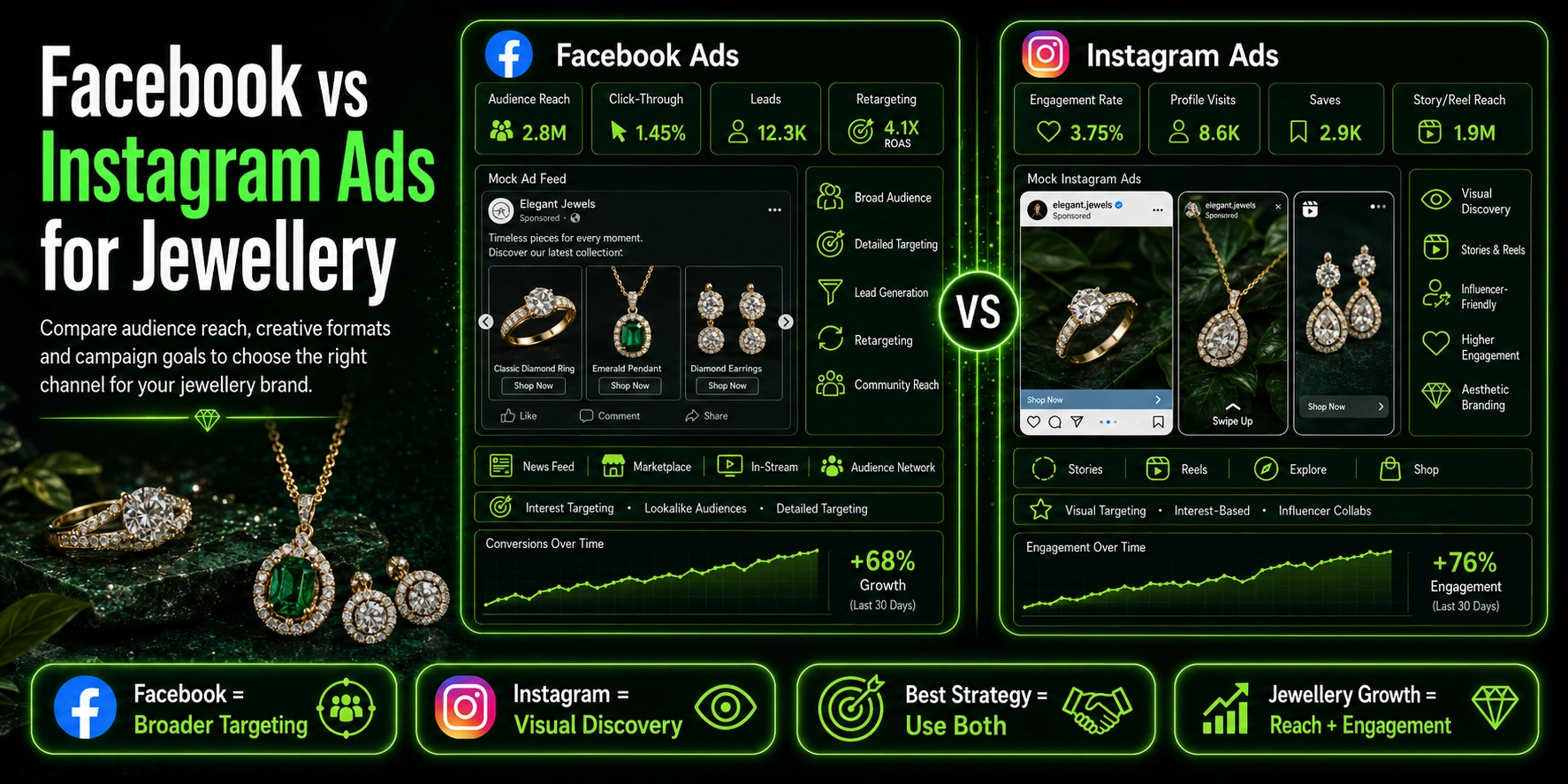
Meta Ads (Instagram + Facebook)
- Prospecting: short videos of products in motion, real Indian skin tones, occasion-led hooks
- Mid-funnel: try-on Reels, craftsmanship behind-the-scenes, customer testimonials
- Retargeting: dynamic product ads, abandoned cart recovery, last-7-day browsers
- Bridal and high-AOV pieces typically need 30 to 60-day retargeting windows because of the long decision cycle
Google Ads
- Search ads on branded and competitor terms
- Shopping ads via Google Merchant Centre feed (essential for fine jewellery)
- Performance Max for catalogue scale
- YouTube for awareness during the festive and wedding season
WhatsApp marketing
- Broadcast lists segmented by past purchase and product interest
- Click-to-WhatsApp ads (very high-quality leads for high-ticket items)
- Cart recovery, order updates, and re-engagement campaigns
Email marketing
- Welcome series for first-time visitors
- Abandoned cart automation with the actual product image
- Birthday and anniversary triggers
- Festive teasers two weeks before key dates
A healthy fine jewellery brand in India typically aims for 3 to 6x ROAS on Meta and 6 to 10x on Google Shopping once retargeting is mature.
Social Media and Content That Build the Brand Behind the Buy
Social media is not “extra.” For a jewellery brand, it is the showroom.
Instagram (the main stage)
- Post 3 to 5 Reels per week
- Use carousels for collections and styling stories
- Stories daily for behind-the-scenes, polls, customer DMs
- Reach is good. Saves and shares are better. They predict purchase intent.
- Often ignored, but a goldmine for bridal and aesthetic searches
- Pin every product image with keyword-rich titles
- Build boards by occasion, style, and budget
YouTube and Shorts
- Long-form: founder story, factory tour, gold purity explainers
- Shorts: try-on videos, styling tips, real customer unboxing
Influencer marketing
- Micro-creators (10K to 100K followers) deliver better ROI than celebrities for most brands
- Focus on authentic creators in your niche: bridal stylists, fashion editors, Gen Z fashion creators
- Pay in product plus performance-linked fee, where possible
User-generated content
- Run a branded hashtag
- Reshare customer photos with permission
- Real customer faces convert far better than studio models
Pinterest, Reddit, Quora, and community forums like r/IndianFashionAddicts and Reddit’s r/IndianStreetBets-style finance subs are surprisingly active places where buyers ask “is this brand legit” questions. Be present, helpful, and never spammy.
Logistics, Packaging, and Returns
A perfect product can still ruin a brand if the unboxing or return experience fails.
- Use insured shipping for any order above ₹10,000 (Shiprocket, Delhivery, Sequel, Brinks for high value)
- Tamper-evident packaging with a security seal
- A small branded velvet pouch or box, a hand-written thank-you note, and a care card
- COD on lower-ticket items, prepaid only on high-ticket pieces, with clear messaging
- Easy 15-day return on artificial and lightweight pieces; clearly defined policy for fine jewellery
- Lifetime exchange policy for gold (industry standard, builds trust)
- Buy-back at the current gold rate minus making charges (the BlueStone and CaratLane playbook)
- Track and notify on WhatsApp, not just email
The Trust Stack: Why Customers Will or Will Not Buy From You
In India, jewellery is emotional, financial, and ceremonial all at once. Trust is the entire game.
Build your trust stack into every touchpoint:
- BIS hallmark plus HUID on every gold piece
- IGI/SGL/GSI certificate scan on every certified diamond
- Real customer reviews with images (not stock testimonials)
- Founder’s face and story on the About page
- Transparent pricing with making charges and GST broken out
- Visible return, exchange, and buy-back policies
- Phone number that an actual human answers
- Press mentions, awards, and partner logos where applicable
- A clear, generous response to anyone who complains publicly
A simple trust audit: open your site on a phone you have never used. If a first-time visitor cannot find the return policy, the contact number, and the hallmark explanation within 10 seconds, you have work to do.
Measure What Actually Matters
Forget vanity metrics. Track:
- AOV (average order value) by category and channel
- ROAS by platform and campaign type
- CAC payback period (how many months until a customer pays back acquisition cost)
- Repeat purchase rate at 90 days and 12 months
- Customer lifetime value (LTV)
- Wishlist to purchase ratio
- Cart abandonment rate and recovery rate
- Organic traffic and AI Overview impressions
- Branded search growth (a sign your brand is becoming a category leader)
Clicks from AI Overviews tend to be higher quality, with users spending more time on site, so do not panic if click counts drop in AI Mode. Look at engagement and conversion per visit.
Common Mistakes Indian Online Jewellery Brands Make
Avoid these, and you will already outrank half your competitors:
- Hiding the price behind “Enquire for price” on browse-friendly fashion pieces
- Reusing the same supplier description across every product page
- Posting only product-only photos without lifestyle context
- Treating WhatsApp as customer support instead of a sales channel
- Buying followers and engagement instead of building an audience
- Running discount campaigns every week (kills full-price perception)
- Skipping schema markup
- Forgetting alt text on images
- Letting old, out-of-stock pages 404 instead of redirecting
- Ignoring the wedding and festive calendar in content planning
- Outsourcing all content to AI without expert review (against Google’s people-first content guidelines)
How Kyros Solution Helps Indian Jewellery Brands Scale Online
Most agencies treat jewellery like any other ecommerce category. It is not. The conversion psychology, the certifications, the photography demands, the bridal cycle, and the WhatsApp behaviour are unique.
Kyros Solution is a digital marketing and branding agency built around exactly this. The team has worked with D2C, boutique, and luxury jewellers from Surat, Mumbai, Jaipur, Bangalore, and beyond. From their Surat and Bangalore offices, Kyros builds D2C jewellery brands through brand strategy, identity, ecommerce, and 3D renders.
Their jewellery-focused services include:
- Brand strategy and identity for new D2C launches and legacy retailers going online
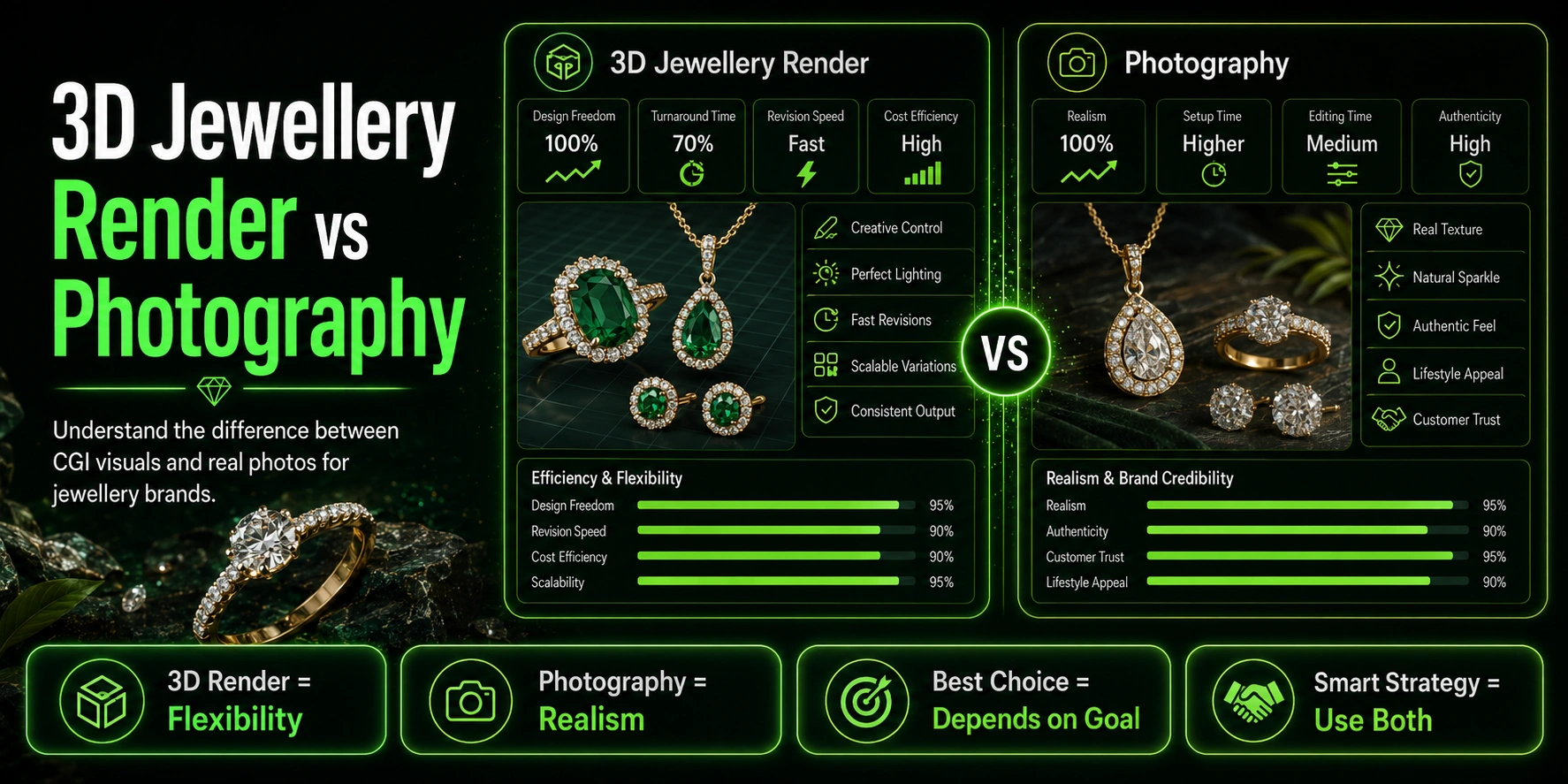
- 3D jewellery renders and product photography that replace expensive sample shoots
- Shopify and WordPress ecommerce development with jewellery-specific UX (HUID display, certificate downloads, sizing guides, COD, EMI)
- SEO built for both Google and AI Overview discovery, including schema, content, and technical audits
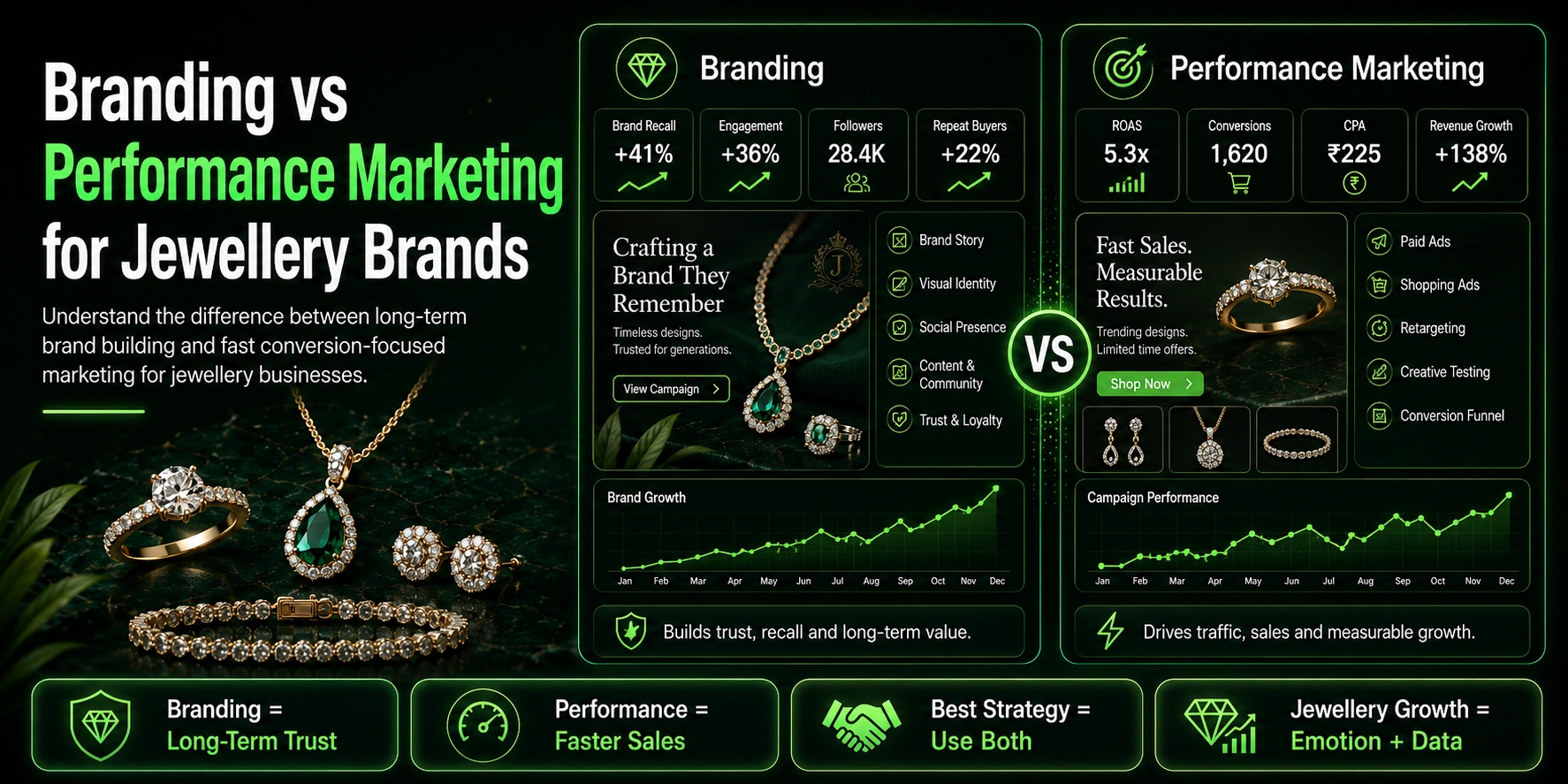
- Performance marketing on Meta, Google Shopping, YouTube, and Performance Max, tuned for the long jewellery decision cycle
- Social media management with Reels, carousels, and creator collaborations specific to the jewellery audience
- Influencer and content marketing programs that prioritise micro-creators and real ROI
- UI/UX design for high-converting product pages and bridal landing pages
Kyros has helped boutique and luxury jewellers achieve 200%+ ROI through tailored SEO, influencer partnerships, and ecommerce enhancements, including one handcrafted jewellery brand that grew online orders by 150% in six months through Google Ads and Instagram strategy.
Whether you are a fourth-generation jeweller bringing a legacy store online, or a founder launching India’s next lab-grown diamond brand, Kyros builds the full digital stack so you can focus on craft, sourcing, and customer relationships.
Reach out through the Kyros Solution website to talk about your jewellery brand’s growth plan.
Final Thought
Selling jewellery online in India is not a tech game. It is a trust game played with the help of technology. Buyers want to feel the same confidence online that they feel walking into a 60-year-old family showroom. Every photograph, every certificate, every line of product copy, every Reel, every WhatsApp reply either adds to that confidence or takes from it.
Build the trust stack, pick a niche, ship great photography, run patient performance marketing, and tell a real story. The market is wide open, and India’s online jewellery decade has only just begun.
If you want a partner who has done this specifically for jewellery brands, talk to Kyros Solution. Surat to Bangalore, boutique to scaled D2C, the team has built the playbook for selling Indian jewellery online.
Want to receive a free 30-minute jewellery brand audit covering your site, product pages, SEO, and ad accounts? Request a consultation. The team will walk you through exactly where your store is leaving revenue on the table and the steps to fix it.
FAQs
How much does it cost to start selling jewellery online in India?
A serious launch typically needs ₹2 to ₹8 lakhs for an artificial or silver brand, and ₹15 to ₹50 lakhs for a fine gold or diamond brand. Costs include initial inventory, photography, website, packaging, certifications, and 3 to 6 months of marketing budget.
Is the BIS hallmark mandatory for selling gold online?
Yes. Selling gold jewellery (14K and above) without BIS hallmarking and HUID is illegal in India, including for ecommerce. Apply for a BIS registration certificate before listing products.
What is the best platform to sell jewellery online in India?
For your own brand store, Shopify works for most launches. For marketplaces, Amazon and Flipkart for fine and lifestyle pieces, Meesho for affordable and artificial jewellery. Run a hybrid (own store plus one or two marketplaces plus Instagram and WhatsApp) for best results.
Do you need GST registration to sell jewellery online?
Yes, for practical purposes. Most marketplaces and payment gateways require it, and you cannot issue compliant invoices without it. Register before you go live.
How long does it take to see results from digital marketing for a jewellery brand?
Paid ads can show meaningful results in 2 to 6 weeks. SEO and content typically take 3 to 6 months to compound. Influencer and brand-building work pays off over 6 to 12 months.
How do you build trust with online jewellery buyers?
Display BIS hallmark and HUID, share independent certifications, show real customer reviews, publish transparent making charges and return policies, and put a real human (phone or WhatsApp) on every page.
Is selling jewellery online in India still profitable?
Yes, if you choose a clear niche and invest in trust. Fine jewellery brands routinely hit 3 to 6x ROAS on Meta and 6 to 10x on Google Shopping with mature retargeting. Margins are healthy for D2C brands that own their customer relationship.
Can you sell handmade or artisan jewellery without a huge investment?
Absolutely. Start on Instagram, WhatsApp, and Etsy with a small inventory, document your craft, and reinvest profits into your own Shopify store once you cross ₹50,000 to ₹1 lakh in monthly revenue.