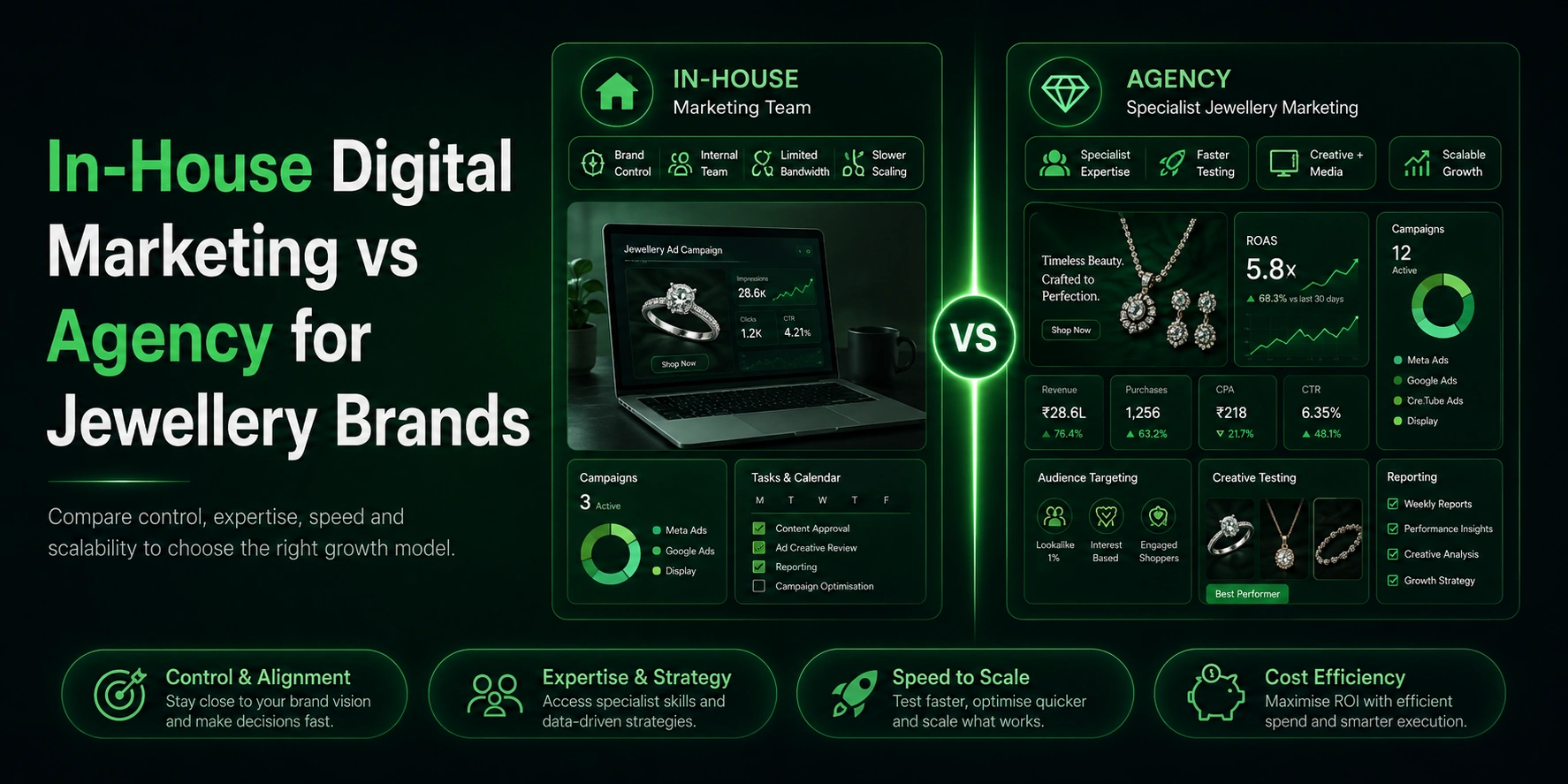
Most advice on “in-house versus agency” is written for software companies or generic online stores. Jewellery does not behave like either. A customer does not buy an Rs 80,000 bridal set the way they buy a phone case. They save the post, open five tabs, read every review, ask a cousin, check whether the diamond is IGI certified, message you on WhatsApp at 11 pm, and come back three weeks later. The marketing that moves this kind of buyer is not the same marketing that sells fast-moving products, which is exactly why the in-house versus agency question deserves a jewellery-specific answer rather than a recycled checklist.
This guide gives you that answer, with real Indian cost figures, the trade-offs nobody mentions, and a simple way to decide which model fits your brand right now.
The short answer first
If your monthly marketing budget is below roughly Rs 5 lakh, a specialist agency will almost always give you better results for the money than a team you build yourself. Between Rs 5 lakh and Rs 15 lakh a month, a hybrid setup tends to win: a small internal owner for brand and direction, with an agency handling specialist execution. Above Rs 15 lakh a month on a sustained basis, building a senior in-house team starts to make economic sense, provided you can actually hire and keep good people, which is harder than most founders expect.
That is the headline. The rest of this guide explains why jewellery changes the maths, and how to apply the framework to a bridal label, a lab-grown diamond brand, or a lightweight everyday-wear D2C line, because those three do not need the same thing.
Why jewellery is a harder marketing problem than most
Before comparing teams and agencies, it helps to be honest about what jewellery marketing actually has to overcome.
Five things make it different.
It is a trust-first purchase, not a visibility-first one: Being seen is not enough. A jewellery buyer in India is weighing certification, hallmarking, exchange and buyback clarity, founder credibility, and whether the brand feels safe to hand money to. Hallmarking (BIS), IGI or GIA details, photo reviews from real customers, and a responsive WhatsApp line often matter more than another round of ads. Marketing that ignores trust signals burns budget no matter how polished the creative is.
The buying cycle is long and non-linear: People save your posts, revisit the same product page several times, compare you against two or three other brands, and convert weeks later. Brides routinely research for six to twelve months. This means retargeting, email and WhatsApp follow-up, and consistent content matter far more than a single viral moment. A team or agency that only knows how to chase last-click sales will struggle here.
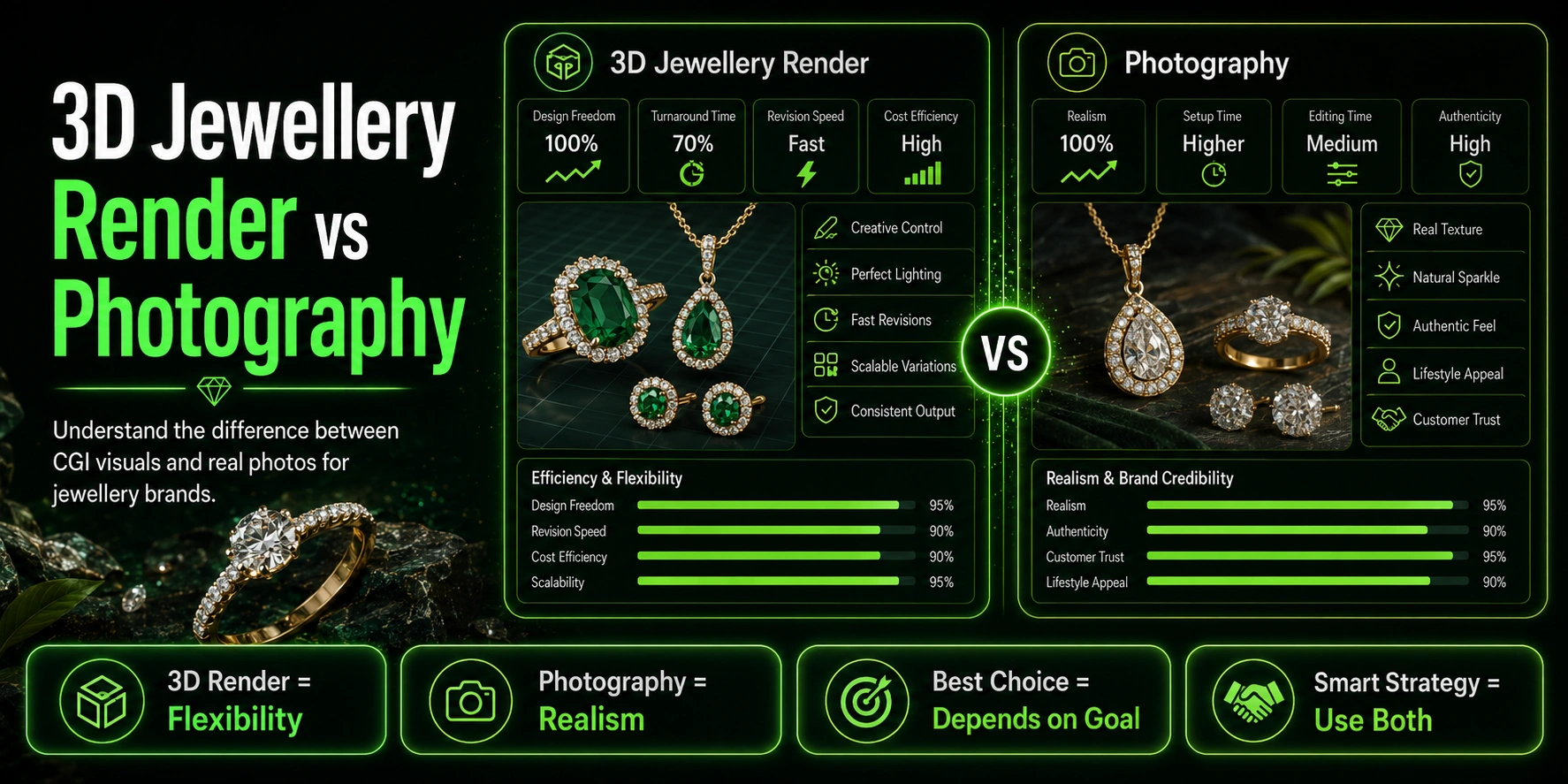
It is intensely visual and increasingly three-dimensional: Jewellery sells on detail: the way light catches a stone, how a piece sits on the skin, the finish of the metal. Flat catalogue photos are no longer enough. Indian brands are now using 3D renders and augmented-reality try-on, and try-on features have been shown to lift purchase intent meaningfully because they remove the “will it look right on me” doubt. Producing this kind of asset is a specialist craft, not a quick task for a generalist.
It is deeply seasonal: Demand spikes hard around weddings, Dhanteras, Akshaya Tritiya, and the festive months. Your marketing has to plan campaigns, inventory storytelling, and ad budgets around a calendar that is unforgiving. Miss the run-up to a festival and you miss a meaningful chunk of the year’s revenue.
The category sits inside a huge, competitive market: India’s gems and jewellery sector is one of the country’s largest consumer segments, worth roughly US$85 billion domestically and projected to keep growing through the decade toward the US$130 billion mark. Most of that is still offline, but the online share is rising quickly, and the digital space is crowded with everyone from legacy houses to new D2C labels fighting for the same attention. Standing out requires craft, not just spend.
Hold these five points in mind, because they decide which model will serve you. The core question is not “who is cheaper.” It is “who can actually do jewellery marketing well, at a price that matches my stage.”
What “in-house” really means for a jewellery brand
In-house marketing means you hire and manage your own people to run SEO, paid ads, social media, content, email and WhatsApp, photography and 3D, and analytics. The appeal is real: full control, instant communication, and a team that lives and breathes your brand every day, which usually produces a more consistent brand voice.
The catch is what “your own people” actually has to include. One person cannot be a strong SEO specialist, a paid-media buyer, a content writer, a social media manager, a 3D or photo producer, and a data analyst at the same time. Jewellery needs most of those skills. So a realistic in-house function is not one “digital marketer.” It is a small team, or one stretched generalist who does several things at a passable level and nothing at an expert level.
There is also a hiring reality. Finding and onboarding good marketers in India typically takes two to four months, and during that time your marketing stalls. Senior performance marketers and skilled creative people are in demand and expensive, and smaller brands often lack the pull to attract the best talent. Turnover hurts too: when a key hire leaves, much of the knowledge and momentum leaves with them.
What “an agency” really means (and the one distinction that matters)
An agency gives you a full team of specialists on a retainer, without recruitment, salaries, benefits, tools, or management overhead sitting on your books. You get an SEO person, a paid-media person, a content team, designers, and a strategist for one consolidated fee, and you can scale the engagement up or down as seasons demand.
But here is the distinction that decides everything for jewellery: a generalist agency is not the same as a jewellery-specialist agency. Plenty of founders have burned money handing a luxury, emotional, trust-first product to an agency that runs the same playbook it uses for fashion or supplements. The result is familiar: lots of traffic, very few sales. Fashion tactics do not transfer to jewellery, because the buyer psychology, the trust requirements, the certification language, and the seasonal rhythm are all different. When people say “agencies didn’t work for us,” they almost always mean a generalist agency did not understand jewellery buyers.
So when you evaluate the agency route, you are really asking two questions: does this partner understand jewellery specifically, and can they prove it with relevant work?
The real cost comparison (India, 2026)
Numbers make the decision concrete. These are realistic Indian ranges for 2026. Treat them as benchmarks, not quotes.
| Cost element | In-house team | Specialist agency |
| Salaries | Rs 1.5 to 2.5 lakh/month for 3 mid-level hires; Rs 80 lakh to 2 crore/year for a senior team | Folded into one retainer |
| Tools (SEO, design, automation, 3D) | Rs 40,000+/month, often more | Folded into the retainer |
| Recruitment and training | 2 to 4 months to hire, plus ongoing training cost | None on your side |
| Management overhead | Your time, every day | Handled by the agency |
| Ramp-up time | Marketing stalls 2 to 4 months while you hire | Live in days to a few weeks |
| Turnover risk | High; knowledge leaves with people | Low; continuity is the agency’s job |
A single mid-level in-house marketer costs roughly Rs 12 to 25 lakh a year in salary, before tools. Three mid-level hires (say SEO, content, and social) run about Rs 1.5 to 2.5 lakh a month in salaries alone, before bonuses and software. A genuinely capable senior team (a head of growth, a paid-acquisition lead, a creative producer, and an analyst) lands somewhere between Rs 80 lakh and Rs 2 crore a year in salaries, plus another Rs 5 to 15 lakh a year in tools.
And tools add up faster than people realise. A serious SEO suite like Ahrefs or Semrush is around Rs 15,000 to 20,000 a month each. Add design software, email and WhatsApp automation, analytics, and 3D or creative tools, and you are often past Rs 40,000 a month before anyone has run a single campaign. A useful rule of thumb: when you budget for in-house, add 30 to 40 percent on top of salaries for tools, training, and overhead.
An agency folds all of that into one retainer. At lower spends, this is why an agency is often several times more cost-efficient than the equivalent in-house team for the same output. You are sharing the cost of senior specialists and expensive tools across the agency’s whole client base instead of carrying it alone.
The practical thresholds, drawn from how Indian businesses are actually deciding in 2026:
- Under Rs 5 lakh a month in marketing spend: an agency is almost always cheaper and faster than building in-house.
- Rs 5 to 15 lakh a month: a hybrid model (an internal lead plus agency execution) usually wins.
- Above Rs 15 lakh a month, sustained: an in-house team starts to make economic sense, if you can hire and retain senior talent.
For most jewellery brands that are not yet national chains, this puts the honest answer somewhere between “agency” and “hybrid.”
The honest scorecard
Cost is one axis.
Here is how the two models compare across the things that actually determine results.
| Factor | In-house | Specialist agency |
| Control and speed of decisions | Strong | Moderate |
| Brand intimacy and consistency | Strong | Moderate to strong |
| Breadth of specialist expertise | Limited (often generalists) | Strong |
| Jewellery craft (3D, photo, AR) | Rare to find in one team | Strong, if a specialist |
| Access to premium tools | Expensive to carry alone | Included |
| Scaling for festive and wedding peaks | Hard and slow | Easy |
| Speed to launch | Slow (hire first) | Fast |
| Cost efficiency at lower budgets | Poor | Strong |
| Turnover risk | High | Low |
Read the scorecard honestly against your own situation. In-house wins on control, brand intimacy, and long-term consistency. An agency wins on breadth of expertise, speed, tool access, seasonal scalability, and cost efficiency at the budgets most brands operate at. Neither is “better” in the abstract. The right answer depends on your stage, your budget, and how specialised your needs are.
So which should your jewellery brand choose?
Run your brand through these questions. They take a few minutes and they are more useful than any blanket verdict.
- What is your sustained monthly marketing budget? Below Rs 5 lakh, lean agency. Rs 5 to 15 lakh, lean hybrid. Above Rs 15 lakh consistently for six or more months, evaluate in-house seriously.
- How specialised is your need? If you require 3D renders, AR try-on, jewellery-specific SEO, certification-led trust content, and festive campaign planning, a generalist hire will not cover it. Specialisation favours a jewellery agency.
- How fast do you need results? If you need momentum within ninety days (a festive run-up, a launch, a funding milestone), go agency first. Building in-house during a growth sprint sets you back while the team ramps up.
- Is marketing core to your moat, or a function you need run well? If your brand’s edge genuinely depends on owning marketing end to end, and you have the budget, in-house has a case. For most jewellery brands, marketing needs to be run excellently, not owned at all costs.
- Can you actually hire and keep senior talent? Be honest. If recruiting and retention are not your strength, an agency removes that risk entirely.
If your answers cluster toward small budget, high specialisation, and speed, you want an agency, ideally a jewellery specialist. If they cluster toward large sustained budget, marketing as your core moat, and strong hiring ability, in-house earns its place. Most growing Indian jewellery brands land in the middle, which is why the hybrid model has become a sensible default.
The hybrid model: the answer most brands actually need
The smartest setup for a scaling jewellery brand is rarely pure in-house or pure agency. It is a deliberate split: a small internal team owns brand direction, customer relationships, and decision-making, while an agency owns specialist execution and the capacity to scale up around festive and wedding peaks.
In practice that often looks like one in-house marketing owner (a founder, a brand manager, or a marketing lead) who holds the vision and the customer relationship, partnered with an agency that brings the SEO, paid media, content, 3D and creative, and analytics horsepower. You keep control and brand intimacy where it matters, and you rent expensive expertise and tools instead of carrying them. It is usually the best of both for the budget, and it scales cleanly as you grow.
A note on AI search, because it changes what “good” looks like
You have probably heard you need special tricks to show up in AI search and AI Overviews. You do not. Google has been clear that optimising for generative AI is still SEO, and that there is no magic file, no special schema, and no “AI-only” format that gets you cited. What gets a jewellery brand surfaced in AI answers is the same thing that earns trust with a human buyer: unique, expert, genuinely useful content that answers real questions, backed by a clean, fast site, accurate structured data that matches what is on the page, and strong visuals.
This matters for the in-house versus agency decision in a specific way. AI search rewards depth, first-hand expertise, and trustworthiness, which are the very things a generalist scrambling across ten tasks rarely produces. Whether you build in-house or hire out, the people behind your content need to actually understand jewellery. There is no shortcut around that, and anyone selling you “AI ranking hacks” for jewellery is selling you nothing.
Where Kyros Solution fits
This is the gap Kyros Solution was built for. Kyros is a digital marketing and branding agency that works specifically with D2C, boutique, luxury, and artisanal jewellery brands, which means it sits inside India’s jewellery ecosystem rather than treating the category as an afterthought.
Instead of a generalist playbook, Kyros brings the specific capabilities jewellery marketing demands under one roof:
- Jewellery SEO and GEO (AI-ready search): search built around how jewellery buyers actually look, by material, occasion, price, style, and certification, with product and category pages optimised to turn rankings into revenue and trust signals strengthened so search engines and AI systems treat the brand as credible.
- Brand strategy and identity: shaping a brand’s story, values, and visual world into one cohesive message across the website and social, because jewellery sells on emotion and legacy, not feature lists.
- 3D renders and high-conversion UI and UX: the visual craft that flat photos cannot match, paired with calm, intuitive store experiences designed to move shoppers from browsing to buying without friction.
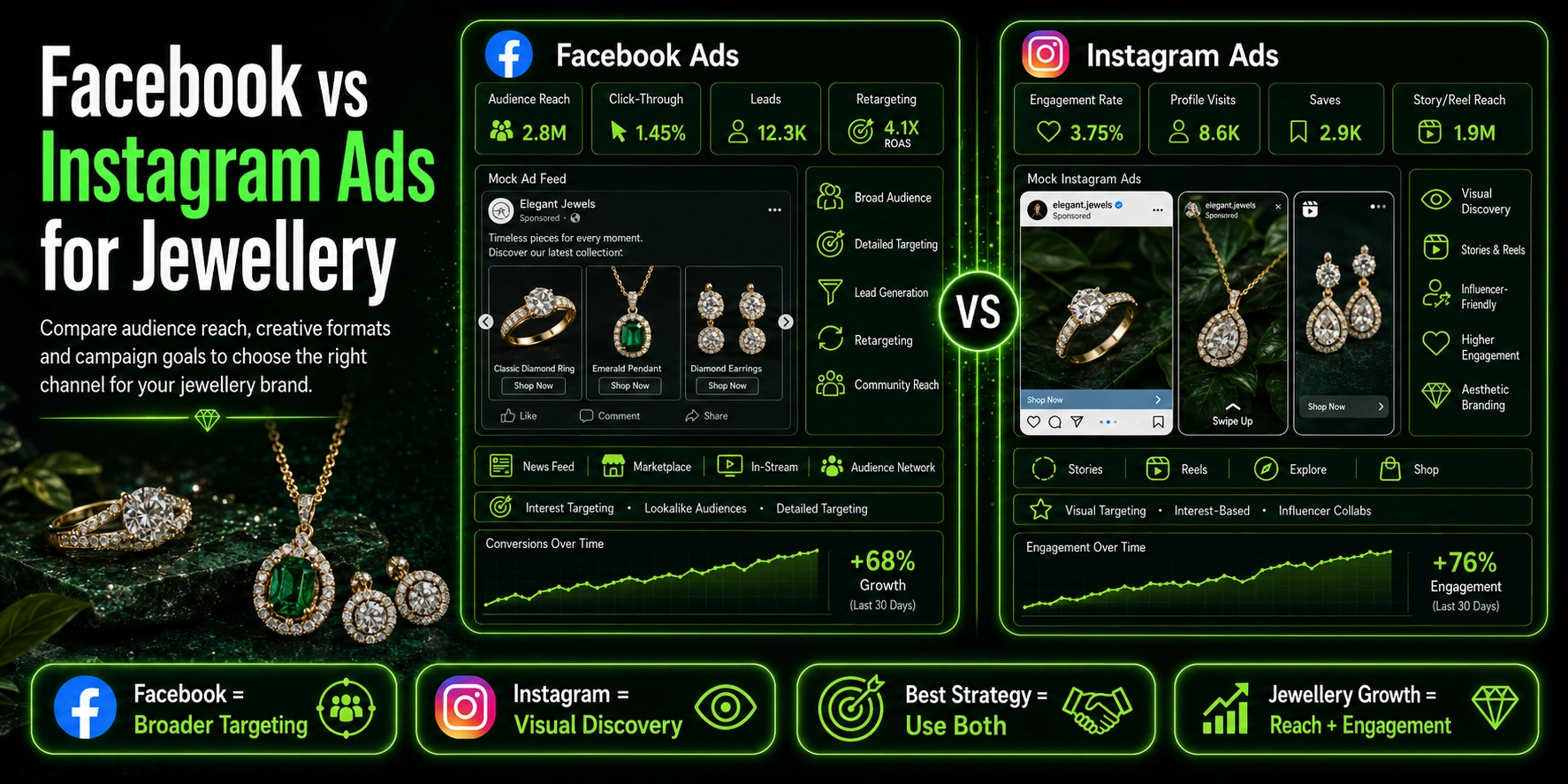
- Social media, content, paid ads, and influencer partnerships: the execution engine that builds presence and qualified demand across Instagram, Pinterest, Google, and the channels where jewellery buyers actually spend their time.
- E-commerce and web development: the storefront and the backend that make all of the above convert.
Kyros also reports strong returns for the brands it works with, and it offers a complimentary audit of your current marketing, website, and competitors as a starting point, which is a low-risk way to see where your brand stands before committing to anything.
If you are weighing in-house against agency and your need is genuinely jewellery-specific, a specialist partner like Kyros gives you the breadth, the craft, and the category understanding without the cost and hiring risk of building all of it yourself. It also slots neatly into a hybrid setup, sitting alongside your internal brand owner as the execution and expertise layer.
The bottom line
For a jewellery brand in India in 2026, the in-house versus agency choice comes down to budget, how specialised your needs are, and how fast you need results. Most brands below national-chain scale are best served by a jewellery-specialist agency or a hybrid model, because jewellery marketing demands a rare mix of trust-building, visual craft, certification fluency, seasonal planning, and channel expertise that one or two in-house generalists cannot deliver, and that an expensive senior team only makes sense for at high, sustained spend.
Decide on the maths and your stage, not on which model sounds more impressive. And whichever you choose, make sure the people doing the work understand jewellery, because in this category, that understanding is the difference between traffic and sales.
FAQs
Is an agency or an in-house team cheaper for a jewellery brand in India?
At most realistic budgets, an agency is more cost-efficient. Below roughly Rs 5 lakh a month in spend, an agency typically delivers more output for the money because you share the cost of senior specialists and premium tools rather than carrying salaries, software, and overhead alone. In-house only becomes economical above around Rs 15 lakh a month sustained.
Can a small jewellery brand afford a good agency?
Often yes, and more easily than it can afford a capable in-house team. A small brand that tries to hire two or three marketers will usually spend more and get weaker, more generalist results than it would from a focused specialist agency at a similar or lower cost.
Why do some jewellery founders say agencies did not work for them?
Almost always because they hired a generalist agency that applied fashion or general e-commerce tactics to a trust-first, high-consideration product. The fix is not to abandon agencies. It is to choose one that understands jewellery buyers, certification, seasonality, and the long, research-heavy buying cycle.
Is the model different for a bridal brand versus an everyday-wear D2C label?
Yes. Bridal involves a six to twelve month research cycle where WhatsApp, real bride testimonials, styling consultations, and bridal SEO matter most. Lightweight everyday-wear leans on Instagram, Pinterest, collection drops, and micro-creators. Lab-grown diamond brands need heavy certification and reassurance content. The right partner adjusts the channel mix to your category instead of forcing one funnel on all of them.
When should we switch from an agency to an in-house team?
When your marketing spend has stayed above roughly Rs 15 lakh a month for six or more months, marketing has become central to your competitive edge, and you are confident you can recruit and retain senior specialists. Until then, an agency or a hybrid model usually serves you better. Many brands never fully switch, and settle on a hybrid permanently.
Do we need special AI or schema tricks to appear in AI search and AI Overviews?
No. Google treats AI search optimisation as ordinary SEO. There is no required AI file, special markup, or “AI-only” format. Unique, expert, helpful content on a fast, well-structured site with accurate structured data is what earns visibility in both classic and AI search.