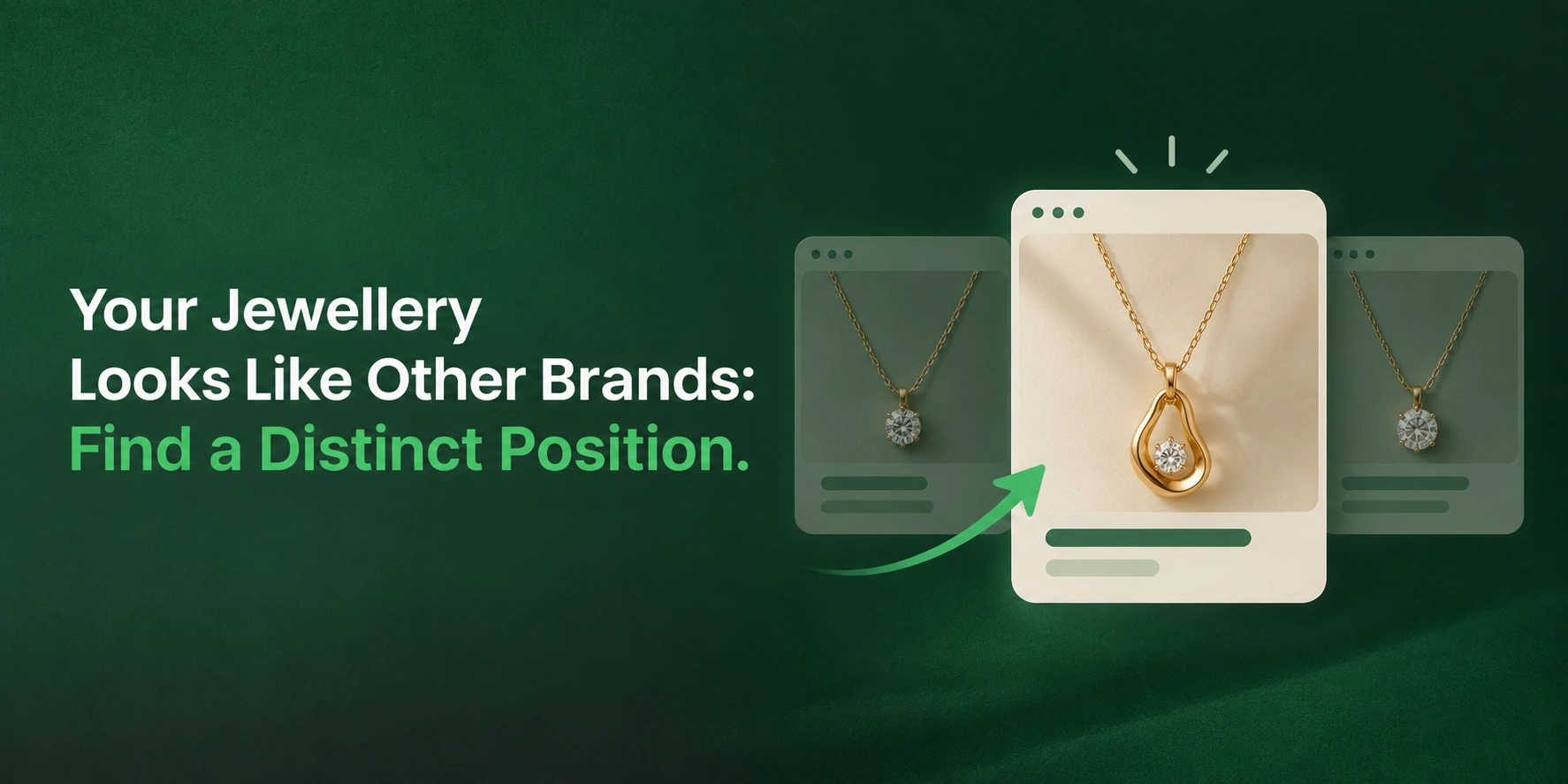
Cover the logo on your homepage, your last twelve Instagram posts, and your bestselling product page. Now ask a customer whose brand it is. For a growing number of Indian jewellery labels, the honest answer is “could be anyone’s.”
That is rarely a design failure. It is what happens when hundreds of brands buy from the same supplier catalogues, run the same Shopify playbook and describe themselves with the same handful of words. In 2026, a fourth force is pushing brands together: AI search, which summarises your entire business in a single line. If that line matches twenty other brands, you are invisible in the answer.
This guide is for founders and marketing heads of Indian jewellery brands, whether you sell demi-fine, silver, lab-grown, or gold. It covers:
- why sameness has become the default in Indian jewellery, with fresh 2026 data
- three quick tests that show how interchangeable your brand is today
- the Copy-Cost Ladder, a way to rank differentiators by how hard they are to copy
- eight positioning territories that work in the Indian market, with real examples
- a one-sentence positioning template, a stress test, and a 30-day sprint to roll it out
The short answer: A distinct position is a specific place in a specific buyer’s mind for a specific buying moment, built on something competitors would find expensive to copy. To find yours, audit how interchangeable your words and visuals are, list the claims your category has worn out, choose one territory you can prove (a defined wearer and moment, a regional craft vocabulary, a proof system, a service model or a collector model), write it as one sentence a customer could repeat, and express it consistently until buyers and AI tools describe you in that sentence.
Why Indian jewellery brands started to look identical
Sameness is not a shortage of creativity. It has four structural causes, and naming them is the first step to escaping them.
1. The supply catalogue is shared
Search “anti tarnish” on a B2B marketplace and the pattern is obvious. On IndiaMART, one wholesaler lists a stainless steel anti-tarnish heart necklace at ₹170 a piece, next to clover bracelets, tennis bracelets, and evil-eye earrings. A Delhi supplier lists anti-tarnish bracelets at ₹80. These are the same motifs that fill D2C storefronts in the ₹500 to ₹3,000 band, the price range that Recon credits with making Indian fashion jewellery so large on Shopify.
There is nothing wrong with sourcing from manufacturers. Most brands do. The problem starts when a catalogue design is presented as the brand’s reason to exist. Your customer can reverse-search an image in seconds. If the product is available to anyone, the product cannot be your position.
2. The growth playbook is shared
Recon’s May 2026 ranking of Shopify jewellery stores by real Chrome traffic classified 745 stores. Of the top 50, 26 were based in India and 35 sold fashion jewellery. Its analysts noted that Indian D2C jewellery brands have been running on Shopify Plus for three to five years and that the playbook is now well understood. One review app, Judge.me, appeared on roughly 46% of the top 50.
Zoom out and StoreCensus counts 60,445 active Indian Shopify stores, of which 15,352 run Dawn, a free theme that was long Shopify’s default. That is roughly one in four. Same theme, same review widget, same “shop the look” Reel, same countdown banner, same free gift above ₹999. The customer experience converges even when founders never study each other.
3. The vocabulary is shared
Read ten Indian demi-fine homepages, and you will meet the same chorus: anti-tarnish, waterproof, hypoallergenic, everyday luxury, affordable, minimal, made for the modern woman. One marketplace directory now lists 65 demi-fine brands and sorts them by what they are made of rather than by what they claim. A sister directory lists 69 brands that sell only lab-grown diamond jewellery.
“Everyday” deserves special mention because it has become the most crowded position in Indian jewellery. Recent trade coverage described Candere’s new ambassador as strengthening its everyday jewellery positioning, Tamannaah Bhatia’s new label as reframing fine jewellery as an everyday essential, and Ekatra Jewels as a brand of everyday elegance. Celebrity faces have converged too: CaratLane, GIVA and Candere have each signed film or sports personalities.
4. AI search compresses every brand into one line
When a shopper asks Google’s AI Mode, ChatGPT or Perplexity “which Indian brand is best for lab-grown diamond studs for office wear?”, the answer is assembled from pages that already describe brands in a sentence each. One jeweller’s comparison guide summarises Limelight as IGI-certified, with an 80% cash buyback and a premium, design-forward position. That is what compression looks like: a whole brand reduced to its most repeatable, checkable facts.
Google’s guide to its generative AI features says they are grounded in core Search ranking systems and favour unique, non-commodity content, with no special AI markup required. AI Mode now answers in Hindi and seven other Indian languages, including Marathi, Tamil, Telugu and Bengali. So the question your positioning must answer has changed. It is no longer only “would a customer remember us?” It is also “if a machine had to describe us in one line, would that line differ from everyone else’s?”
Why sameness costs more now than it did three years ago
A brand that blended in could once survive on cheap Meta traffic and discounts. Four realities of 2026-27 make that much harder.
Gold has repriced the category: 24-karat gold was about ₹1.43 lakh per 10 grams in 2026, after touching roughly ₹1.51 lakh on 12 October. Buyers respond by cutting weight, dropping purity to 18, 14 or 9 karat, or switching to lab-grown stones, according to a January 2026 report by Wazir Advisors. Large jewellers have moved too: PNG Jewellers launched a separate lightweight, lower-carat sub-brand, and its chairman told Reuters the lightweight segment was growing about 30% a year. When everyone pivots to “lightweight” at once, lightweight stops being a position and becomes a format.
Lab-grown diamonds show what commoditisation looks like: The wholesale price of a one-carat lab-grown diamond fell from about USD 4,200 in 2018 to USD 168 in 2025, a drop of roughly 96%, per data compiled by Wazir. Its benchmark of 1-carat solitaire rings in 18-karat gold, priced on 20 January 2026, found 14 brands in a price-led band between ₹25,000 and ₹45,000. Ten of them sat within ₹9,200 of each other, from ₹31,500 to ₹40,700. Five design-led and story-led brands priced the same ring at ₹55,000 to ₹59,000. Wazir’s own conclusion is that without a defensible brand and design edge, the category slides into price competition and squeezed margins.
More of the journey happens online, but the sale often does not: Online sales reached 5% to 7% of the Indian jewellery market in FY26 and are projected to reach 9% to 11% by FY30, according to CRISIL research cited in a 2026 IPO document. Redseer estimates that 50% to 60% of jewellery purchases are already influenced online. Your position has to survive the full research-online, buy-offline loop: an Instagram discovery, a website visit, a WhatsApp question, a store or try-at-home visit, and often a family discussion.
Buyers compare more brands for longer: Industry benchmark compilations put normal fine jewellery conversion rates at 0.5% to 1.6%, with journeys of three to seven weeks across five to eight competing brands. In a shortlist of eight, the forgettable brand is the first one dropped.
Positioning is not your logo, tagline, or mood board
Founders often say “we need to rebrand” when they mean “we need a position”. These are different jobs.
A position is the specific place you hold in a specific buyer’s mind, for a specific buying moment, against the alternatives she is weighing. “Minimal gold-plated jewellery for women” is a category description. “The piece a nurse can wear through a 12-hour shift without a second thought” is a position.
Marketing science adds a useful distinction. Researchers at the Ehrenberg-Bass Institute separate differentiation (a meaningful reason to choose you) from distinctiveness (being recognised as you, even without your name attached). Professor Jenni Romaniuk, who wrote the standard text on distinctive brand assets, judges an asset on two counts: fame, meaning the share of category buyers who link it to your brand, and uniqueness, meaning it points to you and no one else. In interviews, she warns that change is what weakens assets, and that borrowing the colours everyone in your category uses makes you blend in rather than stand out.
For Indian jewellery brands, the practical lesson is that you need both. Differentiation gives the buyer a reason. Distinctiveness lets her find you again in a feed of forty near-identical flat lays. Most brands invest only in the first, then express it with the category’s default visuals. If you are still deciding where brand investment fits against paid growth, our breakdown of branding versus performance marketing for jewellery brands covers the trade-offs.
Three tests: how interchangeable is your brand right now?
Run these before you change anything. They take an afternoon and give you a baseline to measure against later.
Test 1: The Blind Swap Test (your words)
Collect your homepage hero line, the first paragraph of your About page, five product descriptions, your Instagram bio, and your last ten captions. Replace your brand name with a direct competitor’s name in every line. Then mark each line: does it still read as true?
If more than half of your lines still work for a competitor, your words describe a category, not a brand. This threshold is our working rule of thumb rather than an industry standard. The direction matters more than the exact number.
Test 2: The Logo-Off Test (your visuals)
Screenshot your last twelve posts and three product images. Crop out the logo and handle. Mix them with similar shots from three competitors and show the set to ten customers, or run it as an Instagram story quiz: “Whose post is this?”
This is a simplified version of the unprompted recognition test that distinctiveness researchers recommend. If customers cannot pick you out, your visual identity is decoration, not an asset. Check the usual culprits: background colour, lighting, hand and model styling, props, typography on graphics, and the unboxing frame.
Test 3: The One-Line AI Test (your reputation in search)
Ask ChatGPT, Gemini, Google AI Mode, and Perplexity three kinds of questions:
- “What is [your brand] known for?”
- “Which Indian brands are best for [your real use case]?” For example, “silver toe rings for daily wear” or “lab-grown engagement rings with buyback”.
- “[Your brand] or [competitor]: which should I buy?”
Record whether you appear, the one line used to describe you, and which pages are cited. Repeat it monthly in a simple spreadsheet. Pair it with Google Search Console: filter queries that contain your brand name and note which other words appear alongside it. If buyers search “[brand] tarnish” more often than “[brand]” with anything you want to be known for, that is your current position, whether you chose it or not.
| Test | What it measures | Warning sign |
| Blind Swap | Verbal distinctiveness | Most lines still true with a rival’s name |
| Logo-Off | Visual distinctiveness | Customers guess wrong or say “could be anyone” |
| One-Line AI | Search and AI reputation | Not mentioned, or described in generic category words |
The crowded claims list, and what to say instead
Every category wears out its language. These are the claims Indian jewellery buyers increasingly read as background noise, based on what we see across brand sites, marketplace listings, and wholesale catalogues.
| Crowded claim | Why it no longer separates you | What to do instead |
| Anti-tarnish, waterproof | Wholesalers use it as a product name | Publish the specification and the test: base metal, coating type and thickness, hours of sweat or water exposure tested |
| Everyday luxury, daily wear | The most crowded position in the market | Name the day: the first-salary piece, the 12-hour-shift stud, the gym-safe chain |
| Affordable luxury | Every price-led brand says it | Show the price logic: metal value, making charge and margin, linked to the day’s gold rate |
| Handcrafted by artisans | Hard to verify at scale | Name the cluster, the technique, and the karigar; show a process video for one specific design |
| Certified | BIS hallmarking with HUID is the baseline for gold, and IGI reports are standard in lab-grown | Treat certification as the entry ticket and add what it does not cover: written buyback rates, exchange terms, lifetime services |
| For the modern woman | Nobody identifies as the opposite | Define her by moment, region, profession, or belief |
| Minimal | The biggest style cluster attracts the most brands | Keep minimal as an aesthetic; do not mistake it for a position |
| Sustainable, ethical | Vague and rarely evidenced | State something checkable: recycled metal share, traceability, packaging material |
A note on “minimal”. In Wazir’s interviews with lab-grown jewellery buyers, 36% preferred minimalist, daily-wear styles, the largest single group. That is exactly why so many brands crowd into it. Great demand does not mean open space. (The sample was 100 telephone interviews, so treat it as directional.)
The Copy-Cost Ladder: rank every differentiator by what it costs a rival to copy
Most positioning advice asks, “What makes you unique?” A more useful question is, “How long would it take a well-funded competitor to copy this?” We use a simple four-rung ladder.
Rung 1: copied in a day. Adjectives, colour palettes, discount mechanics, hashtags, model styling, a free gift, a celebrity-lookalike shoot.
Rung 2: copied in a month. A design motif, a collection theme, packaging, an influencer roster, a content format.
Rung 3: copied in a year or more. A proof system buyers can verify, a service model that needs real operations (re-plating, resizing, written buyback), deep fluency in a regional or ritual vocabulary, a content library that answers real buyer questions, and the trust of a narrowly defined audience.
Rung 4: copied over years, if ever. Manufacturing capability, a founder’s earned expertise and origin, distinctive assets made famous through years of consistent use, a large community of repeat buyers, and a physical footprint.
The rule we work by: anchor your position on rung 3 or 4, and express it on rungs 1 and 2. Struggling brands usually do the reverse. They try to differentiate with rung-1 tactics, such as a new palette or tagline, on top of a product anyone can buy, then wonder why a competitor matches them within a week.
Two examples make the point. Mejuri’s original idea, fine jewellery you buy for yourself, has become everyone’s language, yet the brand stays distinct because of higher rungs: a weekly Monday drop rhythm, hero collections it deliberately ties to its name, and returning customers who reportedly account for around 40% of revenue. In lab-grown diamonds, Wazir notes that brands started by diamond manufacturers hold a structural cost advantage from backward integration. That is a rung-4 asset a pure marketing brand cannot buy.
What India’s traffic leaders quietly prove
Look again at Recon’s ranking of the highest-traffic Shopify jewellery stores. Among the Indian names are brands you can describe in one sentence, and none of those sentences is “affordable everyday luxury”.
Japam (ranked 9th) sells spiritual wearables: rudraksha, karungali and energy-stone bracelets and malas. Its differentiation sits on rung 3. It sends samples for lab testing and publishes Batch Test Reports, ships certain orders with a ceremony report carrying a QR code that links to a video of the ritual, recommends products through a Kundali-based quiz, and calls its support assistant “Sevak”. It displays more than 21,000 reviews. Whatever your view of the category, the brand has built proof that answers its buyers’ biggest fear: paying for a fake bead.
Sonchafa (ranked 34th) sells Maharashtrian traditional jewellery. Its navigation reads like a regional glossary: nath, bugadi, karanda, waki and mekhala, alongside Puneri Moti and Peshwai collections, with outlets listed across 16 Maharashtra cities. A generic “ethnic jewellery” brand cannot fake that fluency quickly.
Unniyarcha (ranked 35th) sells 925 silver jewellery rooted in Indian motifs and rituals, with collections such as Sui Dhaga, Mithu and a Sacred Edit. It highlights in-house manufacturing, publishes a buyback policy, and sells through quick-commerce apps alongside marketplaces.
A caveat on reading this data. Recon’s ranking is a monthly snapshot of Shopify stores only, so brands such as Tanishq and CaratLane do not appear, and a ranking shows correlation, not cause. These brands also invest in advertising, offers, and scale. Still, the pattern is worth noticing: specific brands are easy to recommend, easy to remember, and easy for an AI to summarise accurately. For how India’s largest players built their own positions, see our CaratLane case study and GIVA case study.
Eight positioning territories that work in Indian jewellery
A territory is the ground your position stands on. Each one below lists who it suits, what it demands from your business, and the main risk. Choose one primary territory. You can borrow from a second, but a brand that claims four territories owns none of them.
1. A specific wearer in a specific moment
Define the buyer by a moment in her life, not an age bracket: the first job, the first salary, the return to work after maternity leave, the NRI buying gifts to carry home, the groom’s family shopping for the bride.
- Suits: demi-fine and lightweight gold brands with a clear core buyer.
- Demands: the discipline to say no to products and campaigns aimed at everyone else.
- Risk: choosing a moment too small to sustain revenue.
2. Ritual and occasion ownership
India’s calendar is a positioning map: Karwa Chauth, Akshaya Tritiya, Dhanteras, Raksha Bandhan, a baby’s first jewellery, a mangalsutra a working woman can wear into a boardroom. Owning one ritual all year is stronger than visiting every festival during sales.
- Suits: brands with real design depth in one ritual category.
- Demands: product depth and content that lasts beyond the festive week.
- Risk: seasonality. Plan off-season reasons to buy, such as anniversaries, gifting, repairs, and restyling.
3. Regional and cultural fluency
Maharashtrian, Bengali, Kerala, Gujarati, Rajasthani, Tamil and Telugu traditions each have their own forms, names and occasions. Redseer reported that Tier 2 and smaller markets outgrew metros in fashion during the first half of 2026, helped by regional assortments and vernacular campaigns. With AI Mode now answering in Marathi, Tamil, Telugu and Bengali, a brand that genuinely speaks a region’s jewellery language has a new way to be found.
- Suits: regional jewellers moving online, and D2C founders from the culture they design for.
- Demands: real vocabulary, real reference pieces and native-language content, not a festive filter on a generic catalogue.
- Risk: capping your market. Many brands expand to a second region only after the first is clearly theirs.
4. Belief and meaning
Spiritual, protective, zodiac and astrological jewellery is a large and under-branded space, as Japam’s traffic suggests.
- Suits: brands with authentic religious or cultural grounding.
- Demands: proof of authenticity and respectful, accurate communication.
- Risk: overclaiming. Do not promise health, wealth, or luck outcomes you cannot substantiate. Misleading claims can draw complaints under advertising codes and destroy trust faster than they build it.
5. Proof and transparency
Make what others hide your headline: a price breakup showing metal value and making charges against the day’s gold rate, the coating thickness on plated pieces, a short video showing buyers how to verify a HUID on the BIS CARE app, IGI report links on every lab-grown product page.
- Suits: gold, lab-grown and premium demi-fine brands where trust gates a high average order value.
- Demands: operations that can withstand scrutiny every day.
- Risk: transparency is only a position if competitors genuinely avoid it. Run the One-Line AI Test on the territory first.
6. Material or craft authority
Become the reference brand for one material or technique: 9-karat gold, sterling silver for men, temple jewellery, meenakari, lab-grown polki. The Eternz directory, for example, already points buyers to Ivana and BIJOU CO. for lab-grown polki. That is a craft territory being claimed in real time.
- Suits: brands with in-house design or manufacturing depth.
- Demands: educational content that makes you the explainer of the craft.
- Risk: a narrow material exposes you to input-price swings, as gold and lab-grown buyers have both seen.
7. Ownership and service model
Differentiate on what happens after the purchase: re-plating, lifetime cleaning, free resizing, a written buyback rate, exchange credit. In Wazir’s interviews with buyers who rejected lab-grown diamonds, resale worries and authenticity doubts dominated the reasons given. A brand that answers resale anxiety in writing is answering the category’s biggest objection. One demi-fine founder told Indian Jeweller that separating demi-fine from both fine and fashion jewellery was a core challenge, and pointed to a re-plating service as something global brands did not offer.
- Suits: brands with operational control and healthy margins.
- Demands: the cash and processes to honour promises at scale.
- Risk: a service promise you cannot keep becomes your most-shared review.
8. Collector and scarcity model
Position as a house for people who collect, not consumers who shop. For Veridion, a luxury client, we positioned the brand as a legacy house created for collectors rather than a jewellery label, built around the idea of “a diamond within a diamond”, and designed a drop-based launch framework in which scarcity is planned rather than accidental.
- Suits: high-design, high-price brands with patient capital.
- Demands: no discount culture, small runs and long lead times.
- Risk: slower cash flow, and the model collapses at the first clearance sale.
Write your position in one sentence a customer could repeat
Use this template. Fill every bracket with specifics. If a bracket can only be filled with an adjective, you are not finished.
For [a specific buyer] who [a moment or need, in her own words], [Brand] is the [frame of reference] that [one benefit], because [proof only you can show]. Unlike [the alternative she would otherwise choose], we [the trade-off we accept].
Three illustrations, using invented brand names so they are not mistaken for real ones:
- Regional silver: For Marathi brides who want a nath and thushi that work with a modern reception look, Kaavya Silver is the Maharashtrian silver house that redesigns heirloom forms in lightweight 925 silver, because every design starts from a documented family piece. Unlike a big chain’s bridal counter, we sell nothing outside the Maharashtrian vocabulary.
- Lab-grown with a resale answer: For couples who will ask “what is it worth later?”, Sathi Lab Diamonds is the lab-grown jeweller that prints its buyback rate on every invoice, because we grow and cut our own stones and can afford to. Unlike brands competing on the lowest solitaire price, we will never be the cheapest ring on your shortlist.
- Demi-fine for shift workers: For nurses, cabin crew and retail staff who cannot take their jewellery off for twelve hours, Shift & Shine is the demi-fine brand engineered for long shifts, because every design passes a published sweat and wear test before launch. Unlike fashion-first labels, we skip trends that will not survive a double shift.
Each sentence contains a buyer you could actually find, a moment she would recognise, proof she could check, and a trade-off a competitor might refuse to make.
Stress-test the position before you commit
Ask four questions. A “no” to any of them sends you back a step.
- Is it true today? Can your product, operations, and team deliver this on an ordinary Tuesday, not just during a campaign?
- Is it wanted? Look for evidence in reviews, DMs, WhatsApp chats, store conversations, and Search Console queries. Buyers’ own words beat your hypotheses.
- Is it unowned? Run the One-Line AI Test on the territory itself. If AI tools already name a brand for exactly this, choose a sharper angle or prepare for a long fight.
- Is it provable in under a minute? What can a buyer verify on her phone quickly? A HUID check, a test report, a buyback rate printed on the invoice, a making video.
Add a fifth question if you plan to raise money or scale: can you fund this for three years? Positions compound slowly. Abandoning one after two quarters often costs more than never choosing one.
Turn the position into a system people can recognise
A sentence on a strategy slide does nothing on its own. The position has to show up as things a buyer can see, hear and hold, repeated until they become yours.
Choose distinctive assets your category is not already using. If every competitor shoots on beige linen with a hand-on-collarbone pose, that is the one composition you cannot own. Consider a signature packaging colour and unboxing ritual, a recurring light and composition for product photography, a construction detail such as a clasp or stamped mark, a naming system for collections, and a consistent voice with a short list of words you use and words you ban. Our guides to jewellery photoshoot ideas for every funnel stage, 3D jewellery renders versus photography, and encouraging customers to share unboxing videos show how to build these consistently.
Make the product range agree with the position. If a large share of your catalogue is wholesale bestsellers that could belong to anyone, your feed will keep telling buyers you are anyone. An honest range edit is often the hardest and most valuable positioning work.
Protect consistency. Distinctiveness research is blunt: change is what weakens assets. Agree on what cannot change for at least two years, and let campaigns, collections, and creators vary around it.
Measure recognition, not just likes. Repeat the Logo-Off Test every quarter with real customers. Recognition is a leading indicator. Revenue follows later.
Make the position visible where buyers and AI look
Website: State the position in your homepage headline, not just a tagline in the footer. Organise collections around your territory, such as a “first salary” edit, a Peshwai collection, or a “shift-proof” range, not only by earrings and necklaces. Add proof modules to product pages: test results, price breakdown, certificate links, buyback terms. Our UI/UX design team builds these as reusable templates.
Search: Build a content cluster around the questions your territory raises: how to style a nath with a lehenga, what a HUID tells you, how long plating lasts through a 12-hour shift. Google’s guidance favours non-commodity content written from real experience and warns against mass-producing near-identical pages for every keyword variation. Our jewellery SEO services and guide to Generative Engine Optimisation go deeper.
AI answers: Use the same one-line description everywhere a machine might read it: your homepage, About page, Google Business Profile, marketplace brand pages, press boilerplate, and founder interviews. Earn genuine third-party mentions in trade media and curated directories. Google’s guide states that chasing inauthentic mentions does not help, so skip paid “mention” packages.
Social: Map content pillars to the position, not only to the festive calendar. A shift-worker brand films a 12-hour wear test; a regional brand explains the meaning of each form. See our social media services and guide to using Reels to increase conversions.
Paid media: Test the positioned message against your current best-performing ad and let the numbers decide. A position should earn its place in performance marketing, not be exempt from it.
Store, WhatsApp and reviews: Because many purchases are researched online and closed offline, give store staff and WhatsApp agents the same one-line position and proof points. When you request reviews, prompt for the thing you want to be known for (“Did the piece survive your shift?”) so future buyers, and AI tools, read it in customers’ own words.
A 30-day positioning sprint
Week 1: Diagnose. Run the three tests. Pull your last 100 reviews, 50 DMs, and three months of Search Console queries. Note every phrase customers use that competitors do not.
Week 2: Decide. Shortlist two territories, draft the one-sentence position for each, and run the stress test. Pick one. Write down what you will stop doing.
Week 3: Express. Rewrite the homepage headline, About page, Instagram bio, and three product description templates. Shoot one test set in a new composition you can own. Brief creators on the position, not just the product.
Week 4: Launch and set a baseline. Publish, update your Google Business Profile and marketplace brand pages, and record your Week 1 test scores as the baseline. Set a monthly reminder to rerun the AI test.
On timing: if you are reading this during the Dhanteras and wedding-season rush, complete weeks one and two now and roll out the visible changes after the peak. Changing how you look during your highest-traffic weeks confuses returning buyers who are mid-decision.
How to tell whether it is working
Different signals move at different speeds. Recognition signals can shift within weeks, search signals within a few months, and commercial signals over one to three quarters.
| Signal | What to track | Where |
| Distinctiveness | Blind Swap and Logo-Off scores | Quarterly customer tests, Instagram story quizzes |
| AI reputation | Mentions and the one-line description used | Monthly AI test log |
| Search | Brand plus territory queries, branded clicks | Google Search Console |
| Social | Saves, shares and DMs that mention the territory | Instagram insights, WhatsApp |
| Commercial | Repeat rate, discount dependence, conversion on positioned pages | Shopify and analytics |
The most underrated metric is discount dependence. A brand with a real position should need fewer sitewide sales to hit the same monthly number.
When positioning is not your problem
We would be doing you a disservice if we suggested positioning fixes everything.
It does not fix:
- A product that fails: If your reviews mention tarnish, broken clasps, or skin reactions, no sentence will save you. Fix quality first.
- A catalogue you do not control: If every SKU comes from a wholesaler’s open catalogue and that will not change, compete honestly on curation, service, and speed, and do not claim design originality.
- Operations that break promises: Late deliveries, painful returns, or unanswered WhatsApp messages will define you louder than any brand idea.
- A position you cannot fund: If you cannot sustain consistent expression for at least a year, start with a narrower, cheaper territory rather than an ambitious one you will abandon.
How Kyros Solution helps jewellery brands find and hold a position
Kyros Solution works only with jewellery and lifestyle brands, from offices in Surat, India’s diamond-cutting capital. Positioning is where many of our engagements begin, because every channel downstream performs better when it has something specific to say.
Our brand positioning and branding work covers the sequence in this guide: the sameness audit, territory selection, the positioning statement, messaging, visual identity, and collection storytelling. Our teams then carry it into content marketing, SEO and GEO, social, performance media and conversion-focused design, so the position reads the same everywhere a buyer, or an AI, meets you. See how we approached Veridion and Kymee, browse our portfolio, or read how we analyse a jewellery brand before starting work and the common pattern we noticed among fast-growing jewellery brands.
We are probably not the right fit if you want a new logo next week without changing anything else, you are unwilling to edit your product range, or you need a short-term sales spike rather than a position you will hold for years.
If you have run the three tests in this guide and the results worry you, bring them to a strategy call. We will tell you honestly whether the gap is positioning, product or execution.
FAQs
What is brand positioning for a jewellery brand?
Brand positioning is the specific place your brand holds in a buyer’s mind for a specific buying moment, compared with the alternatives she is considering. For a jewellery brand, it usually combines who the jewellery is for, the moment or need it serves, and the proof that makes the claim believable, such as certification, a written buyback policy, or a craft tradition.
How can your jewellery brand stand out if you source from the same manufacturers as others?
Move your differentiation off the product and onto things that are costly to copy: a defined wearer and moment, regional or ritual fluency, a proof system buyers can verify, a service model such as re-plating or written buyback, or a disciplined range edit. Be honest that designs are sourced, and compete on curation, service and trust rather than claiming originality you cannot prove.
Is “everyday luxury” still a good position in India?
On its own, no. It is now one of the most common claims among Indian jewellery brands, from new celebrity-backed labels to the lifestyle arms of legacy jewellers. “Everyday” can describe your format, but the position needs something more specific, such as a defined wearer, a ritual, a region or a service promise.
Do you need a new logo to reposition your jewellery brand?
Usually not. Repositioning starts with deciding who you serve and what you can prove. Visual changes should follow that decision, and you should keep any existing asset customers already recognise, because changing recognised assets weakens them.
How long does it take for a new position to show results?
Recognition tests can shift within weeks of consistent use. Search signals, such as more brand searches paired with your territory, typically take a few months. Commercial results like higher repeat rates and lower discount dependence usually take one to three quarters, depending on budget and consistency.
How do you check how ChatGPT or Google AI Mode describes your brand?
Ask each tool what your brand is known for, which brands are best for your core use case, and how you compare with a named competitor. Record whether you appear, the exact description used, and the sources cited. Repeat monthly and compare the results with your brand queries in Google Search Console.
Can a small jewellery brand compete with Tanishq, CaratLane or GIVA on positioning?
Yes, by being more specific rather than more general. Large brands must serve broad audiences, so they cannot own every niche. A smaller brand can own a ritual, a region, a profession, or a craft far more convincingly, provided it can prove the claim and sustain it.